

Alright…
Let’s skip the drama and talk money.
If someone keeps threatening to jack up your rent every week…
you don’t argue.
You quietly pack your stuff and move.
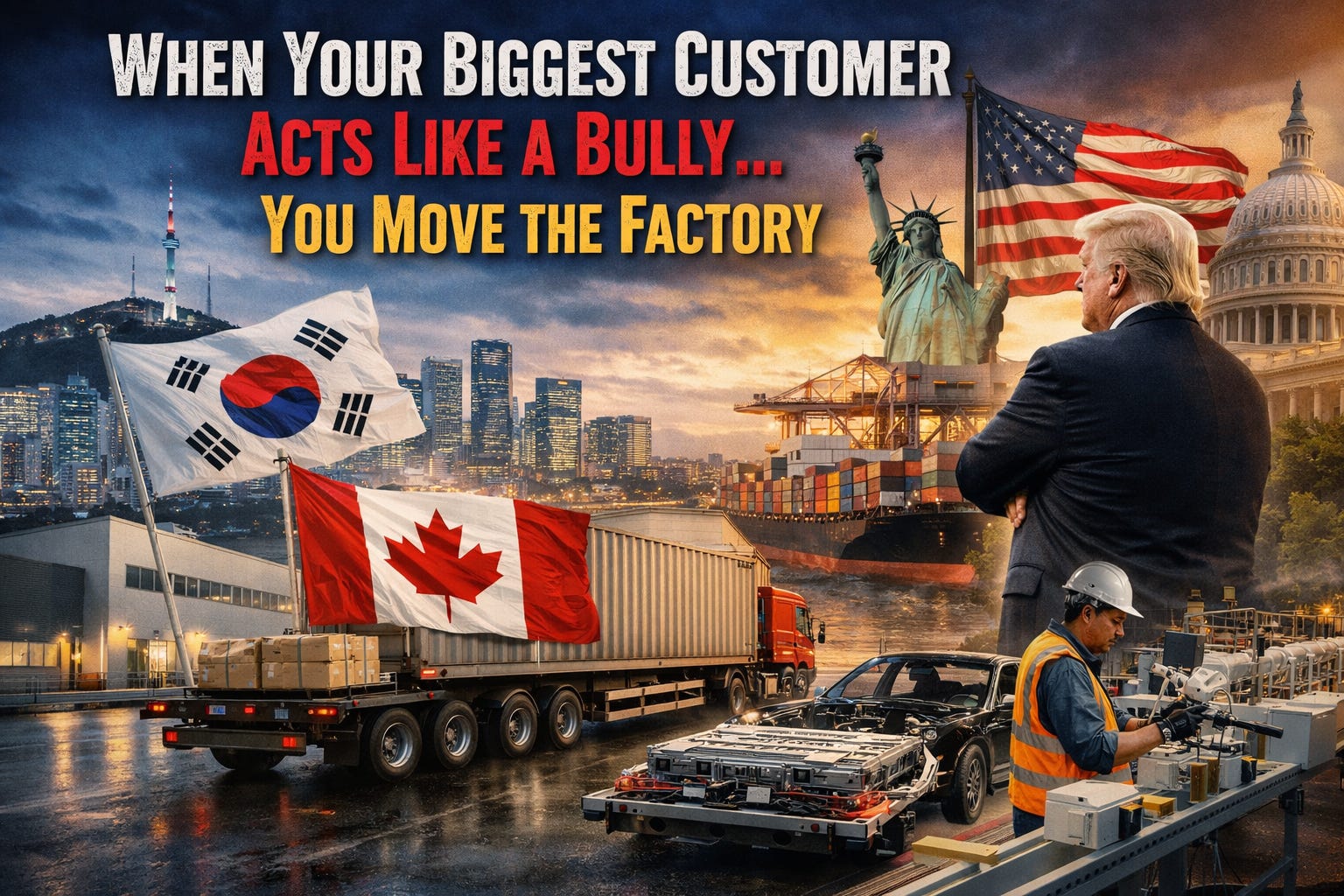
That’s exactly what South Korea just started doing to the United States.
And guess who gets the moving truck?
Canada.
Here’s the plain-English version
While Trump was floating 25% tariffs on Korean goods, Canada and Seoul signed an agreement to shift real manufacturing north.
Not talk.
Not photo ops.
Factories.
We’re talking…
Electric vehicles
Battery supply chains
Critical minerals
Hydrogen tech
Plus a $41.4B defense/submarine deal in the mix
And the Korean delegation wasn’t interns and coffee runners.
It included the boss-level people from Hyundai Motor Group.
When the suits show up, the chequebook’s open.
Why this happened (no PhD required)
Simple math…
U.S. keeps threatening tariffs
Tariffs = unpredictability
Unpredictability = risk
Risk = companies move capital elsewhere
Markets hate chaos more than taxes.
When those tariff threats hit, Korean auto stocks dropped fast… billions wiped off valuations in days.
That’s Wall Street code for…
“Get your production out of there.”
Canada’s play (and it’s sneaky smart)
Canada basically said…
“If you build here, we’ll treat you better.”
Preferential access.
Policy stability.
Long-term deals.
Same trick we used decades ago with Japanese automakers.
Result?
Today about 70% of Canadian auto assembly is Japanese.
That wasn’t luck.
That was policy.
Now we’re running the same playbook with Korea.
The numbers people miss
Let’s zoom out…
Canada builds ~ 1.2 million vehicles/year
Korea builds ~ 4.1 million/year
U.S. imports $131.6B worth of Korean goods annually
If even a slice of that Korean capacity relocates here…
Those plants don’t “go back later.”
Factories are 20–30 year bets.
Once the concrete’s poured, it’s permanent.
This isn’t a weekend move.
It’s a generation shift.
The part the tariff crowd doesn’t understand
Tariffs only work if you’re the only game in town.
But Canada is quietly building alternatives…
12 new economic/security agreements recently
Expanding trade with India, ASEAN, South America
Even cutting EV tariffs with China in exchange for ag exports
Translation…
Less dependence on the U.S.
More options.
Every new deal weakens Washington’s leverage.
My take (GeezerWise version)
This isn’t politics.
It’s plumbing.
If water keeps leaking from one pipe, you reroute the line.
Right now, companies see the U.S. as a pipe that randomly shuts off.
So they’re building a bypass.
Canada is that bypass.
And once traffic starts flowing here, it doesn’t magically flow back.
What I expect next
Nothing fancy. Just logic…
More Korean factory announcements in Canada
More tariff threats from the U.S.
More countries copying the Canada workaround
Japan, Europe, others… they’re watching.
If this works for Korea, it becomes the template.
Bottom line
You can’t threaten your customers into loyalty.
You just teach them how to live without you.
And that’s exactly what’s happening.
Quietly.
Systematically.
Factory by factory.
Classic unintended consequences.
Source credit:
Research based on reporting and analysis originally discussed by House of El (YouTube); facts verified and fully rewritten in my own words.
Canada Strong Movement… House Rule & Disclosure
Canada Strong exists to defend Canadian sovereignty, democratic norms, and economic independence… without imported talking points or borrowed outrage.
House rule… Facts and good-faith discussion are welcome. I use AI tools to help turn my spoken drafts into clear writing. I’m 73, my hands shake, and I type with two fingers… so I speak first, then edit.
The ideas, positions, and final message are mine.
💌 If you enjoyed this, subscribe at GeezerWise.com to get future Unlearn letters straight to your inbox: www.geezerwise.com/subscribe ✌️
#CanadaStrongMovement #CanadaStrong