

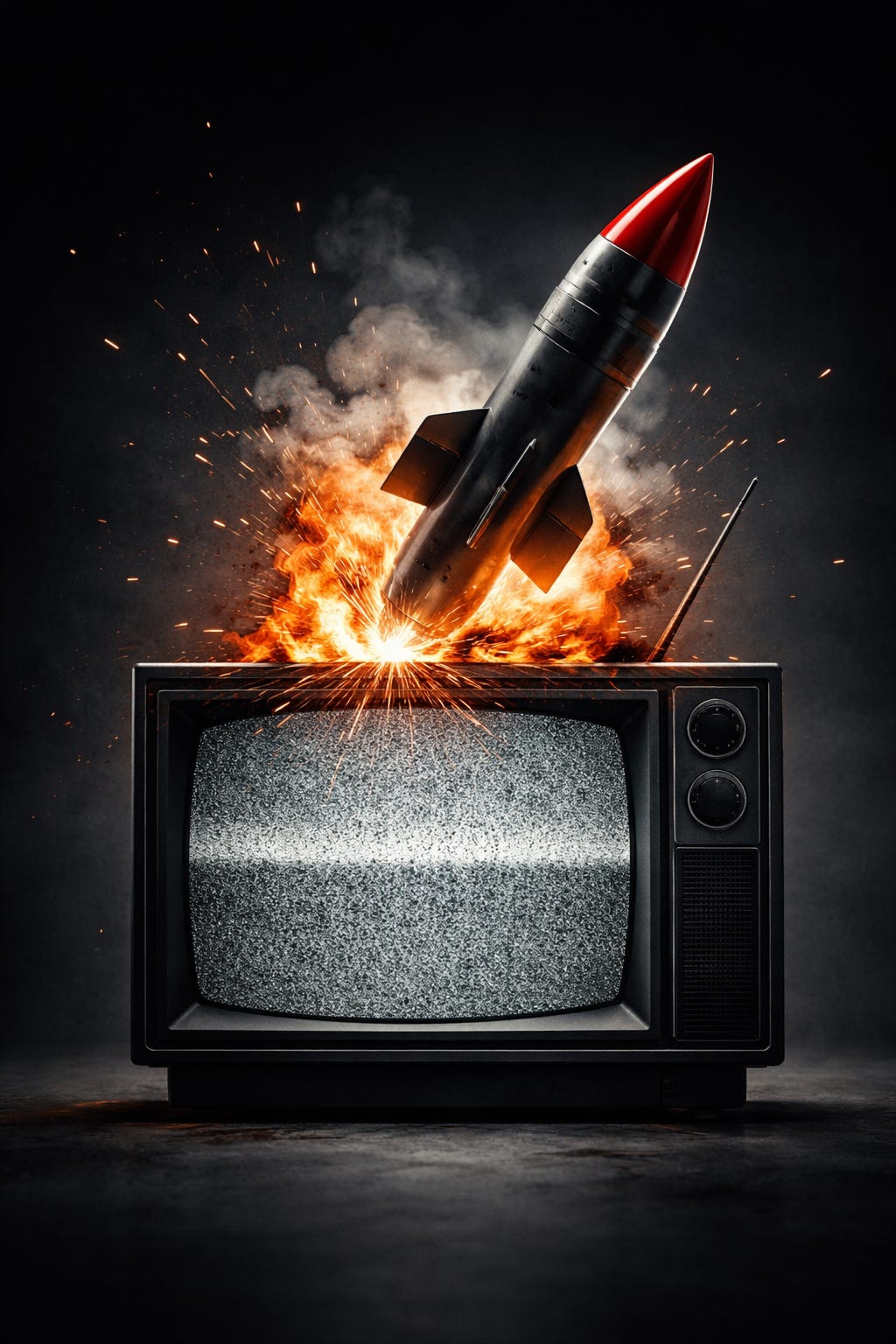
Something strange has happened to the way war is talked about in the United States.
Not debated.
Not explained.
Not even clearly justified.
Just… talked about.
Recently the U.S. launched military strikes connected to the escalating conflict with Iran. Yet the American public never got the traditional moment that usually comes with war… the president addressing the nation, explaining the threat, outlining the objective, and asking Congress for authorization.
Instead, what Americans got was fragments.
Short phone interviews.
Contradictory comments from officials.
Speculation bouncing between news networks and social media.
A fog of explanations rather than a single clear reason.
One senior U.S. official argued the attack was necessary because Iran might retaliate against the United States after being attacked by someone else… meaning the U.S. struck first to avoid being hit later.
That kind of reasoning leaves ordinary observers scratching their heads.
It’s the geopolitical version of punching someone in a bar because you think they might get angry at someone else and eventually walk over to your table.
Circular logic isn’t strategy.
It’s narrative management.
And then comes the second half of the modern American war machine: entertainment.
Late-night comedy shows immediately turned the conflict into material. Jokes about potential Iranian leadership candidates being killed in the same strike drew laughs from studio audiences.
Think about that for a second.
Not jokes about politicians.
Not satire about policy.
Jokes about people being killed in a foreign country during a military strike.
The audience laughs.
Not because they support the war.
Many of them probably oppose it.
But the war itself has become just another storyline… something to joke about between commercial breaks.
That’s the deeper issue.
For most Americans, war no longer feels like war.
It’s something seen through edited video clips:
Drone footage.
Missile strikes filmed from thousands of feet above.
Crosshairs on a screen.
A flash.
Target gone.
It plays like a video game highlight reel on TikTok.
Meanwhile, in the countries being bombed, war means something very different.
It means the school down the street is gone.
It means the electrical grid collapses.
It means hospitals running without power.
It means families burning furniture in winter because fuel supplies were destroyed.
War isn’t cinematic there.
It’s survival.
Americans actually understand this… at least once they did.
On September 11th, 2001, war suddenly arrived on their own soil. For one day the distance disappeared. The shock reshaped global security policy overnight. Airport security changed everywhere. Governments rewrote laws.
One day of war on American soil altered the world.
But when war happens somewhere else, thousands of miles away, it slowly becomes abstract again.
Politics debates it.
Television jokes about it.
Social media memes it.
And the public absorbs it like just another news cycle.
This isn’t about claiming the United States is always wrong. History shows plenty of moments where the U.S. stood firmly against real threats… World War II being the most obvious example.
But even then, America didn’t rush into that war.
It entered after being attacked.
Today the pattern looks very different.
The United States has conducted military strikes in multiple countries over the past few decades, often with limited congressional debate and shifting explanations for why those actions were necessary.
In the current Iran situation, several narratives are circulating at once…
• Preventing a future Iranian retaliation
• Attempting regime change
• Disrupting nuclear development
• Supporting Israel’s security
• Strategic control of a volatile region
Pick whichever explanation you prefer… they’re all being floated.
But when the reasoning keeps shifting, something else becomes clear.
Nobody really knows the full story.
There is one undeniable fact, though.
Many of the world’s largest oil reserves sit in politically unstable regions.
And many of those same regions have also been the focus of intense U.S. military or economic pressure for decades.
Draw your own conclusions.
What concerns many outside observers isn’t simply American power.
It’s the cultural numbness surrounding it.
When war becomes political talking points, comedy sketches, and viral clips, the reality of what it does to human lives fades into the background.
And that’s the truly unsettling part.
Not the bombs.
The indifference.
The Recap…
War used to come with speeches, debates, and national clarity.
Now it comes with cable news clips and late-night jokes.
When military strikes turn into entertainment segments, something deeper has changed… not just in politics, but in culture.
And that should make everyone pause.
The Gut-Punch…
“When war becomes entertainment, reality is already lost.”
Source Credit:
Source: Commentary based on public political statements, media coverage, and late-night television discussion surrounding the recent U.S.–Iran conflict.
🔎 The GeezerWise Standard
This space is built on disciplined thinking.
Facts over spin.
Verification before amplification.
Good-faith discussion over tribal noise.
I use AI tools to help shape my spoken drafts into clear writing.
The judgment, conclusions, and final message are mine.
If you’re new here, this explains how I decide what’s worth sharing:
How I Decide What’s Worth Sharing → [link]
💌 Subscribe at GeezerWise.com to receive future letters:
www.geezerwise.com/subscribe
— Fred Ferguson
GeezerWise
#CanadaStrong
What once thought itself a beacon of hope and inspiration to the world ( if in fact it ever was) is now but a hollow shell of nothingness. The sorry truth is that it is dragging the rest of the world with it.
Contrary to popular war hawk fantasies (often held by those without any military service), human nature is adverse to killing other humans. Brigadier General Marshall was a US Army historian that noted only 15-20% of American riflemen fired at the enemy during WW II combat. See also: On Killing: The Psychological Cost of Learning to Kill in War and Society. Written by Lt. Col. Dave Grossman who taught psychology at West Point & Military Science at Arkansas State. Nominated for the Pulitzer Prize in non-fiction.
"Macho, macho man (macho man, yeah)
I gotta be a macho man (I gotta be a macho man)"