

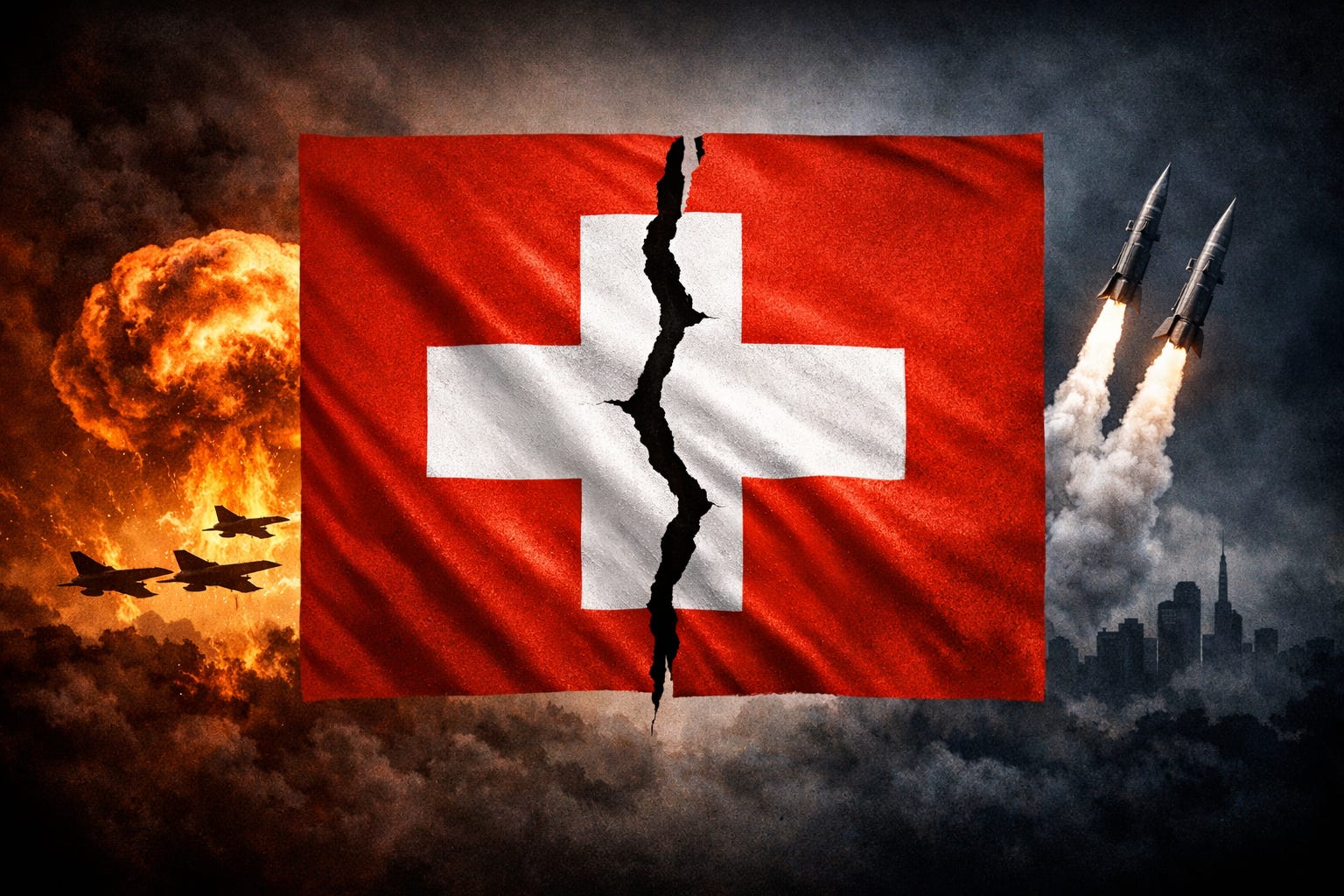
Most countries shout when they disagree.
Switzerland doesn’t.
That’s what makes this moment so unusual.
For more than two centuries, Switzerland has built its global identity around neutrality.
It stayed out of world wars.
It hosts international negotiations. Geneva became the legal and diplomatic heart of the modern rules-based order.
So when Swiss officials publicly say a military action violates international law… people in diplomacy notice.
And that’s exactly what just happened.
The Swiss defence ministry stated that recent attacks on Iran violate international law and breach the global prohibition on the use of force.
That’s not political rhetoric.
That’s legal language.
When Switzerland says it, it carries weight.
The Neutral Referee Just Blew the Whistle
Switzerland isn’t just another European country issuing an opinion.
It plays a very specific role in global diplomacy.
Since the Iranian hostage crisis in 1979, the United States has had no embassy in Iran. For decades, Switzerland has served as the official intermediary between Washington and Tehran.
Every diplomatic message between the two countries has passed through Swiss channels.
That arrangement is known as a “protecting power mandate.”
In simple terms, Switzerland acts as the diplomatic middleman.
So when the same country facilitating communication between the two governments publicly states that international law may have been violated, it isn’t theatre.
It becomes part of the legal and diplomatic record.
That kind of statement matters later… in UN debates, international courts, and negotiations that may follow the conflict.
Switzerland Is Already Acting
The shift isn’t just rhetorical.
Switzerland has already rejected two requests from the United States to allow military aircraft to fly through Swiss airspace since the conflict began.
And the Swiss Federal Council is now examining whether the conflict should legally be classified as a war under Swiss neutrality law.
If that happens, the consequences become automatic.
Swiss airspace would be closed to US military flights.
Arms exports to the United States would halt.
Neutrality rules would legally require Switzerland to treat the conflict as a war between states.
For a country that normally bends over backwards to remain neutral, even considering that step signals how serious the situation has become.
Europe Is Showing Fractures
Switzerland isn’t the only country drawing lines.
Spain has already blocked the use of key US-linked military bases on its territory for operations related to the conflict, saying the strikes were unjustified and outside the framework of international law.
Spain’s government has also emphasized that its bases remain under Spanish sovereignty and cannot be used without approval.
The United Kingdom initially refused access as well, later allowing only limited defensive use.
France and Germany have expressed support in principle… but with clear limits and caveats.
Meanwhile, some European leaders have openly condemned the escalation.
That’s not a unified Western front.
That’s a patchwork.
Logistics Matter in War
Modern military operations depend on cooperation.
Aircraft need refueling bases.
Flights require overflight permissions.
Operations rely on networks of allied infrastructure.
When countries begin restricting those things, military flexibility shrinks quickly.
Refueling aircraft have already been relocated between bases in Europe as access rules change.
Flight routes become longer.
Fuel consumption increases.
Mission timing becomes harder to coordinate.
None of that stops operations overnight.
But it complicates them.
And over time, friction adds up.
Switzerland’s Position Carries Symbolic Weight
There’s another reason this matters.
Many of the world’s legal frameworks governing warfare… including the Geneva Conventions… are tied directly to Switzerland.
Geneva hosts dozens of international organizations and UN agencies.
So when Swiss officials speak about violations of the international rules governing war, they’re speaking from the institutional center of those rules.
That’s part of why diplomats take notice.
The Diplomatic Paradox
At the same time, Switzerland continues to maintain its role as intermediary between Washington and Tehran.
Even after evacuating staff from its embassy in Tehran due to security risks, the diplomatic channel remains open.
That creates a strange balancing act.
Switzerland condemns the legality of the war…
while still facilitating communication between the two sides.
From the Swiss perspective, that’s neutrality.
From the outside, it’s a complicated tightrope.
The Bigger Picture
None of this means alliances collapse overnight.
But it does reveal something important.
The automatic assumption that the United States leads and its allies simply follow is no longer guaranteed.
European governments are increasingly willing to assert their own legal and political positions… even when they diverge from Washington.
That shift is subtle.
But it’s real.
And when the most famously neutral country on earth starts speaking up, the diplomatic world pays attention.
Because Switzerland rarely raises its voice.
When it does…
it usually means the room has gotten very quiet.
The Recap…
Switzerland almost never takes sides.
So when it publicly says a military action violates international law… people in diplomacy listen.
The neutral referee just blew the whistle… and Europe may not be as united as Washington assumes.
This story is bigger than headlines.
The Gut-Punch…
When Switzerland speaks bluntly, it’s usually because everyone else in the room already knows something is wrong.
Source Credit:
Source House of El: Analysis of Swiss government statements, European diplomatic responses, and international neutrality law discussions reported in recent geopolitical commentary.
🔎 The GeezerWise Standard
This space is built on disciplined thinking.
Facts over spin.
Verification before amplification.
Good-faith discussion over tribal noise.
I use AI tools to help shape my spoken drafts into clear writing.
The judgment, conclusions, and final message are mine.
If you’re new here, this explains how I decide what’s worth sharing:
How I Decide What’s Worth Sharing → [link]
💌 Subscribe at GeezerWise.com to receive future letters:
www.geezerwise.com/subscribe
— Fred Ferguson
GeezerWise
#CanadaStrong
had some great observations As usual, Fred some great points here,, but having lived in Switzerland, I have a slightly different unfortunately negative impression of Switzerland.
Neutrality has served as a tool to protect Swiss interests rather than a purely moral commitment to peace.
Swiss neutrality is essentially pragmatic. It allows Switzerland to remain deeply connected to global economic systems while maintaining political independence and military autonomy.
The reputation of neutrality therefore becomes a strategic asset in international relations.
Another great column Fred, yesterday it was Italy calling this war out, today it is Switzerland. Do you think that under any circumstances Trump will try to pull other countries into his war using NATO Rule 5?
I don't think it applies in this case, and I bet that it was never contemplated at the time the rule was created that one of NATO's members would be the aggressor country.