

Nobody plans for a global energy reshuffle.
It usually shows up uninvited… loud, messy, and expensive.
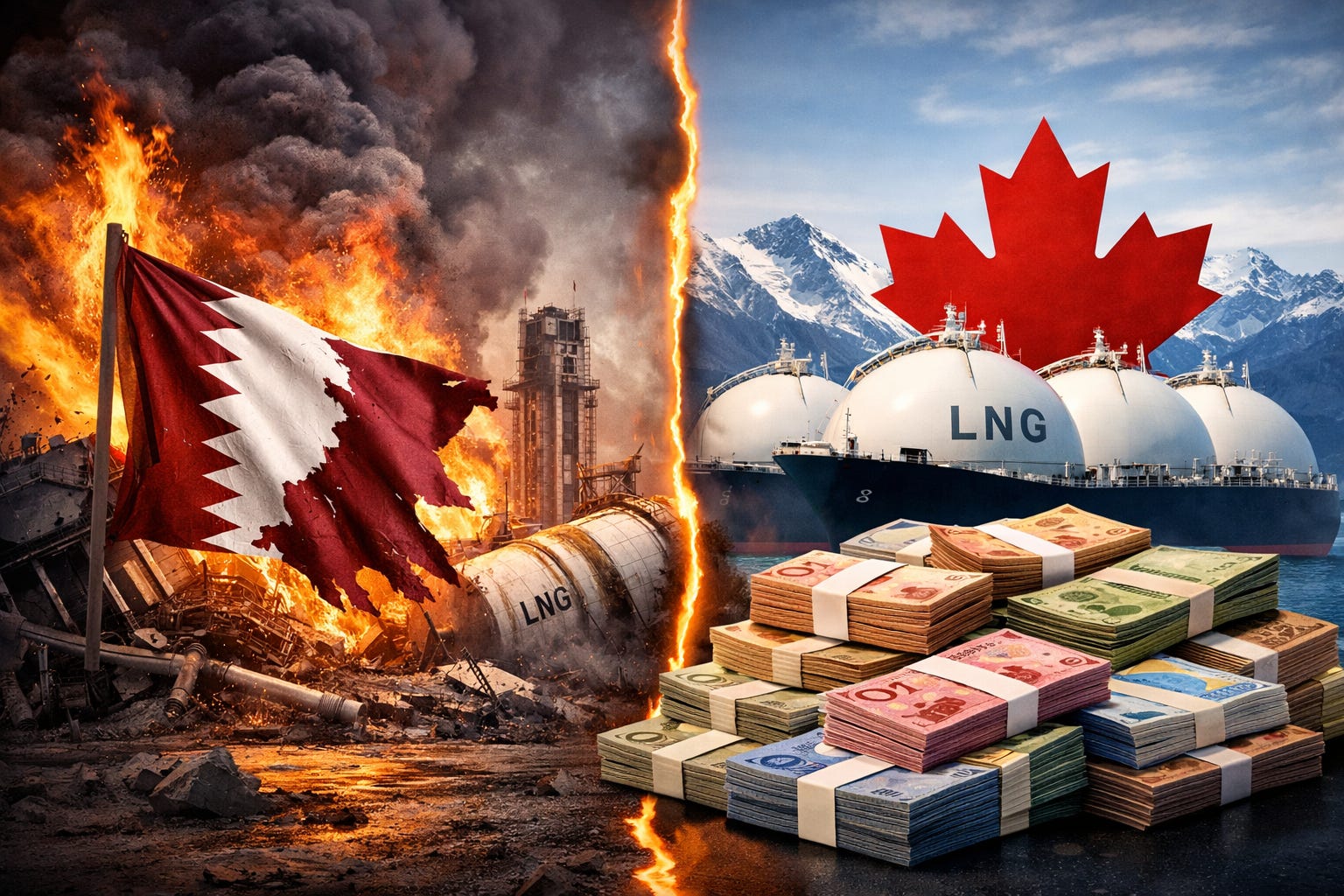
That’s exactly what just happened when a major LNG facility in Qatar took a hit and knocked a serious chunk of global supply offline.
We’re not talking about a temporary hiccup. We’re talking years of reduced output from one of the world’s biggest gas exporters.
And here’s the part most people miss…
Energy demand doesn’t politely step aside when supply disappears.
It panics.
The Gap Nobody Can Ignore
Asia isn’t slowing down.
China is pulling in massive volumes of LNG. India’s demand is climbing fast. Southeast Asia is industrializing and needs fuel yesterday, not next decade.
So when a big supplier stumbles, the market doesn’t shrink.
It hunts.
Prices jump. Contracts get rewritten. Buyers start calling anyone who can deliver.
And suddenly, geography matters.
The Price Shock That Changes Everything
Within hours of the disruption, gas prices didn’t creep up… they jumped.
Europe saw a surge. Canada followed. What used to trade in the low double digits suddenly pushed into premium territory.
That’s not inflation.
That’s a payday.
Because when prices double and your production stays the same, your revenue doesn’t grow… it explodes.
Norway: Already at the Table
Norway doesn’t need to build anything new.
They’re already plugged into Europe with pipelines and running at full tilt.
They can’t produce much more.
But they don’t have to.
They’re selling every cubic meter they’ve got… at higher prices.
That’s the easiest money you’ll ever make in the energy business.
Canada: Late to the Party… Perfect Timing
Now here’s where it gets interesting for us.
Canada hasn’t been a major LNG exporter… yet.
But the first big facilities are coming online right now, especially out of British Columbia, with direct routes to Asia.
Shorter shipping times than the U.S. Gulf.
Stable politics.
No war zones in the backyard.
That combination suddenly looks very attractive when buyers are nervous about supply security.
And timing?
Couldn’t be better if you planned it… which nobody did.
The Real Opportunity Isn’t Today… It’s the Next Five Years
The damaged infrastructure in Qatar isn’t getting patched over in a weekend.
We’re talking multi-year rebuilds, massive cost, specialized equipment, and long timelines.
Even in the best-case scenario, the gap stays open for years.
That window matters.
Because once Canada and Europe step in to supply that demand, they don’t just make a few sales…
They build relationships.
Contracts.
Dependency.
And once buyers diversify, they don’t go back to relying on one supplier again… not after seeing how fragile that setup can be.
This Is How Markets Actually Shift
People like to think global systems change slowly.
They don’t.
They sit still… right up until something breaks.
Then everything moves at once.
A conflict interrupts supply. Prices spike. New suppliers step in. Long-term deals get signed. Power shifts.
Not because anyone voted on it.
Because the market had no choice.
And Here’s the Uncomfortable Truth
War doesn’t just destroy.
It redistributes.
One country loses production.
Another gains leverage.
Someone else cashes in.
That’s not a moral statement.
That’s how the machine works.
Right now, the countries positioned to fill that gap—Canada included—aren’t scrambling.
They’re stepping into a vacuum that just opened up.
And if they play it right, this isn’t a short-term win.
It’s a long-term seat at the table.
The Recap…
Qatar takes a hit… and the gas market doesn’t blink.
Prices jump. Supply shifts. New players step in.
Canada just moved from “potential exporter” to “perfectly timed supplier.”
This isn’t about energy.
It’s about who fills the gap when the system breaks.
The Gut-Punch…
When supply disappears, the market doesn’t wait—it replaces you.
Source Credit:
Source: House of El - Geopolitical energy analysis based on LNG supply disruption and global demand trends
🔎 The GeezerWise Standard
This space is built on disciplined thinking.
Facts over spin.
Verification before amplification.
Good-faith discussion over tribal noise.
I use AI tools to help shape my spoken drafts into clear writing.
The judgment, conclusions, and final message are mine.
If you’re new here, this explains how I decide what’s worth sharing:
How I Decide What’s Worth Sharing → [link]
💌 Subscribe at GeezerWise.com to receive future letters:
www.geezerwise.com/subscribe
— Fred Ferguson
GeezerWise
#CanadaStrong
Fred, this is a sharp and compelling take—and you’re absolutely right to centre the point that shocks don’t shrink demand, they re-route it. That’s the essence of energy geopolitics.
That said, I’d add a bit of caution to the “Canada steps straight into the vacuum” narrative.
Yes, the timing for Canadian LNG is unusually favourable. A multi-year disruption in Qatar does exactly what you describe: it forces buyers—especially in Asia—to diversify fast, lock in contracts, and pay a premium for reliability. In that sense, Canada isn’t just selling gas, it’s selling risk mitigation, which is often even more valuable.
But the substitution isn’t frictionless.
Canada’s capacity is still ramping, not scaling at the level Qatar represented. Even with British Columbia projects coming online, we’re talking about incremental volumes relative to a truly massive global supplier. That means Canada benefits disproportionately on price and contracts—but only partially on volume. The real “gap fillers” are likely to be a mix: Norway (price leverage), the U.S. (flexibility), and to some extent Australia.
Where Canada does stand out—and where your argument is strongest—is structurally:
Pacific access into Asian demand centres
Political stability in a risk-sensitive market
A perception of long-term reliability at a moment when that premium has just been repriced globally
That last point matters. Once buyers experience a supply shock of this scale, they don’t just diversify—they institutionalise that diversification. That’s where Canada’s long-term upside lies, not just in today’s price spike.
I’d also underline a second-order effect you hint at but could push even further: this isn’t just a market shift—it’s a contract shift. LNG is moving away from opportunistic spot exposure back toward long-term, security-driven agreements. That tends to favour stable, rule-of-law producers like Canada disproportionately.
So yes—war redistributes, and the market moves faster than most people expect. But the real story may be less about a sudden Canadian “payday” and more about a gradual locking-in of Canada as a permanent second pillar of supply in Asia.
That’s a quieter outcome—but arguably a more consequential one over the next decade.
Awesome thanks so much for sharing ❤️