

Politics runs on slogans.
Engineering runs on physics.
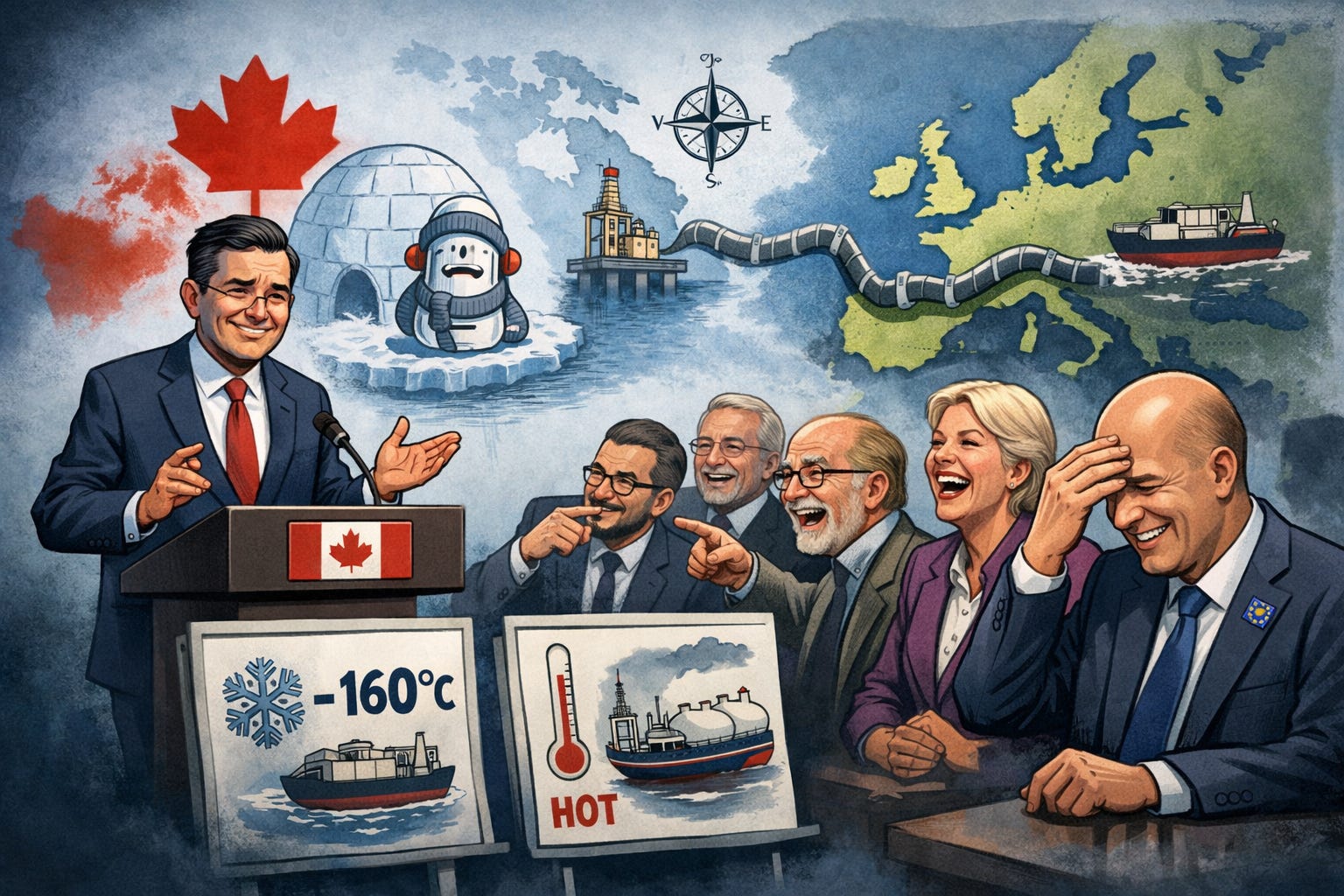
Those two worlds collided recently during a speech in Germany by Canadian Conservative leader Pierre Poilievre… and the result was awkward enough that parts of the audience reportedly laughed.
Not because Germans are rude.
Because the room was filled with scientists and engineers.
And engineers have a habit of checking the math.
The claim that triggered the reaction
During the talk, Poilievre praised Germany’s rapid response to the energy crisis following Russia’s invasion of Ukraine in 2022.
Germany managed to build an LNG import terminal in under 200 days… a major achievement during a supply emergency.
He then compared that speed to Canada, pointing out that major LNG projects here have taken far longer to approve and build.
That comparison sounds powerful in a political speech.
But technically, it compares two completely different kinds of infrastructure.
Import terminals vs export terminals
Germany built an LNG import facility.
That type of facility receives already-liquefied natural gas delivered by tanker ships and converts it back into gas for pipelines.
Canada’s projects, by contrast, are LNG export facilities.
Those require far more infrastructure…
• Large natural gas fields
• Gathering pipelines from thousands of wells
• Long-distance transmission pipelines
• Massive liquefaction plants
• Specialized LNG tankers
For example, Canada’s west-coast LNG projects require pipelines running roughly 1,000 kilometres across mountainous terrain to reach export terminals.
Liquefaction facilities alone can cost tens of billions of dollars.
In other words…
Receiving LNG is relatively simple.
Producing LNG for export is one of the most complex industrial systems on the planet.
The geography problem
Another point raised in the speech involved shipping LNG to Europe.
The argument suggested Canada could ship gas to Europe faster than the United States Gulf Coast.
But there’s a logistical complication.
Canada’s largest natural gas reserves are located in northeastern British Columbia and northwestern Alberta.
Those resources currently flow toward the Pacific coast for export to Asia.
Shipping gas to Europe from Canada’s Atlantic coast would require…
• a massive cross-country pipeline
• new export terminals
• additional energy infrastructure
Estimates for such projects have ranged into the tens of billions of dollars.
None currently exist.
The “cold weather” moment
One comment that generated particular reaction involved the cost of liquefying natural gas.
Poilievre suggested Canada’s cold climate could make LNG production cheaper.
In reality, liquefaction requires cooling gas to roughly –260°F (–162°C).
At those temperatures, the difference between starting at 15°C or –10°C barely matters.
Most of the energy required comes from the final stages of deep cryogenic cooling…which requires massive compressors and energy input regardless of the local weather.
Again, this is basic engineering.
Which is why scientists in the audience likely reacted the way they did.
Why this moment matters
None of this means Canada can’t export LNG to Europe.
In fact, Canadian LNG exports are growing — especially from the Pacific coast.
But it does highlight something important about international policy conversations.
When politicians speak to general audiences, simplified messaging works.
When they speak to rooms full of engineers…
simplifications can fall apart quickly.
The bigger picture
Canada absolutely has enormous energy resources.
It could play a larger role in global LNG supply.
But doing that requires decades of infrastructure investment, complex regulatory approvals, and private-sector capital.
Those are engineering problems.
Not talking points.
And rooms full of engineers tend to notice the difference.
The Recap….
A Canadian politician walked into a room full of German engineers and started talking about LNG.
Within minutes… parts of the audience were chuckling.
Not because they disagreed politically.
Because the physics didn’t line up.
Politics runs on slogans.
Engineering runs on reality.
The Gut-Punch…
You can win arguments with applause lines.
You can’t win them against thermodynamics.
Source Credit:
Speech excerpts and commentary regarding remarks by Pierre Poilievre during a policy discussion in Germany, alongside publicly available LNG infrastructure data and engineering context.
🔎 The GeezerWise Standard
This space is built on disciplined thinking.
Facts over spin.
Verification before amplification.
Good-faith discussion over tribal noise.
I use AI tools to help shape my spoken drafts into clear writing.
The judgment, conclusions, and final message are mine.
If you’re new here, this explains how I decide what’s worth sharing:
How I Decide What’s Worth Sharing → [link]
💌 Subscribe at GeezerWise.com to receive future letters:
www.geezerwise.com/subscribe
— Fred Ferguson
GeezerWise
#CanadaStrong
Most of us, when we know nothing about a particular conversation piece, keep our mouths shut to prevent embarrassing ourselves & the audience, but, not PP, he has verbal diarrhea, same as Trumpi, & can't help himself LOL
Hopefully some of the engineers already knew who they were dealing with, by reputation.