

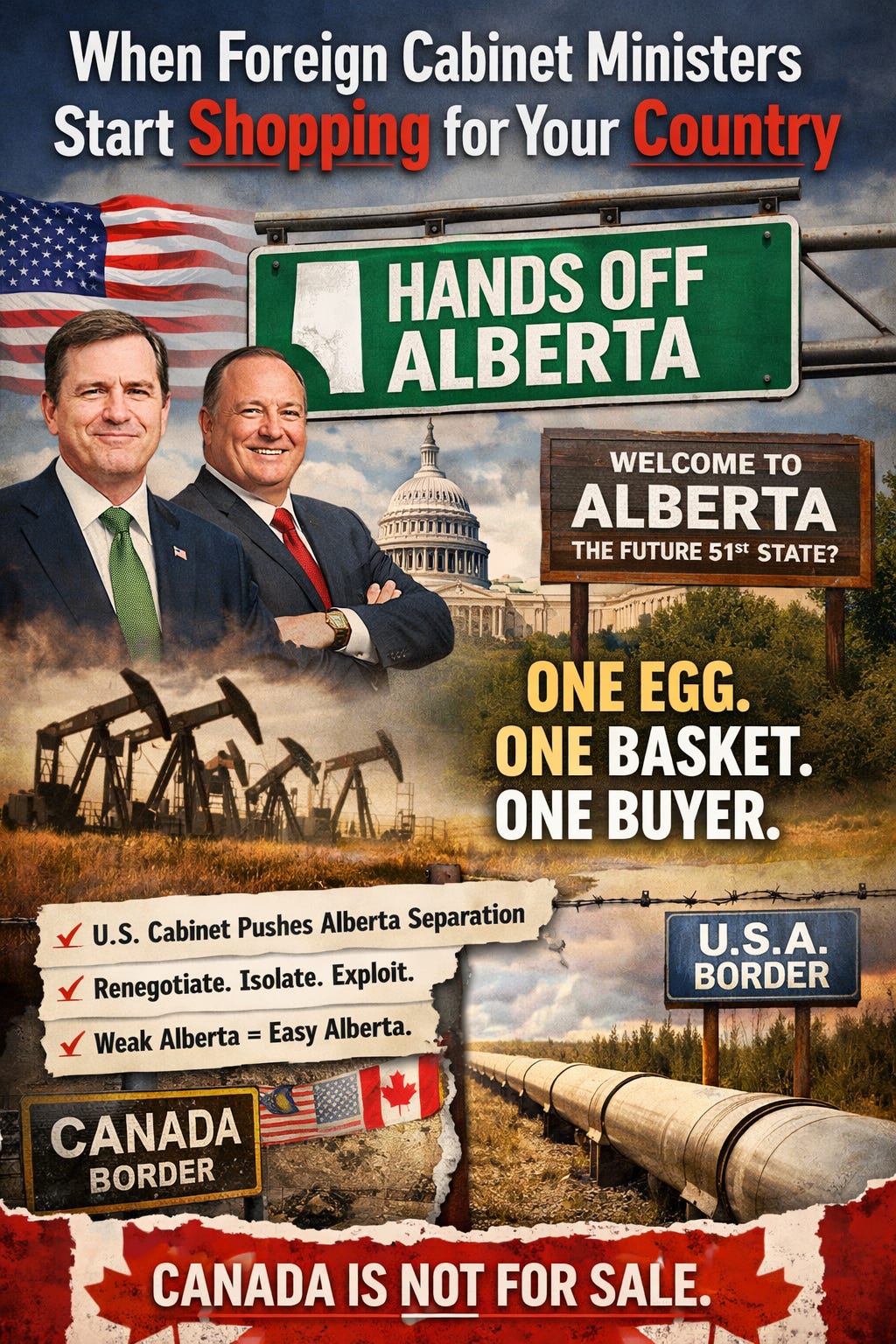
Here’s a basic rule of adulthood… personal or political…
If someone from outside your house starts suggesting which room they’d like to take over, you don’t call that “a misunderstanding.” You call it a problem.
That’s where Canada is right now.
Because senior U.S. officials have stopped hinting and started talking… openly… about Alberta as if it’s an unclaimed parking spot they might like to reserve.
And somehow, we’re supposed to pretend that’s just friendly chatter.
“Relax, It’s Just a Spat” … Except It Isn’t
When Canada’s Prime Minister described the current moment as a rupture, not a transition, the response from Washington was basically: lighten up.
One U.S. cabinet official waved it off as a “minor disagreement,” comparing it to a harmless marital squabble.
That analogy alone tells you how seriously they’re taking us.
If someone minimizes a fracture by calling it a joke, it’s usually because the crack doesn’t run through their house.
Then the Talk Got Specific … And Serious
This is where it stops being tone-deaf and starts being dangerous.
Another senior U.S. cabinet member went much further… openly describing Alberta as a “natural partner” for the United States. Not Canada. The U.S.
He talked about Alberta’s resources, its frustration with pipelines, and then floated something far more revealing:
rumours of Alberta leaving Canada… and possibly joining the U.S.
That isn’t commentary.
That’s interference.
This wasn’t a backbencher. This was a top-tier official whose job description includes protecting U.S. economic security.
Apparently, that job now includes cheerleading the breakup of a neighbouring democracy.
Funny How Sovereignty Only Matters Sometimes
Here’s the part that should bother everyone, regardless of party.
When China so much as sneezes in Canada’s direction, certain politicians instantly find their backbone. Big statements. Tough talk. Democracy this. Meddling that.
But when a U.S. cabinet minister aligns himself with a separatist movement inside Canada?
Silence.
No outrage.
No warnings.
No “hands off our democracy.”
Just crickets.
And that silence tells you more than any speech ever could.
Why the Silence Makes Sense (Politically … Not Morally)
There’s a reason some leaders suddenly develop selective hearing when Alberta separatism comes up.
A relatively small number of highly motivated party insiders… concentrated in one region… now wield outsized influence over leadership survival.
We’re not talking millions of voters.
We’re talking tens of thousands… and in some cases, far fewer.
When that group includes separatist sympathizers, the math becomes obvious:
you don’t challenge them… you accommodate them.
That’s not leadership.
That’s hostage management.
Let’s Talk Reality… Not Fantasy Economics
Now for the part the separatist fantasy always skips.
An independent Alberta wouldn’t become a swaggering, low-tax paradise overnight. It would become one of the most economically exposed regions on the planet.
Why?
Because the moment Alberta becomes a separate country…
• Every pipeline crossing into British Columbia crosses an international border
• Every export agreement must be renegotiated
• Canada has zero obligation to move Alberta’s product to tidewater
• Alberta becomes a single-export economy with one dominant customer
That’s not freedom.
That’s fragility.
It’s like quitting a unionized job with benefits to become a one-client contractor… whose only client already controls the pricing.
One Egg. One Basket. One Buyer.
Canada already knows the danger of over-reliance on a single trading partner. We’re living it.
Now imagine doing the opposite of diversification… intentionally.
An independent Alberta would rely almost entirely on energy exports to the United States. If that tap gets turned off… even temporarily… the fiscal shock wouldn’t take years.
It would take months.
And here’s the uncomfortable truth…
that vulnerability is exactly why some U.S. officials like the idea.
A weakened neighbour is easier to pressure than a united one.
Canada’s Strength Is Boring … And That’s the Point
Canada isn’t strong because of one resource.
It’s strong because of many.
Energy. Forestry. Fisheries. Mining. Manufacturing. Research. Agriculture.
Three oceans. East-west infrastructure. A diversified tax base.
Boring? Maybe.
Stable? Absolutely.
Breaking that apart doesn’t create sovereignty.
It creates leverage… for someone else.
Final Thought
When foreign officials start casually discussing the breakup of your country — and your own leaders suddenly lose their voice… pay attention.
Because history shows us something very clearly…
Countries rarely lose sovereignty all at once.
They lose it by pretending the warning signs are just “noise.”
And by the time it’s loud enough to hear… it’s already too late.
Source credit:
Source note:
This piece was informed by a public video discussion and mainstream media reporting. Facts were verified and the analysis, structure, and wording are entirely my own.
Canada Strong Movement… House Rule & Disclosure
Canada Strong exists to defend Canadian sovereignty, democratic norms, and economic independence… without imported talking points or borrowed outrage.
House rule… Facts and good-faith discussion are welcome. I use AI tools to help turn my spoken drafts into clear writing. I’m 73, my hands shake, and I type with two fingers… so I speak first, then edit.
The ideas, positions, and final message are mine.
💌 If you enjoyed this, subscribe at GeezerWise.com to get future Unlearn letters straight to your inbox: www.geezerwise.com/subscribe ✌️
#CanadaStrongMovement #CanadaStrong