

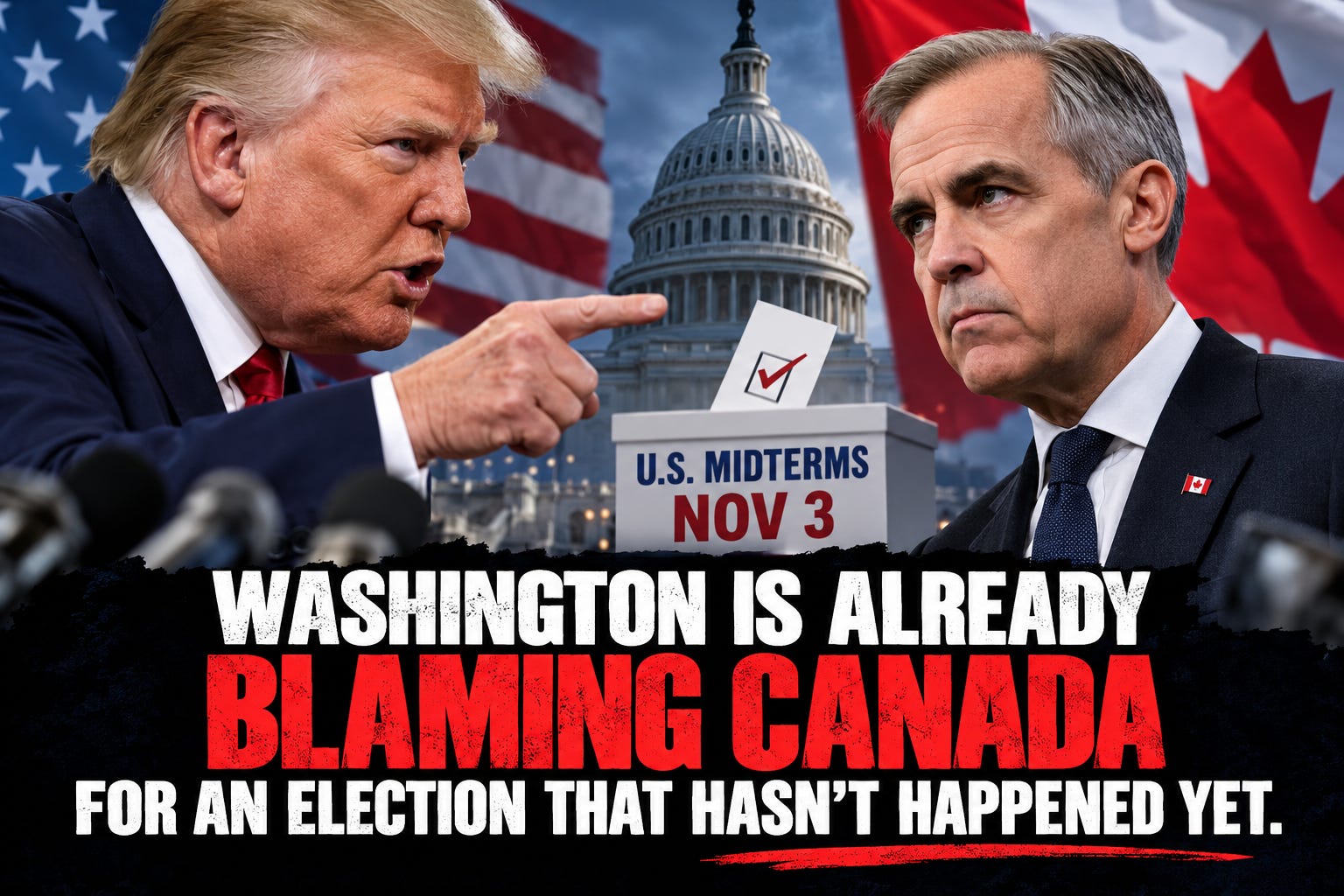
There’s a big difference between defending Canadian interests and interfering in an American election.
A reader raised a question that deserves more than a quick answer.
With the American midterm elections approaching, how far might Washington go in blaming Canada if the results don’t favour Donald Trump?
And what about reports of Canadians being arrested for voting illegally in American elections?
Those are fair questions.
Because something unusual is happening between our two countries.
The United States is accusing Canadian politicians of interfering in an election that hasn’t even taken place.
And some American officials are already talking about consequences.
Let’s look at what we actually know.
Washington Has Made the Accusation Official
This isn’t just something Donald Trump said at a rally.
On October 21, the U.S. Embassy in Ottawa published a fact sheet accusing Canadian political leaders of trying to influence American politics.
It pointed to statements by Industry Minister Mélanie Joly, actions by Ontario Premier Doug Ford, and meetings involving Canadian politicians and American officials.
The embassy suggested Canada was dismissing legitimate concerns about potential election interference.
American Ambassador Pete Hoekstra had already warned Canadian politicians that Washington was watching their activities.
And White House trade adviser Peter Navarro went further.
Speaking in September, Navarro warned that Canada could face additional consequences if it interfered in elections in states such as Maine or Michigan.
Those aren’t casual remarks.
They’re coming from senior representatives of the American government.
But here’s the question.
What exactly is Canada supposed to have done?
Apparently, Defending Canadian Jobs Is Suspicious
One of Washington’s complaints involves Mélanie Joly.
She discussed Canada’s strategy of applying economic pressure to American states and industries affected by the trade dispute.
That’s true.
Canada has used retaliatory tariffs to pressure Washington into reconsidering its trade policies.
Some of those measures were designed to affect politically important American states.
That’s also true.
But retaliatory tariffs are not automatically election interference.
They’re a familiar instrument of international trade disputes.
When one country imposes tariffs, the other country may respond with tariffs of its own.
And those responses are frequently designed to create political pressure.
That’s the point.
Washington also complained about Ontario’s advertising campaign featuring former U.S. president Ronald Reagan criticizing tariffs.
The advertisement was intended to persuade Americans that tariffs were harmful.
Trump didn’t appreciate it.
But trying to persuade another country’s citizens about trade policy is not, by itself, evidence of illegally interfering in their elections.
Governments do that sort of public diplomacy regularly.
There is an important distinction between trying to change a government’s policy and secretly manipulating an election.
Washington seems determined to blur it.
But What About Canadians Arrested for Voting?
This part deserves particular attention.
On October 16, the U.S. Department of Justice announced charges against five non-American citizens accused of voting illegally in federal elections.
Two were Canadian nationals.
The other three were nationals of Britain and Bosnia.
All five were lawful permanent residents of the United States.
The charges concerned voting in previous elections, not ballots cast in the upcoming November 3 midterms.
And the defendants are presumed innocent unless proven guilty.
The U.S. Embassy has also referred to a broader collection of cases involving 11 Canadians charged with illegal voting over a period of years.
Now, I don’t believe Canadians have any business voting illegally in American elections.
If someone knowingly breaks American election law, they should face the appropriate legal process.
That’s straightforward.
But here’s what matters.
An individual Canadian allegedly voting illegally is not evidence that the Canadian government organized election interference.
Those are two very different accusations.
The evidence made public so far does not establish a coordinated operation directed by Ottawa.
And combining unrelated individual cases with complaints about tariffs and political advertising doesn’t establish one either.
We should be careful not to turn criminal allegations against individuals into accusations against an entire country.
One Canadian woman. One photograph. A much bigger accusation.
One case caught my attention after a reader brought it up.
Lise Marie Johnson, a 69-year-old Canadian living in Florida as a lawful permanent resident, was recently charged with falsely claiming U.S. citizenship to register to vote and illegally casting a ballot.
The alleged offences date back to 2021 and the 2022 American election.
Not the upcoming 2026 midterms.
The U.S. Department of Homeland Security released a photograph appearing to show Johnson outside a home after dark, wearing a housecoat and slippers, surrounded by federal agents.
My reader Tracy found that photograph disturbing.
So do I.
Now, let’s be clear. Johnson has been charged, not convicted. She’s entitled to due process, and the allegations deserve to be examined in court.
But there’s something else worth examining.
How does an alleged voting offence from four years ago become part of the political conversation about Canadian interference in an election that hasn’t even happened?
One Canadian accused of illegally voting is not evidence that Canada is interfering in American democracy.
Those are two very different accusations.
And when politicians start treating individual criminal allegations as evidence of something much bigger, Canadians should be asking for proof.
Not photographs.
Not political speeches.
Proof.
Mark Carney Isn’t Buying It
On October 23, Prime Minister Mark Carney rejected Washington’s allegations.
He said there was no merit to the claims and expressed disappointment with Ambassador Hoekstra.
Canadian diplomats have also been instructed to avoid meetings and events involving American election candidates during this sensitive period.
That seems like a sensible precaution.
Canada has enough problems negotiating with Washington without becoming involved in American election campaigns.
But Carney made another point worth remembering.
The United States initiated the trade actions that prompted Canada’s response.
Canada has been defending Canadian businesses, workers and economic interests.
That doesn’t stop simply because Americans are holding an election.
And it shouldn’t.
Now Comes the Really Interesting Part
On October 28, The Guardian reported that Ambassador Hoekstra had suggested Republican losses in important states could create additional problems for Canada.
According to the report, remarks attributed to Hoekstra raised the possibility that Trump might blame Canada if Republicans lost those races.
The U.S. Embassy disputed that interpretation and said the remarks had been taken out of context.
That distinction matters.
We cannot report as fact that Washington has decided to blame Canada for Republican losses.
But we can say that American officials have repeatedly raised the possibility of Canadian election interference before the votes have even been counted.
And that creates a troubling situation.
If Republicans lose seats on November 3, Canada could become a convenient political target.
Not because anyone has demonstrated that Ottawa changed a single vote.
But because Washington has already introduced the accusation into public debate.
Political scientist Daniel Béland has warned about precisely that possibility.
It’s a warning, not a prediction.
And Canadians should understand the difference.
There’s Another Side to This Story
While Washington complains about Canadian politicians trying to influence American politics, senior American officials have been making statements about Canadian sovereignty.
Donald Trump has repeatedly suggested Canada should become America’s 51st state.
American officials have met with representatives of Alberta’s separatist movement.
And U.S. Treasury Secretary Scott Bessent publicly described Alberta as a natural partner for the United States.
Washington maintains that meetings with separatist activists were routine contacts and involved no commitments.
Fair enough.
But consider the standard being applied.
If a Canadian minister discussing tariffs with American politicians raises concerns about foreign influence, shouldn’t American officials engaging with Canadian separatists invite scrutiny too?
I’m not suggesting those activities are legally identical.
They aren’t.
I’m suggesting that the same principles of sovereignty and democratic independence should apply on both sides of the border.
Canada doesn’t get to decide who Americans elect.
And Washington doesn’t get to decide Canada’s political future.
What Happens After November 3?
Nobody knows yet.
Republicans could retain control of Congress.
Democrats could make gains.
The results could be close, disputed, or politically messy.
And Washington’s relationship with Canada could improve or deteriorate regardless of who wins.
What we do know is that the Trump administration has already accused Canadian politicians of potential interference.
We know it has threatened consequences.
And we know Canadian officials have rejected those accusations.
What we don’t have is evidence establishing that the Canadian government has organized an operation to manipulate the American midterm elections.
That is the distinction Canadians should insist upon.
Because accusations are easy.
Evidence is harder.
And when the accusation comes from the government of our largest trading partner, the difference matters enormously.
The Recap…
Washington has accused Canadian politicians of potential interference in the November 3 American midterm elections.
Its examples include retaliatory tariffs, political meetings, advertising and separate cases involving Canadians accused of voting illegally in earlier elections.
Those individual criminal allegations deserve proper investigation.
But they do not establish Canadian government involvement.
Mark Carney has rejected Washington’s claims, and the evidence publicly presented so far does not demonstrate an organized Canadian effort to manipulate the election.
Whether Canada becomes a political scapegoat after November 3 remains to be seen.
The Gut-Punch…
America gets to choose its own government.
Canada gets to defend its own country.
And if Washington doesn’t like the election results on November 3, it should look at the voters who cast the ballots.
Not the neighbours who refused to surrender their sovereignty.
Facts, not fables.
— Fred Ferguson
GeezerWise
Source credits:
These are the sources supporting the article, including the original U.S. Justice Department release.
U.S. Embassy… Fact Sheet: Monitoring Canadian Activities in U.S. Politics (October 21). The original document was linked by AP; direct access was restricted during verification.
U.S. Department of Justice… Five Non-Citizens Arrested for Voter Fraud (October 16)
The Guardian… Ambassador’s Reported Warning About Republican Losses (October 28)
The New York Times… Why Is the U.S. Accusing Canada of Election Interference? (October 25)
If you enjoy thoughtful conversations, Canadian stories, and the occasional smart-ass observation about the world we’re living in, you’re in the right place.
Subscribe free and get new stories, insights, and observations delivered directly to your inbox.
No paywall.
No spam.
No nonsense.
Leave anytime with a single click.
I promise not to take it personally.
Fred, if Trump loses the midterms he’ll be looking for a scapegoat and regardless of what Canada has or has not done, I suspect we’ll be blamed.
Trump resents the fact that Canada has responded with counter-tariffs. He seems to believe he’s Don Corleone and that every country must kneel down and kiss his ring.
What he hasn’t accounted for is Mark Carney’s strategic approach. Carney is gradually moving Canada away from its dependence on the United States by strengthening relationships with other countries and securing opportunities such as associate membership in the EU.
As Canada develops its enormous natural resource potential, including critical minerals, uranium, hydroelectric power and new oil pipeline capacity, our economic options will expand considerably.
Eventually, the United States may realize that its approach to Canada has been a costly strategic mistake. And history may judge people like Trump, Navarro and Lutnick rather differently than they imagine.
Canada is not trying to harm the US we are simply reducing our vulnerability to American political decisions.
Seems like Might Makes Right is the new USA standard. All the warnings suggest some rough consequences are being planned regardless of culpability. Well,the world will get to see.