

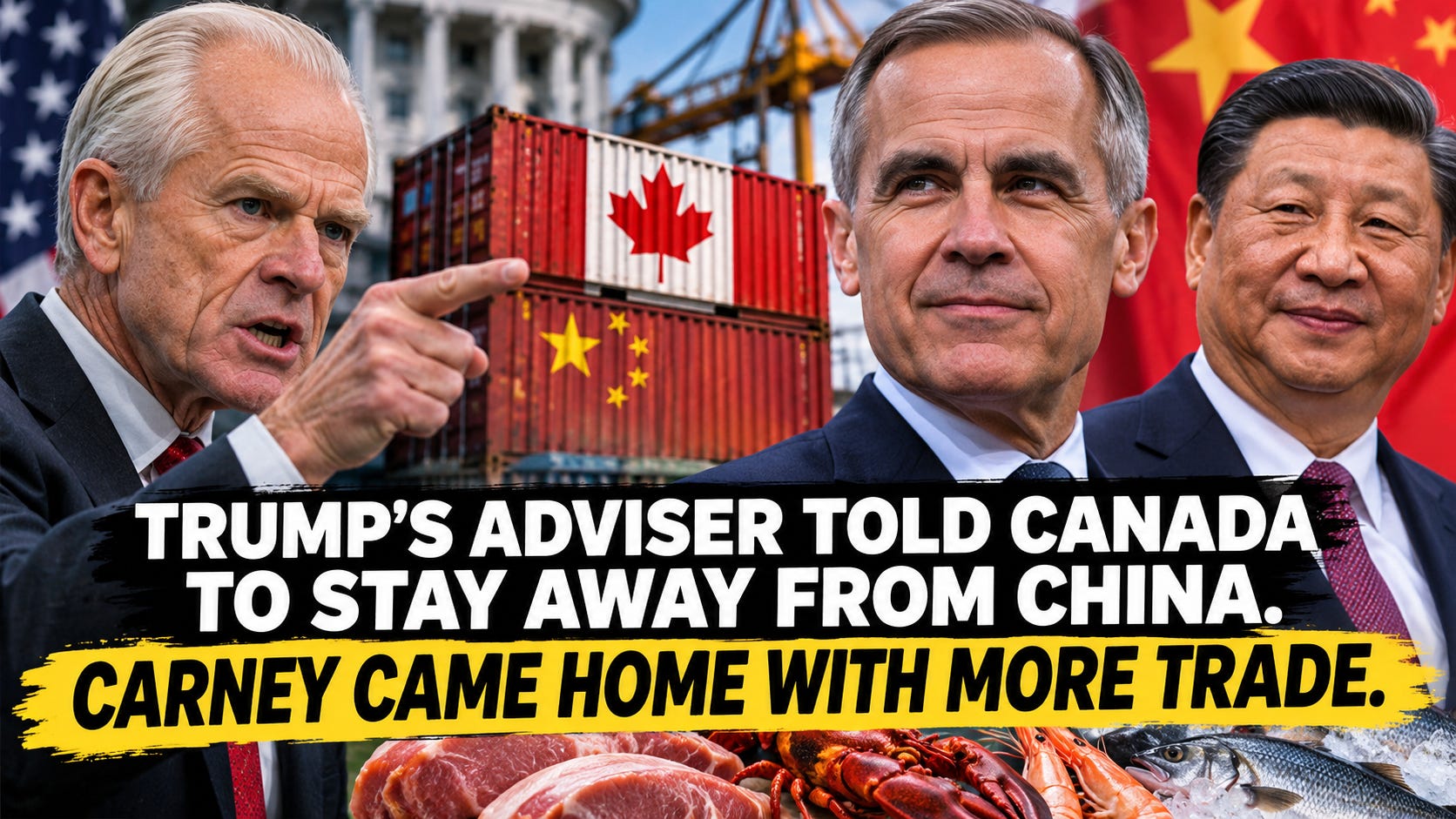
Peter Navarro has a problem.
Canada is behaving like an independent country.
And apparently, that’s not how Donald Trump’s trade adviser thinks this relationship is supposed to work.
While Prime Minister Mark Carney was in Asia working on trade agreements, Navarro was busy telling Canada what it should and shouldn’t do.
He was particularly upset about Canada developing closer economic ties with China.
Imagine that.
The United States can trade with China. Donald Trump can negotiate with China. American companies can buy Chinese products and sell into the Chinese market.
But Canada?
We’re apparently supposed to ask permission.
I must have missed the ceremony where we handed over our sovereignty.
The part Navarro seems to have missed
On November 17, Carney met Chinese President Xi Jinping in Shenzhen.
And they announced something considerably more useful than another round of diplomatic insults.
China agreed to extend and expand tariff relief covering approximately $400 million in Canadian pork and seafood exports.
That includes…
$116 million in frozen pork products.
$96 million in Greenland halibut.
$87.5 million in cold-water shrimp and prawns, including Pacific spot prawns.
$61.4 million in certain molluscs, including geoduck.
$39.4 million in sea cucumber.
Those aren’t imaginary numbers somebody pulled out of a political speech.
They’re in the Canadian government’s November 17 announcement.
And they represent actual Canadian products that will have improved access to one of the world’s largest markets.
The relief is scheduled to run from January 1, 2027, through December 31, 2028.
That’s two more years of predictability for exporters who’ve had quite enough uncertainty already.
One important distinction: $400 million is the approximate value of exports covered by the tariff relief. It isn’t $400 million in new sales or money automatically deposited into Canadian businesses.
Still, ask a seafood exporter whether reduced trade barriers matter.
I suspect you’ll get a different answer than the one coming out of Peter Navarro’s office.
Canada didn’t get everything for nothing
There was a trade-off.
Canada agreed to extend certain tariff exemptions on Chinese steel and aluminum products through the end of 2028.
The exemptions also expand to 32 additional tariff categories where Canadian supply is insufficient or unavailable.
That’s worth examining carefully.
Our steel and aluminum industries are already dealing with enormous pressure from American tariffs. We shouldn’t create another problem while trying to solve the first one.
But there’s a difference between allowing selected imports Canada cannot adequately supply and throwing open the doors to unlimited Chinese steel.
This agreement concerns specific exemptions.
And that distinction matters.
Trade negotiations involve giving something to get something. The question is whether Canadians benefit from the exchange.
At least this time, we can see what was negotiated.
Meanwhile, back in Washington
Navarro didn’t merely disagree with Carney’s approach.
He described Canada’s willingness to use China as an alternative trading partner as offensive.
He even suggested that China was already consuming Canada economically, adding the extraordinary line…
“Vancouver is not B.C. It’s P.R.C.”
That’s the kind of remark you expect from somebody trying to start an argument at the end of a long night.
Not from a senior American trade adviser.
There are legitimate reasons to approach China cautiously.
Its human rights record, political interference concerns, and treatment of foreign businesses deserve scrutiny.
Canadians shouldn’t ignore any of that.
But Navarro’s outburst wasn’t a careful discussion of national security or economic risk.
It was an American official objecting to Canada developing alternatives to the United States.
And there’s a rather obvious problem with that position.
The United States helped create the very need for those alternatives.
You cannot impose punishing tariffs on your neighbour, undermine the reliability of an established trading relationship, and then act surprised when that neighbour starts looking elsewhere.
Well, apparently you can.
But don’t expect Canadians to applaud.
Carney is doing something Canada should have done years ago
Here’s what I find particularly interesting.
Canada’s relationship with China hasn’t suddenly become wonderful.
Nobody should pretend it has.
What has changed is Canada’s willingness to negotiate where Canadian interests can be advanced.
Earlier this year, China agreed to reduce barriers affecting Canadian agricultural products.
This month’s announcements extend relief for products including canola meal, peas, lobster and crab.
Now pork and additional seafood products are included.
Carney’s government says it has restored access for more than 90% of the Canadian trade previously affected by China’s retaliatory tariffs, representing nearly $7.5 billion in exports.
That’s a government estimate of trade covered by improved access, not a claim that $7.5 billion in new exports has already materialized.
The distinction matters.
But so does the direction.
Canada is rebuilding trading relationships that had been damaged.
And we’re doing it while maintaining the ability to disagree with China on matters that go well beyond trade.
That’s not surrender.
That’s diplomacy.
And what about the Conservatives?
Pierre Poilievre has criticized Carney’s overseas diplomacy as expensive political theatre.
Conservative MP Jamil Jivani has also expressed concern about closer ties with China and the possible consequences for Canadian auto workers.
Those concerns deserve answers.
China’s automotive industry is formidable. Canadian workers should not be sacrificed for a diplomatic announcement or a few cheaper imported vehicles.
But there’s another question worth asking.
What happens to Canadian auto workers if our entire future depends on an American president who keeps threatening the industry we’ve spent decades building together?
Carney has said Canada could seek automotive partnerships with Chinese, European or Japanese companies if negotiations with Washington fail to preserve our integrated industry.
That isn’t a signed deal to hand Canadian factories to China.
It’s a warning that Canada has options.
And any serious alternative must involve real Canadian production, Canadian workers and enforceable protections.
The Conservatives are entitled to challenge the details.
I’d like to hear their alternative.
Because telling the prime minister to stop travelling while our largest trading relationship is under extraordinary strain doesn’t sound much like an economic strategy.
It sounds like waiting beside the telephone.
The bigger story isn’t China
It’s Canada.
For decades, we built an economy that relied heavily on access to the American market.
That relationship brought enormous benefits.
It also left us vulnerable.
Trump has demonstrated just how vulnerable.
Now Canada is trying to change the equation.
China is one market. Europe is another. Asia-Pacific countries offer additional opportunities.
None will replace the United States overnight.
Nor should replacing America with dependence on China be our objective.
The goal is something much more sensible.
More customers. More choices. Less vulnerability to any single government.
And that’s what seems to bother Navarro.
An economically independent Canada is harder to pressure.
A Canada with alternative buyers has more room to negotiate.
A Canada that doesn’t have to accept whatever Washington puts on the table is a very different trading partner.
Personally, I rather like that idea.
The Recap…
Peter Navarro criticized Canada’s growing relationship with China.
Carney met Xi Jinping and secured additional tariff relief covering approximately $400 million in Canadian pork and seafood exports.
Canada made concessions in return, and the agreement deserves scrutiny.
But the larger point remains: Canada is building alternatives to a trading relationship Washington itself has made less reliable.
The Gut-Punch…
America doesn’t have to like Canada’s trading partners.
But America doesn’t get to choose them.
And the sooner Washington understands that, the sooner we can get back to behaving like neighbours instead of landlord and tenant.
Source credit
Prime Minister of Canada… November 17, 2026, Prime Minister Carney advances Canada’s strategic partnership with China across trade, commerce, and culture.
Reuters… November 17, 2026, Canada and China extend trade deals as Xi meets Carney ahead of APEC summit.
Associated Press… November 16–18, 2026, reporting on Carney’s automotive comments, Navarro’s response and Canada–China relations.
If you enjoy thoughtful conversations, Canadian stories, and the occasional smart-ass observation about the world we’re living in, you’re in the right place.
Subscribe free and get new stories, insights, and observations delivered directly to your inbox.
No paywall.
No spam.
No nonsense.
Leave anytime with a single click.
I promise not to take it personally.
The USA does 500 billion in trade with China. Frankly the US needs to take a hike
The snobbery and bullying coming out of trumps team is proof our relationship has been too accommodating for far too long. Like a bad marriage that should have ended before the ugly came out but finally realized who you were married to. Am beyond proud of PM Carney, what a cool thoughtful focused approach to all the drama across the border and across the floor. Thanks Fred.. you are who I look for with my morning coffee and was missing you!