

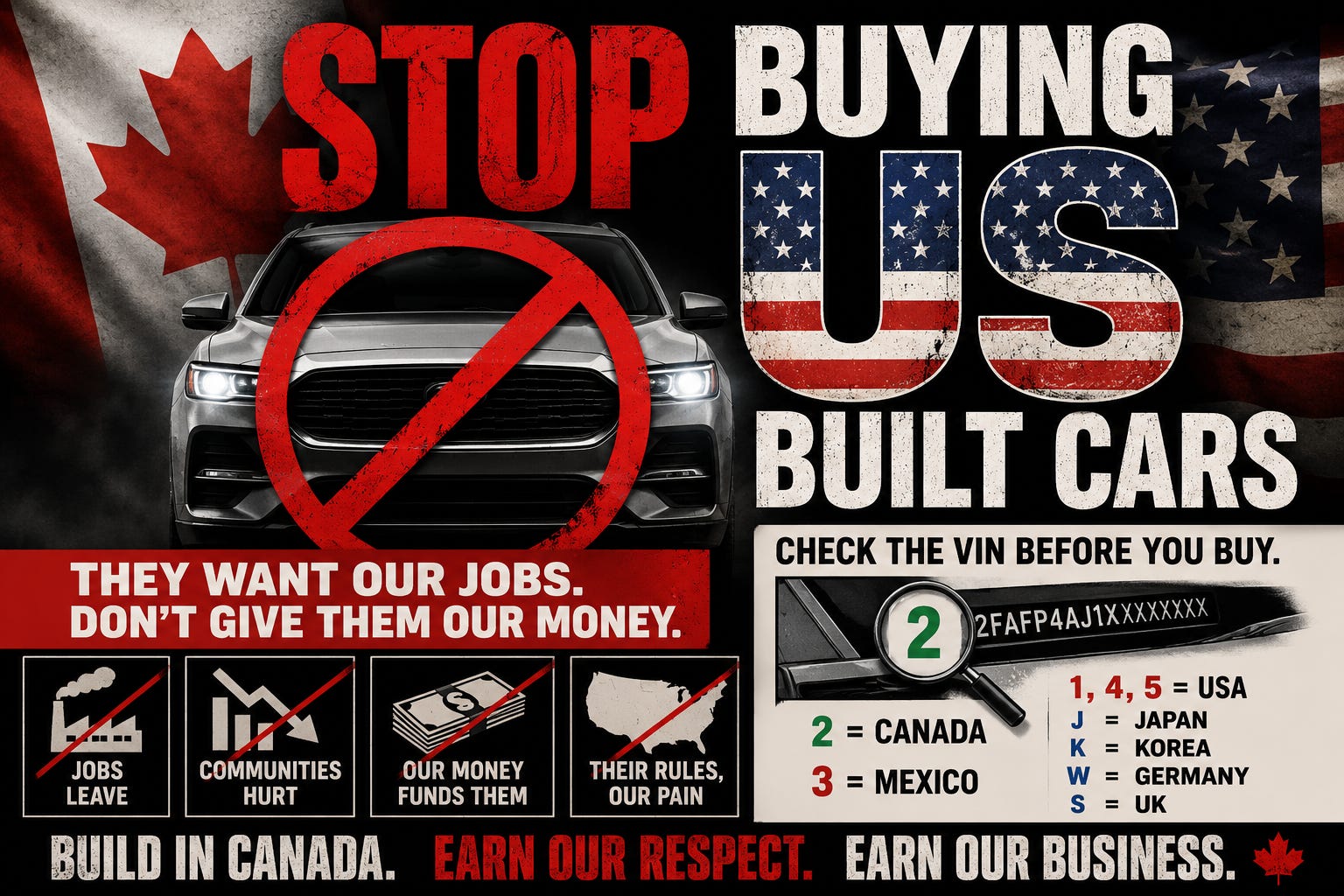
There is something Donald Trump appears to have forgotten about Canada.
We aren’t just producers.
We’re customers.
And customers have wallets.
Trump has now threatened to raise U.S. tariffs on Canadian-made cars, trucks, automotive parts and steel to 50% beginning January 1, 2027.
The message isn’t particularly subtle.
Build in America or pay.
Fine.
Then Canadian consumers should start thinking about an equally simple message:
Build in America instead of Canada… and don’t automatically expect Canadians to buy it.
That isn’t a government tariff.
It isn’t retaliation legislation.
It doesn’t require Mark Carney, Doug Ford or anybody else to sign a bloody thing.
It’s a purchasing decision.
And millions of individual purchasing decisions eventually become economic policy whether politicians intended them to or not.
The Auto Fight Just Got Serious
Canada’s auto industry isn’t some little regional side business.
It is a major part of Ontario’s manufacturing economy and part of an integrated North American supply chain that took decades to build.
Trump’s answer is apparently to make Canadian production increasingly expensive to sell into the United States while telling manufacturers they can escape the tariffs by building there instead.
Think about where that logic ends.
An automaker moves production from Ontario to an American plant.
Canadian jobs disappear.
Canadian communities lose payrolls.
Canadian suppliers lose contracts.
Then the finished vehicle comes north and Canadians are expected to walk into the dealership and buy it.
Why?
That is the part where Canadian consumers have considerably more power than we’ve been giving ourselves credit for.
We don’t control American trade policy.
But we sure as hell control what we buy.
Stop Shopping by Badge
Here’s where this gets interesting.
Buying Canadian doesn’t necessarily mean buying a Canadian-owned automobile company.
We don’t have many of those sitting around.
It means looking at where the actual vehicle was assembled.
A Toyota can be Canadian-built.
A Honda can be Canadian-built.
An American-brand vehicle can be Mexican-built.
And two vehicles carrying the same corporate badge can come from entirely different countries.
Fortunately, the vehicle itself carries a clue.
Check the VIN Before You Buy
Every modern vehicle has a 17-character Vehicle Identification Number — the VIN.
Look at the first character.
For vehicles manufactured in North America:
1, 4 or 5 = United States
2 = Canada
3 = Mexico
You’ll also commonly see…
J = Japan
K = South Korea
W = Germany
S = United Kingdom
The first three characters together form the World Manufacturer Identifier, providing more information about the manufacturer and origin.
So the next time you’re standing on a dealer lot looking at a $50,000 or $70,000 vehicle, don’t just look at the logo on the grille.
Look through the windshield.
Find the VIN.
Check the first character.
If it begins with 2, you’ve found a Canadian-built vehicle.
If it begins with 1, 4 or 5, you’re looking at one assembled in the United States.
That’s information worth knowing before the wallet comes out.
This Is Bigger Than Cars
We’ve already learned something remarkable during this trade fight.
Ordinary Canadians can move markets without waiting for Ottawa.
We did it with American alcohol.
We did it with travel.
We did it with grocery-store choices.
Nobody passed a law ordering Canadians to do it.
People simply started asking:
Where was this made?
And then:
Is there another choice?
That’s economic leverage at its simplest.
Not rage.
Not hatred of Americans.
Not burning anything in the street.
Just choice.
Washington gets to decide how it treats Canadian workers.
Canadians get to decide where we spend Canadian money.
Seems fair to me.
We Don’t Have to Buy Nothing American
This is where I want to be careful.
I’m not suggesting Canadians should run outside tomorrow and sell perfectly good vehicles because they were built in Michigan.
That would be silly.
The money has already been spent.
Drive the damn thing.
I’m talking about the next purchase.
When your car needs replacing, add one more question to the usual list.
Price?
Reliability?
Fuel economy?
Warranty?
Safety?
And now:
Where was it built?
If two vehicles meet your needs and one supports Canadian manufacturing while the other supports the country trying to pull that manufacturing out of Canada, that’s useful information.
You decide what to do with it.
Canada Has More Choices Than We Think
For decades we’ve behaved as though the North American automobile market was almost one domestic market.
That world is changing.
Japan builds excellent vehicles.
South Korea builds excellent vehicles.
Europe builds excellent vehicles.
Mexico builds vehicles.
And Canada still builds vehicles.
Our job isn’t to punish ourselves trying to make some ideological point.
Our job is to become smarter customers.
If Washington wants to make Canadian manufacturing less competitive through tariffs, Canadians don’t have to make American manufacturing more profitable through habit.
That’s the distinction.
Trump can control the tariff at the American border.
He cannot control the Canadian wallet.
And there are roughly 40 million of those wallets up here.
Governments Fight One Battle. Consumers Fight Another.
Ottawa will negotiate.
Provinces will argue about retaliation.
Industries will lobby.
Lawyers will write agreements nobody outside government wants to read.
That’s their battlefield.
Ours is considerably simpler.
Every time we spend money, somebody gets the benefit.
A worker.
A factory.
A community.
A government collecting taxes.
A company deciding where its next factory will go.
That’s why consumer behaviour matters.
Companies don’t build factories because politicians give speeches.
They build them where they believe they can make money.
Canadian demand is part of that calculation.
If companies learn that moving production out of Canada carries a Canadian sales cost, suddenly that calculation looks a little different.
No screaming required.
Just arithmetic.
Check the Damn VIN
This may become one of the easiest little habits Canadians can develop.
Before buying your next vehicle:
Look at the VIN.
1, 4 or 5?
American-built.
2?
Canadian-built.
3?
Mexican-built.
J?
Japanese-built.
K?
South Korean-built.
W?
German-built.
Then make whatever decision makes sense for your family.
Nobody needs to tell you what to buy.
That’s rather the point.
Donald Trump believes tariffs can convince companies to move Canadian production into the United States.
Maybe they can.
But there’s another half to that equation.
Those companies still need customers.
And if Canadian workers are expected to absorb the pain of America’s industrial strategy, Canadian consumers are under absolutely no obligation to finance it afterward.
They can move the factory.
They don’t get to move our wallets with it.
The Recap…
Trump is threatening 50% tariffs on Canadian cars, trucks, auto parts and steel beginning January 1, 2027.
The goal is obvious: make American production more attractive than Canadian production.
But Canadians have leverage too.
Next time you buy a vehicle, check the first character of the VIN.
1, 4, 5 = USA.
2 = Canada.
Know where it was built.
Then decide where you want your money going.
The Gut-Punch…
If you take the Canadian job south, don’t assume the Canadian customer follows it.
Source credit:
Research notes derived from the supplied video transcript; major tariff claims independently checked against current reporting. Vehicle-origin information should be confirmed using the vehicle’s full VIN and an official VIN decoder.
If you enjoy thoughtful conversations, Canadian stories, and the occasional smart-ass observation about the world we’re living in, you’re in the right place.
Subscribe free and get new stories, insights, and observations delivered directly to your inbox.
No paywall.
No spam.
No nonsense.
Leave anytime with a single click.
I promise not to take it personally.
Lots of great information there Fred! Thank you for your quick response/solution to the newest threats from the orange boil! haha
Buying Canadian can make a huge impact on our GDP. When Canadians started the Buy Canadian initiative there were at least 3 months where the GDP held strong because of people using their wallets. This works Canada 🍁!!!