

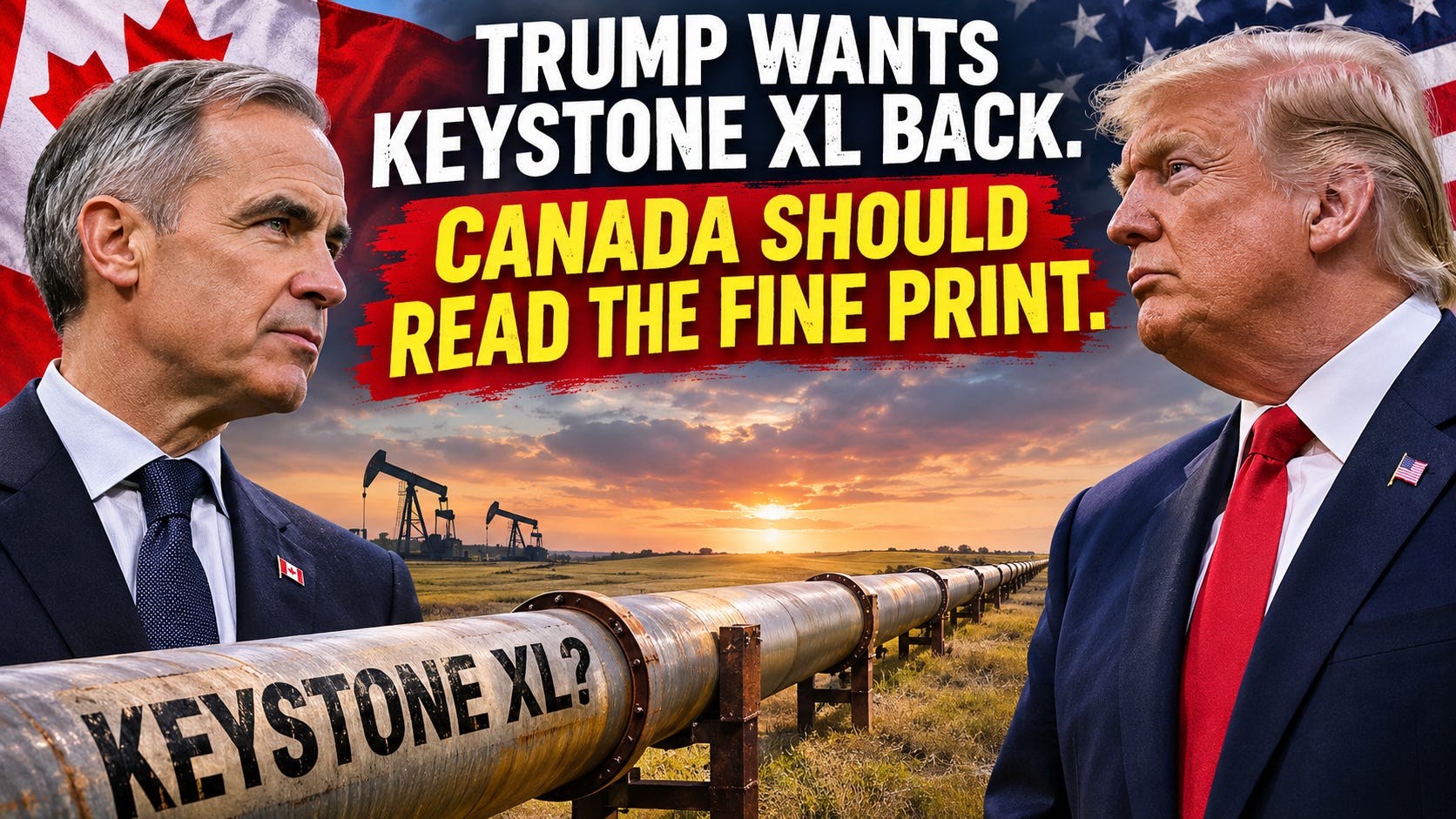
Donald Trump wants Keystone XL back.
Mark Carney wants American tariffs reduced.
And somewhere between those two ambitions, there might be a deal.
I can see why people are getting excited.
Alberta gets another route for its oil. Canadian steel and aluminum producers might get some relief. Trump gets to claim he revived a pipeline that Joe Biden killed.
Everybody gets something.
Sounds wonderful.
Now, who’s paying?
Because that’s the part of this story that caught my attention.
On November 1, Trump told reporters that Canada would build the Keystone pipeline and pay for it.
That’s quite a statement considering nobody has announced a completed agreement.
Carney, meanwhile, has been talking about a mutually beneficial trade deal that respects Canadian sovereignty.
Those aren’t necessarily contradictory positions.
But they’re certainly not the same thing.
And after everything we’ve been through with Washington, I think Canadians have earned the right to ask a few questions before breaking out the champagne.
This didn’t start last week
Back in October 2025, Carney raised the possibility of reviving Keystone XL during a White House meeting with Trump.
The Canadian Press reported that Trump was receptive and that the two leaders discussed linking energy cooperation with progress on steel and aluminum tariffs.
That was more than a year ago.
Since then, we’ve watched trade negotiations advance, collapse, restart and produce enough contradictory statements to keep a roomful of political reporters employed until retirement.
But something else has been happening.
The pipeline industry hasn’t been sitting around waiting for politicians.
South Bow, the Calgary company that inherited Keystone’s oil pipeline business from TC Energy, is advancing a project called Prairie Connector.
It would use part of the infrastructure already built for the abandoned Keystone XL project.
And here’s where things get interesting.
South Bow has secured 20-year transportation commitments from nine customers for 465,000 barrels of oil per day.
That’s not a politician making a speech.
That’s commercial interest backed by contracts.
The company still needs permits, financing and a final investment decision, which it expects to make in 2027.
But the project is considerably more tangible than another Trump announcement.
Alberta wants pipelines. B.C. wants its coastline protected.
We’ve been watching Danielle Smith and David Eby argue about another proposed oil pipeline to the British Columbia coast.
That fight involves geography, environmental protection, Indigenous rights and the federal tanker restrictions.
None of those issues disappears because somebody in Ottawa wants a nation-building project.
Prairie Connector offers a different possibility.
It runs through Alberta and Saskatchewan toward the American border.
No northern B.C. coastline. No attempt to overturn the tanker ban to accommodate that route.
That doesn’t mean there are no environmental or Indigenous concerns. It means this is a different project with different obstacles.
And it might give Carney something useful at the negotiating table.
Trump wants more Canadian oil moving south.
Canada wants relief from tariffs hurting its industries.
There’s room for a conversation.
Maybe even a worthwhile agreement.
But I wouldn’t call it a victory yet.
Here’s what bothers me
Canada has spent much of the past year learning a very expensive lesson about relying too heavily on one customer.
We’ve talked about finding new markets for our energy, expanding trade with Europe and Asia, and building Canadian industries that aren’t at the mercy of whoever occupies the White House.
I’ve supported that direction.
I still do.
So when somebody suggests that building another pipeline into the United States is automatically a great Canadian victory, I have to wonder.
Are we increasing our bargaining power?
Or are we increasing our dependence?
Those are two very different things.
Now, I’m not opposed to selling oil to Americans.
They’re our neighbours. They need energy. We have energy to sell.
That’s business.
What I object to is pretending that every deal involving more American purchases automatically strengthens Canada’s independence.
It doesn’t.
The details matter.
If Carney can secure meaningful, enforceable tariff relief without surrendering Canadian control over our economic decisions, I’ll be among the first to applaud.
If Canada is expected to assume enormous financial obligations in exchange for tariff promises that can be reversed by another presidential proclamation, that’s another matter entirely.
We’ve already seen what happens when Washington changes its mind about pipelines.
Keystone XL was cancelled in 2021.
Alberta’s government estimated its financial loss at roughly $1.3 billion.
That’s an expensive reminder that presidential enthusiasm isn’t the same thing as long-term certainty.
Carney doesn’t need a headline. He needs a deal.
I know some people are eager to declare Carney the winner of this negotiation.
I understand the temptation.
It would be quite a political achievement if he managed to connect Alberta’s desire for pipeline capacity with relief for Canadian steel and aluminum workers.
And it would be especially satisfying after all the criticism that Ottawa hasn’t done enough to get pipelines built.
But let’s not award the trophy while the players are still negotiating.
I want to know what tariffs disappear, what conditions are attached, who finances construction and what happens if Washington changes the rules again.
I also want to know whether any agreement leaves Canada free to pursue other energy customers.
Because that’s the bigger prize.
Not simply selling more to America.
Having the freedom to sell wherever it makes sense for Canada.
If Keystone or Prairie Connector becomes part of a good agreement, fine.
Build the business case. Respect the regulatory process. Protect Canadian taxpayers.
But don’t mistake a pipeline announcement for a trade victory.
We’ve heard enough announcements from Donald Trump to last several lifetimes.
Show me the agreement.
Then we’ll talk about who won.
The Recap…
Trump wants Keystone XL revived, and Carney is negotiating over tariffs.
Meanwhile, a related Canadian pipeline project already has long-term customer commitments.
There’s a possible deal here. But there’s no confirmed victory.
Canada needs tariff relief without trading away its economic independence.
The Gut-Punch…
A pipeline that carries Canadian oil south isn’t automatically a pipeline that moves Canada forward. The deal determines that.
Source Credit:
The Canadian Press, October 8, 2025 … Carney’s Keystone XL proposal and tariff discussions.
Reuters, November 1, 2026 … Trump’s pipeline and trade agreement comments.
Canada Energy Regulator, 2026 … Prairie Connector’s status, route and regulatory requirements.
South Bow, Q3 2026 filing … Transportation commitments, investment timeline and project details.
Government of Alberta, Keystone XL … Cancellation and provincial financial exposure.
If you enjoy thoughtful conversations, Canadian stories, and the occasional smart-ass observation about the world we’re living in, you’re in the right place.
Subscribe free and get new stories, insights, and observations delivered directly to your inbox.
No paywall.
No spam.
No nonsense.
Leave anytime with a single click.
I promise not to take it personally.
Good question Fred
Good morning Fred. I’m thinking that moving too quickly on this issue would be a mistake. Yes relief on tariffs, yes to a better partnership. But I think that one of the most important things to keep in mind is to remember who we are dealing with. A person who, at the last minute of a potential deal, did his best to change the rules of the deal to, let’s be frank, steal from a partner in a very dishonest way. I agree. It is best not to get excited at this point and read too much into this. I believe an attitude of wariness should be in play because as I have said remember who we are dealing with. There is no clear solution in my estimation.