

Here’s something I think Canadians need to get our heads around.
Trade wars aren’t ultimately decided at press conferences.
They’re decided in boardrooms.
A politician can stand behind a podium and announce tariffs, deadlines, threats and whatever other economic thunderbolt sounded clever that morning.
But eventually somebody running an actual business has to decide where to put the next billion dollars.
And that’s where this gets interesting.
Because General Motors just made one of those decisions.
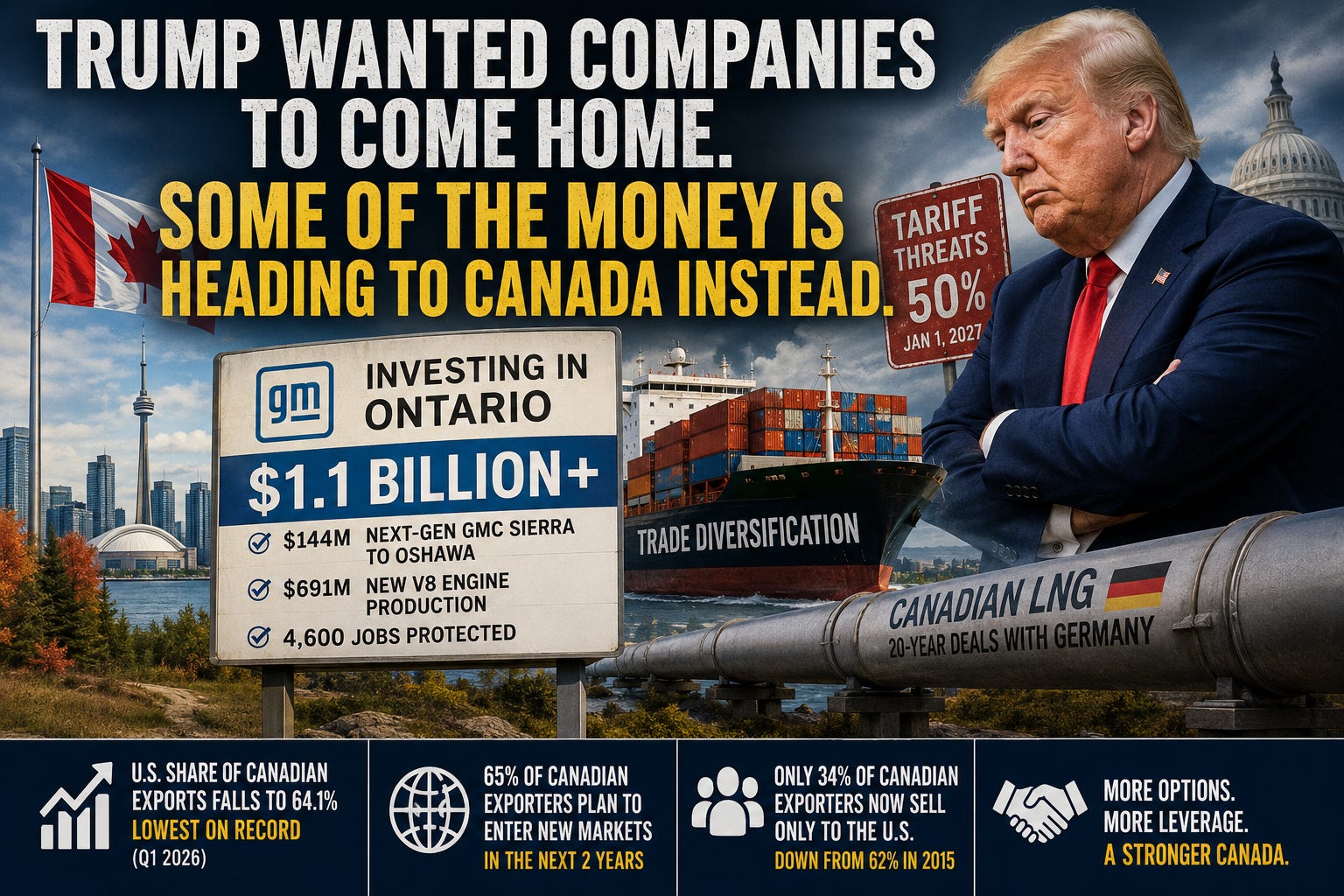
GM and Unifor have reached a deal covering roughly 4,600 workers in Ontario, with more than C$1 billion in Canadian investment attached to it.
That includes C$144 million to bring the next-generation heavy-duty GMC Sierra to Oshawa, alongside an earlier C$691-million commitment for new V8 engine production in Ontario. GM also committed to keeping its CAMI assembly plant in Ingersoll open while alternatives for future production are explored. (Reuters)
And here’s the part worth noticing.
This is happening while the United States is threatening to double tariffs on Canadian vehicles and parts to 50% beginning January 1, 2027. (Reuters)
Think about that for a second.
The whole theory behind Trump’s tariffs is that companies will look at the cost of doing business outside America and say:
Fine. We’ll build it in America.
Except GM just looked at the landscape and committed another billion-plus dollars to Ontario.
That doesn’t mean GM is abandoning America.
It doesn’t mean Detroit is packing up and moving to Oshawa.
And it certainly doesn’t mean Canada has somehow won the trade war.
Let’s not get silly.
It means something more useful.
Canada is still investable.
And predictability has value.
Businesses hate one thing more than taxes
Uncertainty.
Businesses can calculate taxes.
They can calculate wages.
They can calculate transportation costs.
They can calculate electricity, steel, labour, exchange rates and financing.
What they have trouble calculating is:
What the hell are the rules going to be six months from now?
That’s the danger America is creating for itself.
And Canada doesn’t have to defeat the United States economically to benefit from that.
We simply have to become the more predictable alternative.
There’s evidence Canadian companies have figured this out too.
Export Development Canada recently surveyed Canadian exporters and found 65% plan to enter new markets during the next two years.
Even more interesting, the percentage of Canadian companies beginning their exporting life by selling only to the United States has fallen from 62% in 2015 to 34% in 2025. (Export Development Canada)
That’s not anti-Americanism.
That’s Business 101.
If one customer can wreck your company, you have too much riding on one customer.
Canada spent decades ignoring that lesson because the biggest, richest market on Earth happened to live next door.
Fair enough.
It worked wonderfully.
Until it didn’t.
The numbers are already moving
This isn’t merely companies talking about diversification.
The trade numbers are beginning to show it.
Global Affairs Canada reports that the U.S. share of Canadian goods and services exports fell to 64.1% in the first quarter of 2026, the lowest level recorded in that quarterly data series.
At the same time, Canadian exports to non-U.S. markets increased by $3.7 billion. (Global Affairs Canada)
Now we’re getting somewhere.
I’ve been banging this drum for months:
Canada doesn’t need to stop trading with America.
That would be bloody stupid.
They’re our neighbours.
They’re enormous.
Our economies are deeply integrated.
What Canada needs is options.
Because options create leverage.
If 80% of what you’re selling has only one buyer, you’re negotiating from your knees.
If Germany wants some, Japan wants some, Britain wants some and somebody in Asia wants some too?
Now we’re having a negotiation.
And Germany just gave us a lovely example
Canada’s LNG relationship with Germany is becoming particularly interesting.
In July, Germany’s Uniper signed a binding agreement to purchase two million tonnes of Canadian LNG annually for up to 20 years, with deliveries expected beginning in 2032.
The LNG will come from the proposed Ksi Lisims project in British Columbia. (Canada)
That’s on top of an earlier agreement involving German energy company SEFE for another one million tonnes annually for up to 20 years. (Canada)
Stop thinking about LNG for a moment.
Think about the 20 years.
Companies don’t make commitments like that because somebody gave a stirring speech.
They’re planning supply chains.
They’re planning infrastructure.
They’re planning decades ahead.
And Canada is becoming part of those plans.
That’s what diversification actually looks like.
Not a politician yelling, We’re diversifying!
A contract.
A plant.
A pipeline.
A ship.
A customer.
A cheque.
This is the opportunity Trump handed Canada
I don’t know whether Donald Trump intended to teach Canadians the danger of economic dependence on the United States.
I’m fairly confident that wasn’t on the whiteboard.
But that’s what happened.
For decades we had the easiest economic arrangement imaginable.
Build it.
Dig it up.
Pump it.
Grow it.
Send it south.
Collect the cheque.
Then Trump reminded 40-odd million Canadians that the fellow writing most of your cheques also has tremendous power over you.
That’s uncomfortable.
But it may turn out to have been useful.
Because Canada finally started looking around.
Europe.
Asia.
Mexico.
Energy.
Critical minerals.
Defence.
Manufacturing.
New trade corridors.
New customers.
And suddenly the conversation isn’t…
How do we get America to like us again?
It’s…
How do we make sure we never need America quite this badly again?
That’s a much better question.
Don’t celebrate yet
There is one mistake Canadians absolutely should not make.
We cannot confuse opportunity with achievement.
Signing an LNG contract is good.
We still have to build the bloody infrastructure.
Attracting investment is good.
We still have to remain competitive enough to keep attracting it.
Finding new markets is good.
We still need ports, railways, pipelines, transmission lines, roads and trade relationships capable of reaching them.
This is where Canada has traditionally been spectacularly talented at turning a good idea into twelve years of meetings.
That won’t cut it anymore.
Because the opening Trump has accidentally created won’t stay open forever.
Other countries want these customers too.
But something has changed
A year ago, much of the Canadian conversation was about what Trump might do to us.
Now I’m watching what Canadian companies are doing about it.
That’s different.
They’re finding customers.
They’re diversifying markets.
They’re making investments.
European companies are signing long-term agreements with Canadian suppliers.
And an American industrial giant is putting another billion dollars into Ontario while Washington threatens Canada with even higher auto tariffs.
That doesn’t mean America is collapsing.
It doesn’t mean Canada has replaced the United States.
It means the economic map is starting to move.
Slowly.
Contract by contract.
Investment by investment.
Customer by customer.
And maybe that’s the biggest lesson in this whole damn trade war.
Trump wanted tariffs to make America impossible to avoid.
Instead, he gave everybody a very good reason to learn how.
The Recap…
Trump’s tariffs were supposed to drive investment back into America.
Then GM committed more than $1 billion to Ontario.
Meanwhile Canadian exporters are finding new customers and Germany is signing 20-year deals for Canadian LNG.
The trade map isn’t flipping overnight.
But the money is starting to move.
The Gut-Punch…
Trump wanted tariffs to make America impossible to avoid. Instead, he gave everybody a reason to learn how.
Source credit:
Source credit: Research notes based on the video “USA PANICS as Companies FLEE to Canada and Europe.” Facts independently checked against reporting from Reuters and information from Global Affairs Canada, Export Development Canada, Natural Resources Canada, Unifor and General Motors Canada. The supplied transcript included the GM investment, LNG agreements and Canadian trade-diversification claims used as starting research points.
If you enjoy thoughtful conversations, Canadian stories, and the occasional smart-ass observation about the world we’re living in, you’re in the right place.
Subscribe free and get new stories, insights, and observations delivered directly to your inbox.
No paywall.
No spam.
No nonsense.
Leave anytime with a single click.
I promise not to take it personally.
What is the state of affairs concerning Stellantis pulling out of Ontario? How are the negotiations going on them returning the cash we gave them to expand?
Brilliant post, and true!