

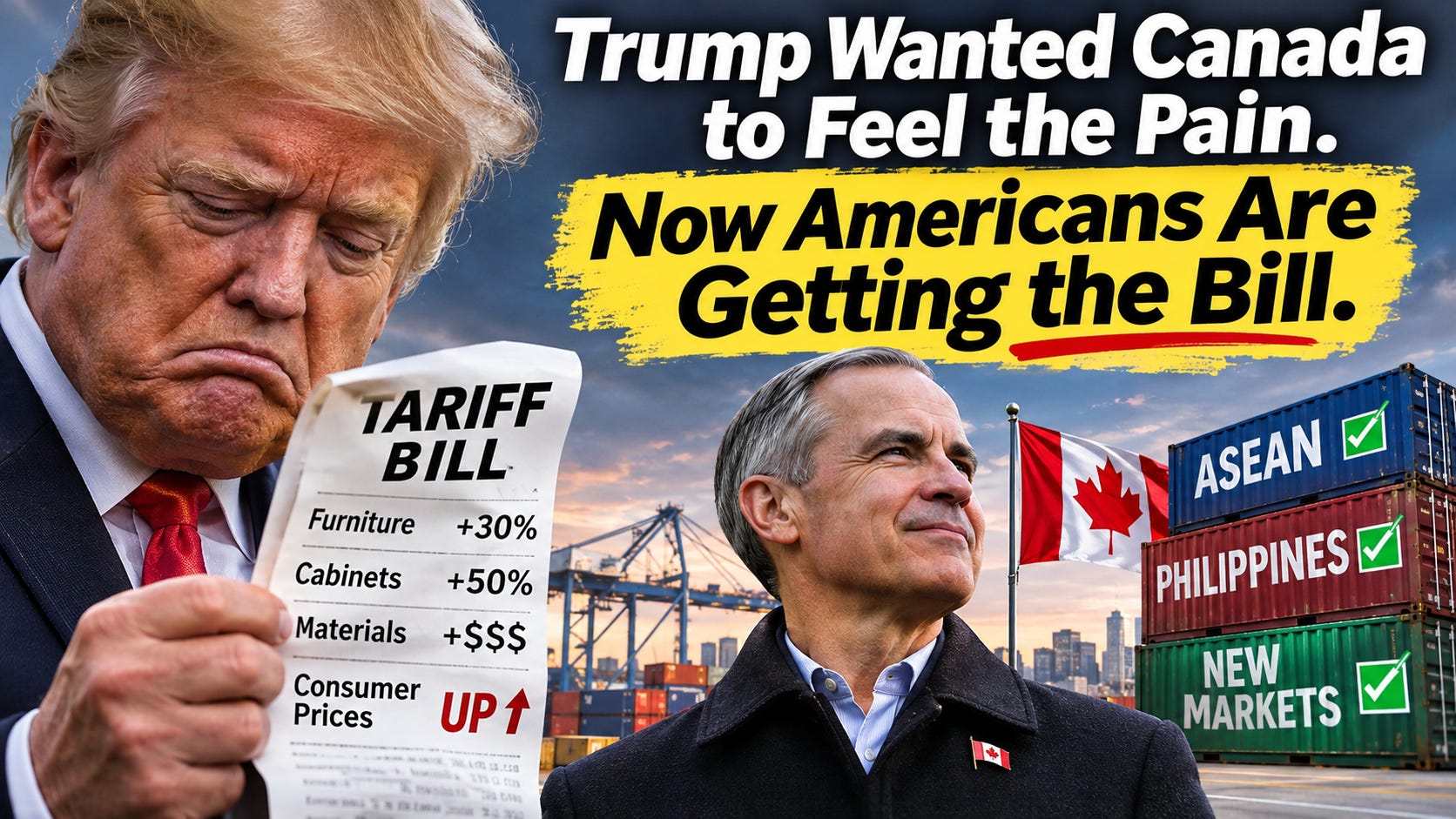
There’s something about Donald Trump’s trade war with Canada that still amazes me.
He seems convinced that if he makes doing business with the United States painful enough, Canada will eventually surrender.
Not negotiate. Surrender.
He has talked about making Canada the 51st state. He’s threatened our industries, imposed tariffs and treated a longtime ally like a troublesome tenant who refuses to pay the rent.
And now Americans are dealing with some of the economic pain themselves.
Funny how that works.
The Numbers Aren’t Cooperating
On November 10, the U.S. Bureau of Labor Statistics reported that American consumer prices rose another 0.4% in October.
Food prices increased 0.5%. Shelter rose 0.3%. Energy was up 0.7%.
None of those numbers is particularly comforting when you’re standing at the grocery checkout wondering how three bags of groceries managed to cost so much.
Tariffs aren’t responsible for every price increase. Energy costs, housing and other economic pressures all contribute.
But tariffs add costs to imported products and materials. American businesses either absorb those costs, pass them along to customers, or do some combination of both.
There’s no magic involved.
And there’s something particularly ridiculous about making American manufacturers pay more for Canadian materials they need to build American products.
You don’t make a factory more competitive by raising its costs and congratulating yourself for being tough.
Meanwhile, Canada’s October inflation rate was 3.1%.
That’s too high as well. Canadians are dealing with rising energy and grocery costs, and we’re certainly not immune to what happens south of the border.
But here’s the difference worth paying attention to.
Canada isn’t trying to solve its economic problems by making imported materials more expensive across the board.
We’re trying to find ways to make our economy less vulnerable.
And that brings me to something Washington ought to be watching.
January 1st Is Coming
Some American tariffs are scheduled to increase again on January 1, 2027.
Certain upholstered furniture imports face an increase from 25% to 30%.
Kitchen cabinets and vanities face an increase from 25% to 50%.
Think about that.
An American homeowner renovating a kitchen could end up paying more because Washington decided imported cabinets represent a national security concern.
A national security concern.
Apparently, the kitchen island has become a threat to the republic.
These tariffs also threaten Canadian manufacturers and their workers. That’s not something to celebrate.
But higher import costs don’t stop at the border. They travel through businesses, contractors, retailers and eventually into household budgets.
And Americans are already unhappy about affordability.
So Washington has a decision to make.
Keep increasing the pressure and risk adding to the costs Americans face.
Or recognize that economic punishment isn’t producing the easy victory Trump apparently expected.
Canada has a decision, too.
And I think we’re finally getting better at making it.
Ottawa Is Learning When Not to Swing the Hammer
On November 9, Finance Minister François-Philippe Champagne announced that Canada would extend certain tariff relief measures until June 30, 2028.
That might sound strange.
Why would Canada provide relief from its own retaliatory tariffs while Washington continues attacking Canadian industries?
Because some Canadian businesses still need American materials and components they cannot easily replace.
Punishing those businesses doesn’t hurt Trump nearly as much as it hurts Canadian workers.
Ottawa is maintaining targeted relief where necessary while removing some exemptions for goods that Canadian companies can supply.
That’s a sensible distinction.
Retaliate where it makes sense.
Protect Canadian businesses where it doesn’t.
And build alternatives so we aren’t stuck having this same argument every time an American president gets another bright idea.
Which brings us to Mark Carney.
While Trump Raises Barriers, Carney Is Opening Doors
On November 14, Carney announced that Canada had concluded free-trade negotiations with the Philippines.
He also announced the substantial conclusion of negotiations with ASEAN, the Southeast Asian trading bloc.
The agreements still need to be finalized and brought into force. Nobody should pretend the benefits have already arrived.
But consider what these developments represent.
ASEAN is a market of almost 700 million people, with an economy approaching $6 trillion.
The Canadian government estimates that an agreement, once implemented, could eventually add nearly $2 billion to our GDP and support almost 14,000 jobs.
Those are projections, not guarantees.
Still, I’d rather see Canada pursuing hundreds of millions of potential customers than sitting around waiting for Donald Trump to become reasonable.
That could be a very long wait.
The Philippines agreement offers opportunities for Canadian agriculture, forestry and other industries.
And the larger ASEAN agreement could give Canadian businesses more options across Southeast Asia.
That’s what diversification actually looks like.
Not another speech about standing up to Trump.
Not another promise that everything will be fine.
Actual negotiations. Actual markets. Actual opportunities.
It won’t replace our enormous trading relationship with the United States overnight.
Nothing will.
But every new market gives Canadian businesses another choice.
And every additional choice reduces Washington’s ability to dictate the terms.
Here’s What I Think Has Changed
For decades, Canada operated on a fairly comfortable assumption.
We had the world’s largest economy next door. We shared an enormous border. Our industries were deeply connected.
Why look much farther?
There were good economic reasons for that arrangement.
Until the relationship itself became a source of uncertainty.
Trump has demonstrated how dangerous it can be to depend too heavily on a trading partner whose government is willing to use that dependence as a weapon.
And I don’t think Canada should forget that lesson when Trump eventually leaves office.
A different president might remove some tariffs.
A friendlier administration might restore some trust.
But neither would change the basic problem.
Canada needs enough customers that no single country can hold our economy hostage.
That’s not anti-American.
That’s common sense.
The Mistake Washington Keeps Making
Trump appears to believe Canada will eventually run out of patience.
That our businesses will panic, our politicians will fold, and Canadians will decide that surrendering something important is easier than dealing with the economic consequences.
Maybe that calculation looked attractive when he first started threatening us.
But Canada isn’t standing still.
We’re negotiating new trade agreements. We’re looking for alternative customers. We’re trying to protect industries that remain exposed to American decisions.
And Americans have their own economic problems to worry about.
None of this guarantees Washington will back down.
Trump has never been particularly predictable, and economic pain doesn’t automatically produce sensible political decisions.
But it does mean the pressure isn’t flowing in only one direction.
Canada has something it didn’t fully appreciate before this confrontation.
A reason to change.
And increasingly, a plan for doing it.
I don’t want Americans suffering. Ordinary Americans didn’t create this mess, and many want no part of it.
But I also don’t believe Canadians should sacrifice their economic independence to spare Washington the consequences of its own policies.
We didn’t start this fight.
We don’t have to enjoy it.
And we certainly don’t have to surrender just because Donald Trump thought we’d be easier to push around.
The Recap…
Trump keeps using tariffs to pressure Canada.
But American businesses and consumers face costs too.
Meanwhile, Canada is extending targeted tariff relief and pursuing new trade agreements across Asia.
The more customers Canada finds, the less leverage Washington has.
The Gut-Punch…
Trump thought Canada’s dependence on America was his greatest weapon.
He may have given us the strongest reason yet to end that dependence.
Source Credit:
U.S. Bureau of Labor Statistics… October 2026 Consumer Price Index
Prime Minister of Canada… November 14 Philippines and ASEAN trade announcement
If you enjoy thoughtful conversations, Canadian stories, and the occasional smart-ass observation about the world we’re living in, you’re in the right place.
Subscribe free and get new stories, insights, and observations delivered directly to your inbox.
No paywall.
No spam.
No nonsense.
Leave anytime with a single click.
I promise not to take it personally.
These outcomes you describe are encouraging. But can we keep dancing? The PM s wonderful successes encourage us to believe so.
The orange one has a pattern of doubling down when challenged no matter how ridiculous. He s got away with so much that way, won t change now. Operant conditioning. And his god like thrall held over his followers allows him to get away with that.
I m rivetted to the next steps from Americans: will they continue to support him in enough numbers(because I think they re far from all turned back despite the election results) so he keeps it up? Will the turn that s begun gain weight until they throw him to the lions? will his decaying mind and body give out soon? and the sooner we know the better: what did he sign over to the really bad guys in secret meetings?can he deliver? Because we re still the meat in the sandwich between two rogue nuclear powers.
One of the statements you made in this article that you mentioned about trump is that he isn’t particularly predictable. I know you are highly intelligent and resourceful but I would like to add something to your attributes. You are incredibly diplomatic!!
That aside it is refreshing that Canada is seeking more trading partners so that dependence is becoming a non-issue. The key word in this sentence for me is trade. I think it was Carney who said “a bad deal is no deal”. Correct me please if I’m mistaken. I don’t think it is possible to come to a good deal with a bully. To me it’s like a nasty child in the playground saying give me your lunch money or else I’m going to beat you up.
It’s brains that overcomes brawn in the long run. Yes it’s going to be difficult through this long haul for both the United State and Canada. But I’m hoping that a more rational scenario presents itself so that the suffering doesn’t become more harder to bear than it already is. Is this possible? I don’t know when we are trying to negotiate with, in my eyes, an irrational trade partner.
To bring this to a close, playing it smart is the only option we have. So far so good I think.