

I had to read this one twice.
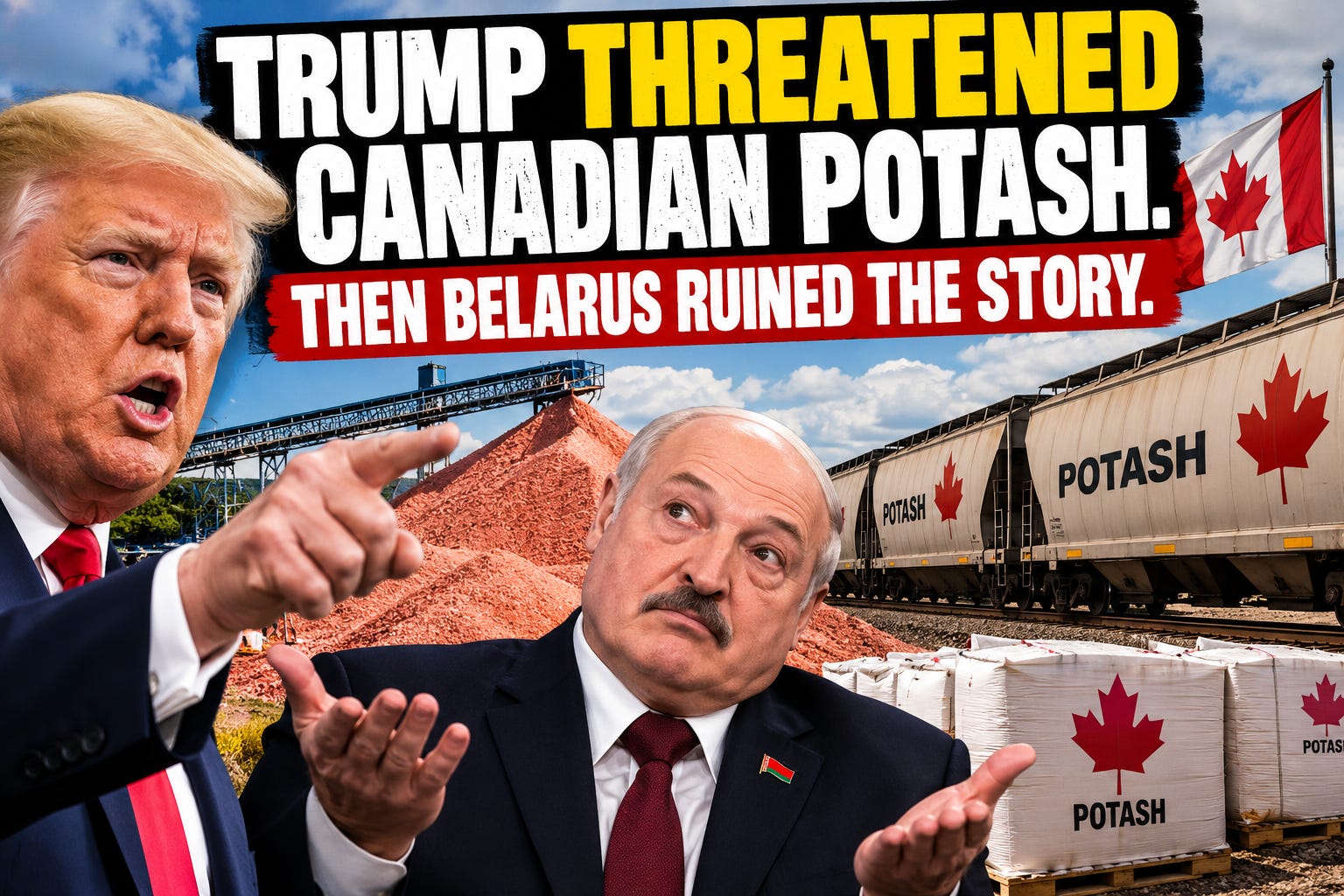
Donald Trump announced that the United States was working on what he called a “massive deal” to buy potash from Belarus instead of Canada.
The reason?
According to Trump, Belarus could sell it to American farmers substantially cheaper.
Sounds impressive.
Until you ask Belarus.
Belarusian President Alexander Lukashenko said his country doesn’t have the spare volume Trump seems to be talking about.
Its potash is already largely committed under existing contracts.
That is what we in the old-guy business call a fairly important detail.
But there’s another one.
Canada isn’t some distant supplier loading fertilizer onto ships halfway around the planet.
Saskatchewan potash gets put on trains and shipped directly into the American agricultural heartland.
Belarus is landlocked.
With European restrictions still complicating its traditional export routes, significant Belarusian potash destined for the United States would face a much uglier logistical journey, potentially involving Russian ports before crossing the ocean and then travelling inland to American farmers.
And Canada isn’t a bit player here.
In 2024, roughly 79% of American potash imports came from Canada, according to U.S. Geological Survey figures cited in reporting on Trump’s announcement.
So Saskatchewan Premier Scott Moe didn’t dance around it.
He attacked the Belarus idea, arguing that buying Belarusian potash would support a government aligned with Russia and questioning how hauling the stuff through Russia and across an ocean could possibly make more sense than buying it next door in Saskatchewan.
Fair question.
Then Canadian politics entered the room.
Conservative House Leader Andrew Scheer also condemned Trump’s proposal.
He called Belarus a dictatorship with a terrible human-rights record and called the suggestion that it would make a better trading partner than Canada ridiculous.
So far, so good.
Then Scheer added something else.
He argued that Prime Minister Mark Carney should remove the industrial carbon tax because it increases costs for Saskatchewan potash producers.
And that’s where things get strange.
Because Saskatchewan already paused its industrial carbon tax.
Effective April 1, 2025, Saskatchewan set the rate under its provincial Output-Based Performance Standards program to zero. The federal government’s own current description of Canada’s carbon-pricing systems notes that Saskatchewan announced that pause.
There is an important wrinkle here.
Ottawa still maintains national minimum standards for industrial carbon pricing, and the federal government is updating those standards.
Saskatchewan’s decision to pause its system therefore remains part of a larger federal-provincial policy dispute.
But telling Canadians that Carney can simply “lift” the industrial carbon tax currently making Saskatchewan potash more expensive leaves out the rather inconvenient fact that Saskatchewan’s own industrial carbon price has been sitting at zero.
Former Alberta premier Jason Kenney noticed.
He praised Moe’s response and criticized federal Conservatives for turning Trump’s potash threat into another domestic carbon-tax argument instead of concentrating on the threat to Canadian industry.
And that is the part of this story that caught my attention.
Not some grand theory about Trump secretly manipulating Canadian politics.
We don’t need one.
Look at what actually happened.
The president of the United States publicly suggested replacing Canadian potash with potash from Belarus.
Belarus itself says its available production is already committed.
The logistics are considerably more complicated than hauling Saskatchewan potash south by rail.
Canada currently dominates American potash imports.
And within hours, Canadians were arguing with each other about carbon taxes.
Maybe that’s the lesson worth remembering.
Every time Trump throws another grenade across the border, Canadians don’t have to pull the pin for him.
Sometimes we could just look at the grenade.
The Recap…
Trump says Belarus can sell American farmers cheaper potash than Canada.
Belarus says its potash is already committed.
Canada already supplies most American potash imports.
And somehow we managed to turn that into another Canadian carbon-tax fight.
We’re talented that way.
The Gut-Punch…
Before Canadians start fighting each other over Trump’s latest threat, maybe we should check whether the threat actually works.
Source credit:
Reporting and verification: Reuters, The Canadian Press, Government of Saskatchewan, Environment and Climate Change Canada, U.S. Geological Survey data reported by AFP, and contemporaneous reporting on statements by Scott Moe, Andrew Scheer and Jason Kenney.
If you enjoy thoughtful conversations, Canadian stories, and the occasional smart-ass observation about the world we’re living in, you’re in the right place.
Subscribe free and get new stories, insights, and observations delivered directly to your inbox.
No paywall.
No spam.
No nonsense.
Leave anytime with a single click.
I promise not to take it personally.
What usually gets lost in this "industrial carbon tax" debate is that many (perhaps most?) of our current/likely trading partners around the world EXPECT such a tax/price to be added to products. Many are conscious of the "green cost" of making products—which is why Europe really likes Canadian aluminum: it uses relatively green hydroelectric energy to process it (vs. high-carbon coal electricity). This is why Carney left the federal carbon pricing alone (and refuses to remove it). We don't put it in, then the importer of our goods ADDS THEIR assumptions onto our product (which might make the cost worse).
This is another example of CPC grievance politics - create an issue that isn't an issue (either that, or they just don't understand the marketplace themselves. I'm not really sure which it is). And as Fred notes, doubly so in the potash case, since there really isn't any carbon price added to it in the first place.