

There’s something almost comical about watching American politicians discover how tariffs work.
For months, Donald Trump has been telling Americans that Canada is taking advantage of them. That tariffs will protect American jobs. That Canada needs to make a deal.
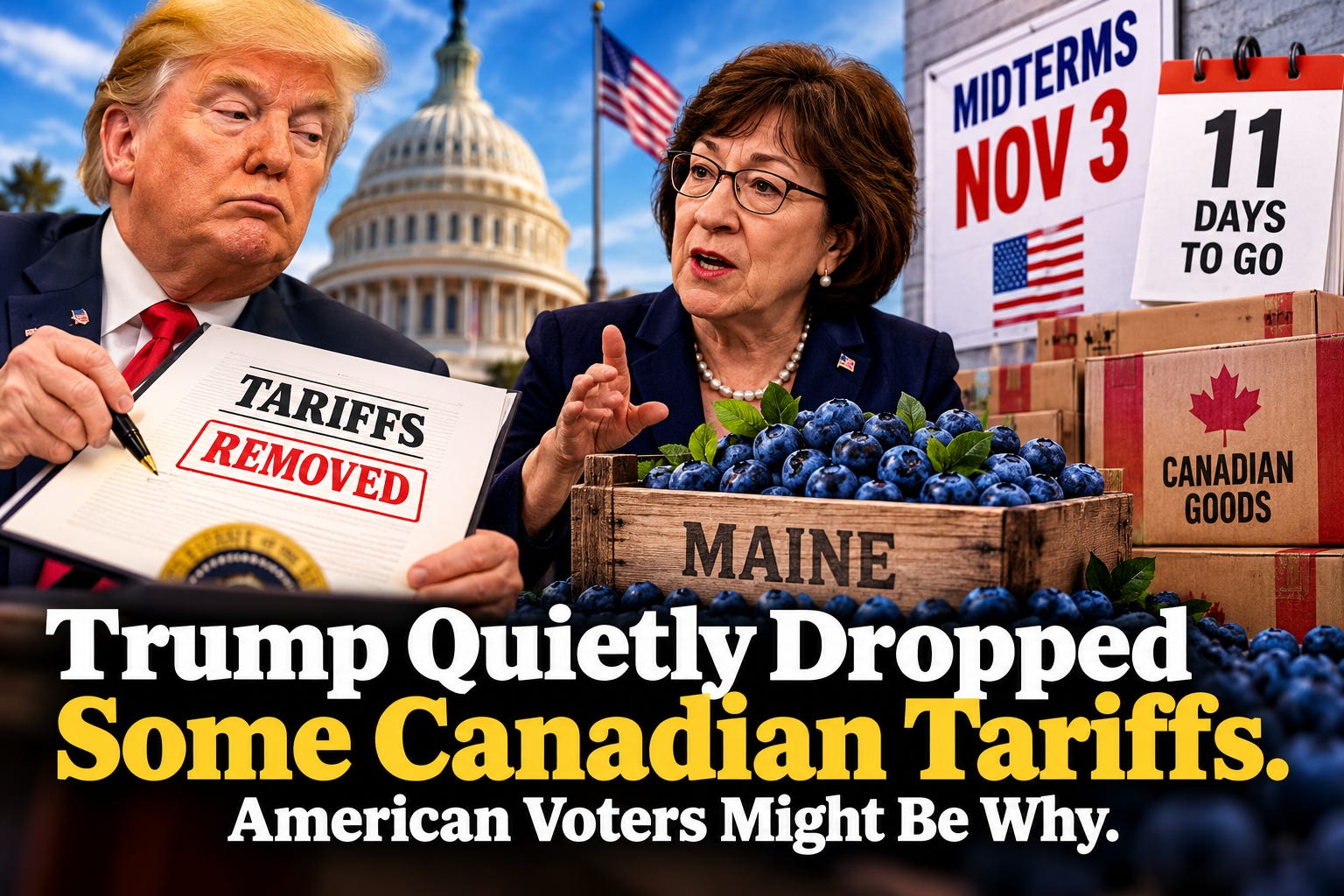
Then, on October 23, he signed an order removing 50% tariffs from a selection of Canadian products.
And guess who had been asking him to do exactly that?
Republican Senator Susan Collins of Maine.
She’s fighting for reelection on November 3, and apparently, tariffs aren’t nearly as popular when the people paying them are your own voters.
Funny how that works.
The blueberry farmers have entered the conversation
Maine has a problem.
Its farmers and businesses depend on Canadian products. Not because they’re unpatriotic Americans. Because Canadian suppliers make things they need.
Blueberry growers use specialized Canadian harvesting boxes. Other farmers need Canadian packaging, refrigeration equipment and machinery.
Some American alternatives aren’t available. Others would cost considerably more.
That’s not my assessment.
That’s what Susan Collins herself explained in her October 23 announcement.
She had been pressing senior Trump administration officials, including U.S. Trade Representative Jamieson Greer and Commerce Secretary Howard Lutnick, to remove tariffs that were raising costs for Maine businesses.
And she got results.
The White House signed an order removing the additional 50% tariff from certain Canadian paper products, packing materials, machinery, refrigeration equipment and other goods.
The changes take effect October 30.
Four days before Americans vote.
Now, I’m not suggesting Trump personally checked the election calendar and suddenly developed sympathy for blueberry farmers.
But I am suggesting that the timing deserves a raised eyebrow.
Collins is in a competitive Senate race against Democrat Troy Jackson, who has been criticizing Trump’s trade policies.
And when Republican politicians start telling their own president that his tariffs are hurting American businesses, something has changed.
Washington has another explanation
The White House says these changes are intended to serve American economic interests while maintaining pressure on Canada.
And here’s something worth understanding.
Trump didn’t simply remove tariffs.
He also added other Canadian products to the 50% tariff list, including certain carpets, valves and other goods.
So this isn’t the end of the trade war.
It’s Washington moving the pain around.
Relief for some American businesses. New costs for others.
That tells us something important about the policy itself.
If tariffs were such a wonderful way to strengthen the American economy, why would American farmers need their senator to negotiate exemptions from them?
Why would specialized Canadian packaging suddenly become a political problem?
Because tariffs aren’t paid by the Canadian government.
They’re collected from American importers. Those costs can then be passed along to American businesses and consumers.
That’s how tariffs work.
And no amount of political speechmaking changes the arithmetic.
Meanwhile, Canada is accused of interfering in American elections
Here’s where this story gets even stranger.
On October 21, the U.S. Embassy accused Canadian politicians of attempting to influence American politics ahead of the midterms.
Among the examples were discussions of retaliatory tariffs and an Ontario advertisement criticizing Trump’s trade policies.
Prime Minister Mark Carney rejected the accusation.
He also pointed out that American tariffs have raised costs for American families while damaging Canadian industries.
That’s not election interference.
That’s describing the consequences of a trade policy.
Canada didn’t impose Trump’s tariffs. Trump did.
Canada responded with its own measures, which have consequences too.
But apparently, pointing out what those policies cost Americans is now something Washington considers politically suspicious.
I suppose it’s easier to complain about Canadians discussing tariffs than explain to American voters why their own businesses need protection from them.
Carney doesn’t need to celebrate
I wouldn’t call these exemptions a Canadian victory.
They’re limited. The broader trade dispute continues. Canadian workers and businesses are still suffering real damage.
And the American administration hasn’t abandoned its protectionist approach.
But there is a political lesson here.
Trump can threaten Canada. He can demand concessions. He can tell American audiences that Canada has been taking advantage of them.
What he cannot do is make the economic consequences disappear.
Eventually, those consequences reach American farms, factories, businesses and households.
And eventually, those Americans start talking to the politicians who need their votes.
Susan Collins didn’t ask Washington for tariff relief because she suddenly became Canada’s trade ambassador.
She asked because Maine businesses needed help.
That’s precisely the pressure Canada has been waiting for Americans to recognize.
We shouldn’t mistake one set of exemptions for a breakthrough.
But we shouldn’t overlook what happened either.
An American Republican senator asked her own president to stop taxing certain Canadian products because those taxes were hurting Americans.
And he listened.
Eleven days before an election.
Make of that what you will.
The Recap…
Trump signed an order removing 50% tariffs from certain Canadian products after Republican Senator Susan Collins pressed for relief.
Maine businesses were paying the price for Canadian goods they depend on.
The exemptions take effect four days before the U.S. midterms.
Washington hasn’t ended its trade war. But American politicians are starting to confront what it’s costing their own voters.
The Gut-Punch…
Trump said tariffs would make America stronger. Now American politicians are asking him to remove them so their businesses can survive the cost.
Sources
Senator Susan Collins… Official tariff exemption announcement, October 23
Reuters… Trump ends tariffs on some Canadian products, October 23
Associated Press… Carney responds to U.S. election interference allegations
If you enjoy thoughtful conversations, Canadian stories, and the occasional smart-ass observation about the world we’re living in, you’re in the right place.
Subscribe free and get new stories, insights, and observations delivered directly to your inbox.
No paywall.
No spam.
No nonsense.
Leave anytime with a single click.
I promise not to take it personally.
Australian PM Albanese described Trump's tariffs as 'self-harm' because they harm the country which applies them.
Australia has abolished its own tariffs.
Trump imposed tariffs of up to 50% on some Australian products, such as steel, aluminium and pharmaceuticals.
Australia did NOT retaliate.
If Americans want to pay up to 50% more for Australian imports, let them. No skin off our nose.
Some Australian exporters simply moved to other markets.
The world is a big place. America is only 30% of global trade, and falling.
Australia only sends 10% of its exports to America anyway.
Just walk away, and trade into other markets.
Let America stagnate.
For example, Trump is well on the way towards killing off the American vehicle-building industry with his tariffs.
Americans are the losers.
Putin and Xi are the winners.
The rest of the world just moves on, leaving America to stagnate.