

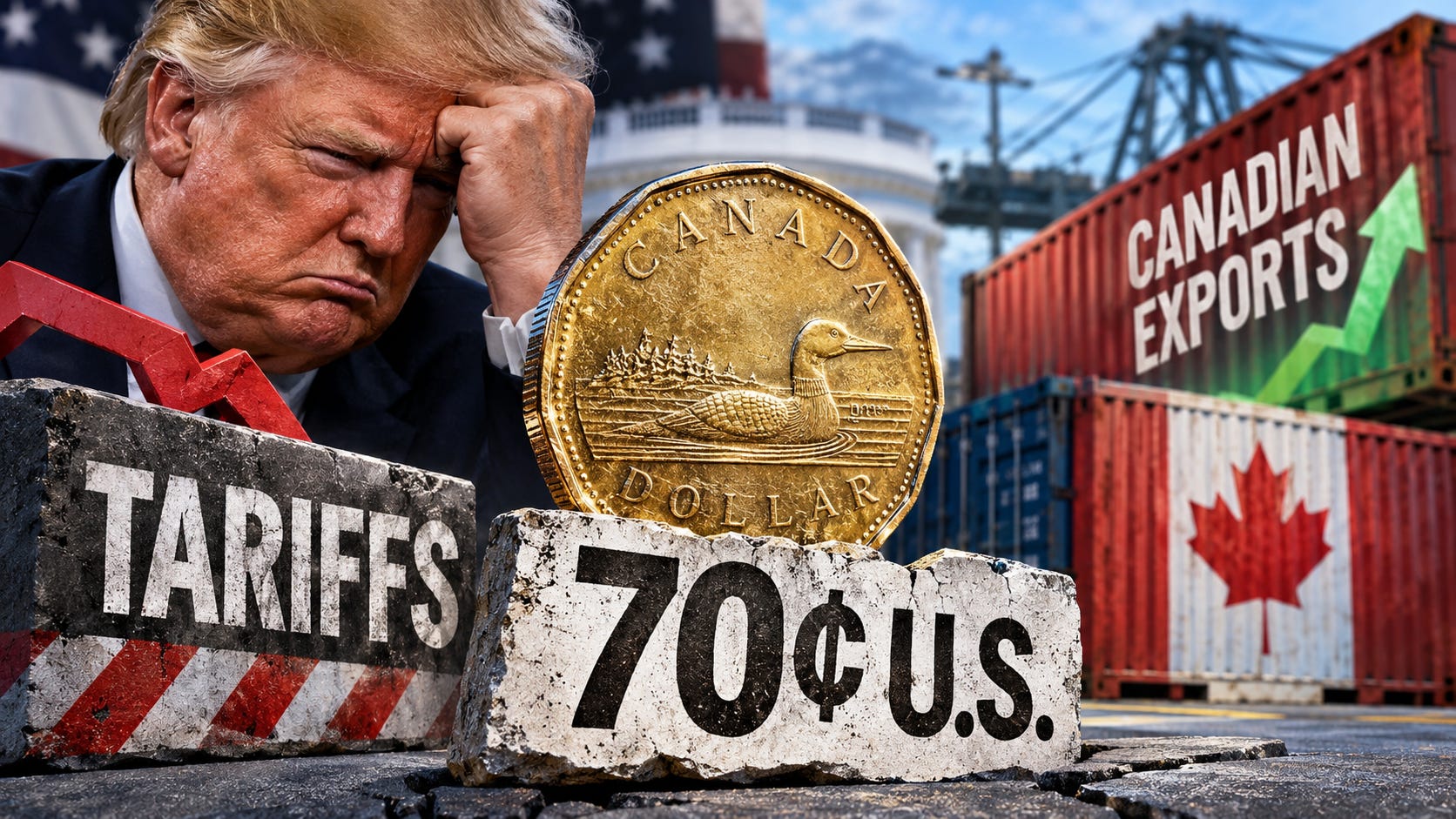
There’s something about the Canadian dollar sitting below 70 cents U.S. that deserves a closer look.
Most Canadians see that number and think about what it costs to travel south, buy American products, or order something online.
Fair enough. Seventy cents doesn’t buy much when you’re paying American prices.
But there’s another side to this story.
And Donald Trump might not appreciate it.
His tariffs are supposed to make Canadian goods more expensive for American buyers. That’s part of the whole plan to encourage companies to manufacture in the United States instead of importing from countries like Canada.
Except currencies don’t necessarily cooperate with presidential ambitions.
And ours has been moving in the opposite direction.
Here’s where the math gets interesting
On November 20, the Bank of Canada reported that one Canadian dollar was worth about 69.8 cents U.S.
At that exchange rate, an American buyer needs roughly $698 U.S. to purchase $1,000 worth of Canadian goods.
Now imagine the Canadian dollar were worth 75 cents.
That same $1,000 Canadian purchase would cost $750 U.S.
That’s a difference of about $52 U.S. before tariffs, shipping, or other costs.
Same Canadian product. Same Canadian price.
Different exchange rate.
And that’s where Trump’s tariff strategy runs into a complication.
A weaker Canadian dollar can partly offset the extra cost of American tariffs.
It doesn’t eliminate them. And it certainly doesn’t guarantee Canadian exporters will make more money.
But it can make Canadian products more competitive than they otherwise would be.
That’s not what Trump had in mind when he started trying to force manufacturing back into the United States.
Meanwhile, Americans are getting another bill
The latest economic numbers aren’t particularly cheerful south of the border.
American consumer prices increased 0.4% in October after rising 0.6% in September.
Food prices rose. Energy prices rose. Housing costs continued climbing.
And if you’re an American trying to buy a house, the mortgage numbers aren’t offering much comfort.
Freddie Mac reported that the average 30-year fixed mortgage rate reached 7.28% on November 19.
A year earlier, it was 6.26%.
That’s a substantial increase for someone borrowing hundreds of thousands of dollars.
Now, I’m not going to pretend Trump personally controls every mortgage rate in America.
He doesn’t.
Interest rates respond to inflation, bond markets, economic expectations, and decisions made by the Federal Reserve.
But tariffs can contribute to inflation by increasing import costs.
And when a president deliberately makes imported products more expensive, he shouldn’t be surprised when some of those costs eventually reach American households.
That’s not political ideology.
That’s how import taxes work.
Canada isn’t exactly celebrating either
Before anybody starts waving a flag over our 70-cent dollar, there’s another side to this.
Canada’s October inflation rate was 3.1%.
That’s unchanged from September.
And gasoline prices were 30.9% higher than a year earlier.
Grocery prices were also rising faster than the previous month.
So no, Canadians aren’t living in some magical economy where everything gets cheaper while Americans suffer.
We’re paying more for plenty of things ourselves.
And a weaker Canadian dollar makes American imports more expensive.
That matters when Canadian businesses purchase machinery, equipment, technology, or supplies priced in U.S. dollars.
It also matters to Canadian families who still travel south.
A $2,000 U.S. vacation costs roughly $2,865 Canadian at the November 20 exchange rate, before credit-card conversion fees.
That’s a pretty expensive reminder that we’re dealing with two different currencies.
And for Canadians who’ve already decided to vacation somewhere other than the United States, the exchange rate gives them one more reason to reconsider going back.
The part that matters for Canada’s future
There’s something else worth remembering.
A low Canadian dollar isn’t automatically a sign of economic strength.
It can help exporters. It can attract buyers looking for competitive Canadian prices.
But it also reduces our purchasing power internationally.
And if Canadian exporters become too comfortable relying on a currency advantage, we’re right back where we started.
Depending on circumstances we don’t control.
That’s why I keep coming back to the same argument.
Canada needs more customers.
Not because we should stop trading with the United States. That would be ridiculous.
We share a continent, an enormous trading relationship, and supply chains that took generations to build.
But depending too heavily on one customer becomes dangerous when that customer starts treating trade as a weapon.
Mark Carney’s government has been pushing to diversify Canada’s trading relationships.
And whatever anyone thinks of Carney, that objective makes sense.
A Canadian company selling into Europe, Asia, and the United States has more options than one whose entire business depends on Washington’s next announcement.
A favourable exchange rate can help open those doors.
But it cannot replace the hard work of building new markets.
Here’s what I find remarkable
Trump’s economic strategy depends heavily on the idea that tariffs will make foreign products less attractive and encourage Americans to buy domestically produced goods.
Yet exchange rates can move against that objective.
American consumers can face higher import costs while Canadian exporters receive some protection from a weaker currency.
And a stronger American dollar can make American exports more expensive to foreign customers.
None of that means Trump’s tariffs have failed across the board.
It means the world economy is considerably more complicated than slapping a tax on imported goods and declaring victory.
Canada shouldn’t mistake a cheap dollar for an economic triumph.
But neither should Washington assume tariffs give it complete control over Canadian competitiveness.
We’ve spent decades building an economy around selling to the United States.
Now we’re being reminded why that was never enough.
And if a 70-cent dollar helps Canadian companies find new customers while we build something more independent, we should use the opportunity.
Because exchange rates change.
Presidents change.
And Canada needs an economic future that doesn’t depend on either one.
The Recap…
Canada’s dollar has slipped below 70 cents U.S.
That’s bad news for Canadians buying American products, but it can give Canadian exporters a competitive advantage.
Trump’s tariffs push prices one way. Currency movements can push them the other.
The real opportunity? Use that advantage to build markets beyond Washington.
The Gut-Punch…
Trump can put a tariff on Canadian products. He can’t order the Canadian dollar to cooperate.
Source credit:
Research informed by the supplied YouTube transcript. Economic claims independently checked against official data.
If you enjoy thoughtful conversations, Canadian stories, and the occasional smart-ass observation about the world we’re living in, you’re in the right place.
Subscribe free and get new stories, insights, and observations delivered directly to your inbox.
No paywall.
No spam.
No nonsense.
Leave anytime with a single click.
I promise not to take it personally.
Thank you Fred. You explain things so well. I think our “saving grace” at this point in time is having a person well versed in economics at the helm so to speak whose every second word out of his mouth isn’t “tariff”. Screaming tariff doesn’t make the dollar listen like you said. Despite the ups and downs you outlined in this article, that last sentence I texted put a little smile on my face. Gloating? Maybe. But after a couple of years of having to listen to a screaming “blowhard” it’s refreshing to have a dose of quiet reality. Thanks Fred. Have a great day. Mine has improved already.
Thank you Fred, this clarification really helps. Good night