

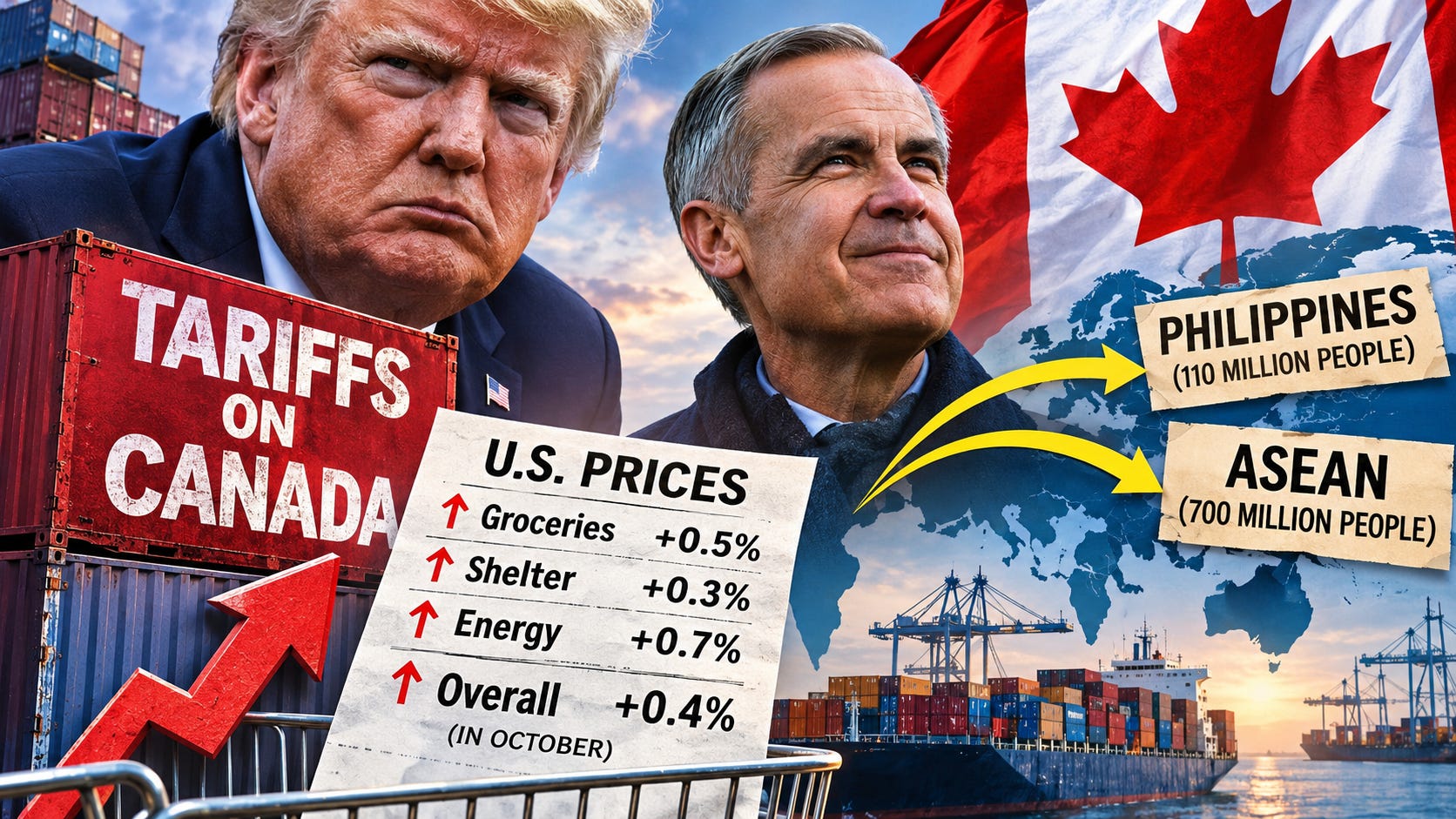
Donald Trump wanted to use economic pain to bring Canada to its knees.
There’s just one problem.
Economic pain doesn’t stop at the border.
And Americans are discovering that a tariff isn’t something you slap on another country and then sit back while its people pay the bill.
Somebody in America pays it first.
Usually an American business importing the goods. And when that business passes along the cost, American customers get their turn.
That’s how tariffs work.
Apparently, nobody explained that part to the fellow who keeps imposing them.
The numbers aren’t cooperating
On November 10, the U.S. Bureau of Labor Statistics released its October inflation report.
Consumer prices had risen another 0.4% in a single month.
Food prices increased 0.5%. Shelter costs rose 0.3%. Energy prices climbed 0.7%.
Now, that doesn’t mean American inflation is running at 4.8% annually. You can’t simply multiply one month’s increase by twelve and call it the official annual inflation rate.
But it does mean Americans are still facing rising prices.
And tariffs are one more cost being pushed into an economy where people are already paying more for groceries, housing, transportation, and just about everything else.
Not every price increase comes from tariffs. Energy costs, supply problems, and other economic pressures matter too.
But putting additional taxes on imported goods certainly isn’t a brilliant way to make those goods cheaper.
You don’t need an economics degree to figure that out.
You just need to have bought something.
Canada isn’t getting a free ride either
Yesterday, Statistics Canada reported that our annual inflation rate was 3.1% in October.
That’s not exactly something to celebrate.
Transportation prices were up 8.9% from a year earlier, with higher gasoline prices contributing to the increase.
So Canadians are feeling the pressure too.
And I don’t particularly enjoy paying more at the pump because somebody else’s political decisions have helped make an already unstable world even more expensive.
But here’s where Canada’s response becomes interesting.
We’re not simply waiting for Washington to come to its senses.
We’re changing how we do business.
Ottawa just made a decision worth noticing
On November 9, Finance Minister François-Philippe Champagne announced changes to Canada’s retaliatory tariff relief program.
The government extended certain exemptions on American imports until June 30, 2028.
At first glance, that might sound like Canada is backing down.
It isn’t.
The exemptions help Canadian manufacturers and other businesses that still need American materials or products they cannot easily obtain elsewhere.
But Ottawa is also removing some exemptions where Canadian-made alternatives are available.
Think about what that means.
If a Canadian business needs an American component that nobody here can supply, the government doesn’t necessarily force that business to pay an additional tax just to prove a political point.
But where Canadian manufacturers can supply the goods, Ottawa is making it more attractive to buy Canadian.
That’s not surrender.
That’s using a little common sense.
And in a trade war, common sense can be a surprisingly useful weapon.
Then Carney went shopping for customers
While Washington continues arguing about tariffs, Mark Carney has been busy opening doors elsewhere.
On November 14, the prime minister announced that Canada had concluded free-trade negotiations with the Philippines.
The two countries are working toward signing the agreement in 2027.
The Philippines has more than 110 million people.
That’s a lot of potential customers for Canadian farmers, manufacturers, forestry companies, and other exporters.
But Carney wasn’t finished.
Canada also announced the substantial conclusion of negotiations on a free-trade agreement with the Association of Southeast Asian Nations, better known as ASEAN.
That region represents nearly 700 million people and an economy approaching $6 trillion.
The government estimates the agreement could eventually add nearly $2 billion to Canada’s economy and support approximately 14,000 jobs.
Those are projections, not jobs already created. The agreements still need to be finalized, signed, and brought into force.
But there’s something important happening here.
Canada is building relationships with countries that don’t require us to spend every morning wondering what the American president might announce before lunch.
And that matters.
This is bigger than Trump
For decades, Canada enjoyed the enormous advantage of having the world’s largest economy right next door.
We built factories, transportation systems, supply chains, and entire industries around that relationship.
It made sense.
Why ship something halfway around the world when you could sell it to a customer a few hundred kilometres away?
But convenience has a price when the customer decides to use your dependence against you.
That’s the lesson Trump has been teaching Canada.
And I think Mark Carney understands something important about that lesson.
You don’t make Canada economically secure by hoping the next American president will be nicer.
You make Canada economically secure by ensuring that no American president can threaten our entire economy whenever a political argument breaks out.
That doesn’t mean abandoning trade with the United States.
It means having options.
More customers. More markets. More Canadian production.
And fewer reasons to panic when Washington starts throwing its weight around.
Here’s what Washington should be worried about
Tariffs can be removed.
Trade agreements can be renegotiated.
Presidents eventually leave office.
But when a Canadian company spends the time and money to develop customers in Asia, Europe, or somewhere else, those relationships don’t automatically disappear when the next American president arrives.
The same goes for the infrastructure, shipping routes, and business partnerships needed to serve those markets.
They take time to build.
And once they’re established, Canadian businesses have every reason to keep using them.
That’s why I think Washington is making a serious long-term mistake.
The United States may eventually decide that punishing its closest trading partner wasn’t such a clever idea.
But by then, Canada could have a lot more choices.
And choices are something we should have developed a long time ago.
I don’t want Americans suffering. Most of them didn’t ask for a trade war with Canada, and many are just trying to make ends meet.
But I also don’t want Canadians spending the next twenty years wondering whether another American president will threaten our jobs, industries, and sovereignty.
We’ve had enough of that.
Trump wanted to teach Canada a lesson about economic power.
Maybe he has.
Just not the lesson he intended.
The Recap…
Trump’s tariffs are adding costs to an American economy already struggling with rising prices.
Canada is feeling inflation too, but Ottawa is doing more than waiting for Washington to change course.
New trade agreements with the Philippines and ASEAN are moving forward, while Canadian tariff policy is being adjusted to protect domestic businesses.
The goal isn’t to stop trading with America.
It’s to stop depending on America for nearly everything.
The Gut-Punch…
Trump can remove his tariffs tomorrow. But he can’t order Canadian businesses to forget the customers they’re finding today.
Source Credit:
U.S. Bureau of Labor Statistics… October 2026 Consumer Price Index, November 10, 2026.
Statistics Canada… October 2026 Consumer Price Index, November 16, 2026.
Department of Finance Canada… Changes to tariff relief measures, November 9, 2026.
Prime Minister of Canada… Free-trade negotiations with the Philippines and ASEAN, November 14, 2026.
If you enjoy thoughtful conversations, Canadian stories, and the occasional smart-ass observation about the world we’re living in, you’re in the right place.
Subscribe free and get new stories, insights, and observations delivered directly to your inbox.
No paywall.
No spam.
No nonsense.
Leave anytime with a single click.
I promise not to take it personally.
Thank you Fred for this article. As a result of it I feel a bit refreshed a more secure than I have been. It will take time to get to the goal Carney has in mind for our country, but I have always said that instant gratification isn’t all that it is cracked up to be.
More great news for Canada Fred. It’s never wise to put all of your eggs in a single basket and thanks to Mr Carney we’re all learning the lesson. That is one great leader. I wish we in Europe would adopt his policies. Instead Ms Van der leyen keeps caving to pressure from large conglomerates and American Big Tech.