

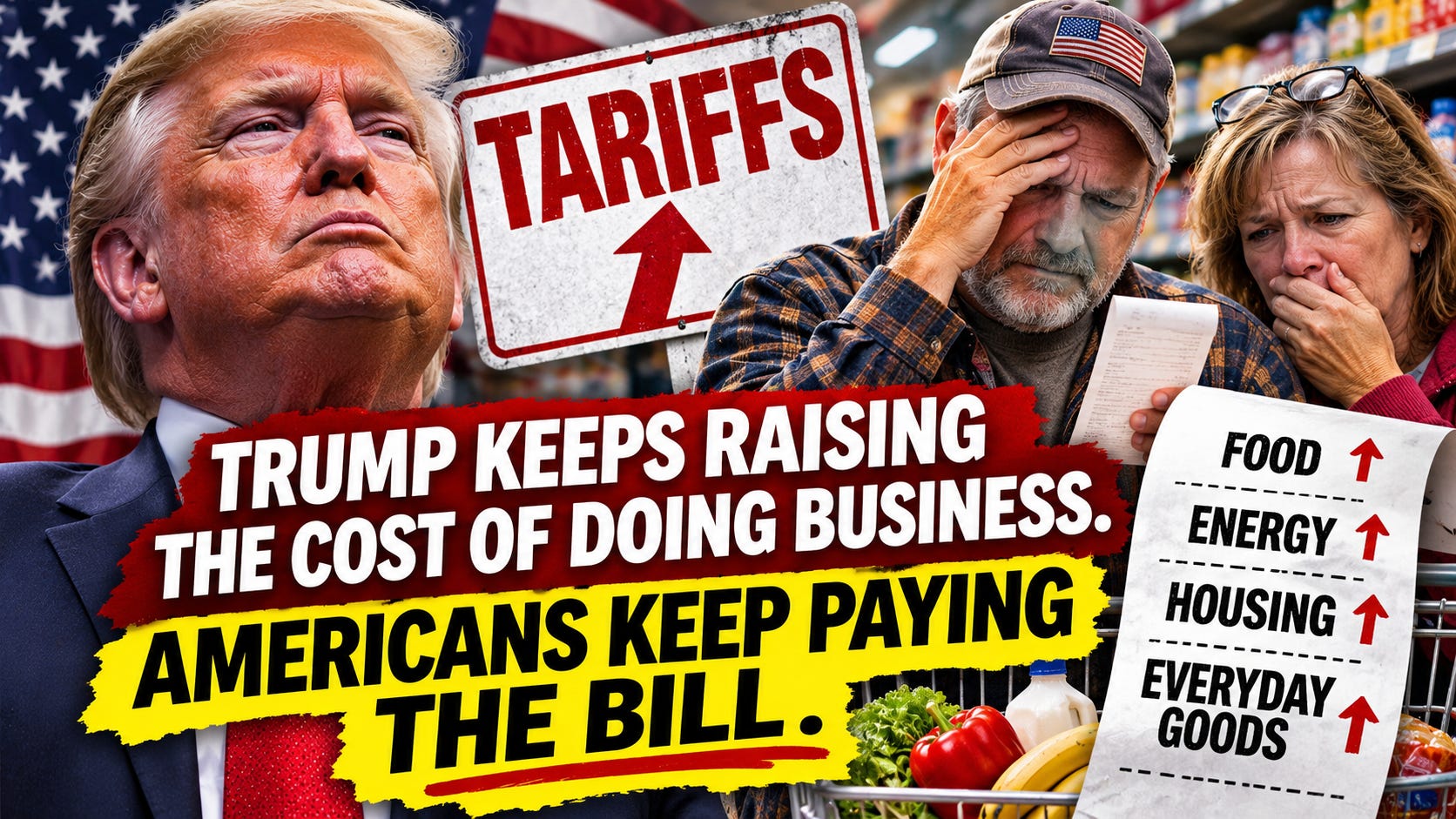
There’s something about Donald Trump’s tariff strategy that has bothered me from the beginning.
He talks about tariffs as though they’re a bill he sends to foreign governments.
Canada gets a bill. China gets a bill. Mexico gets a bill.
And somehow the United States gets richer.
Wonderful arrangement.
Except that’s not how tariffs work.
The American company importing the goods pays the tariff to the American government.
What happens next depends on the business. It might absorb some of the cost, negotiate a lower price from its supplier, or charge its customers more.
Often, it’s a combination.
And when that imported product is something an American manufacturer needs to make another product, the cost can spread through the economy.
This isn’t a complicated political theory.
It’s how businesses operate.
And now we have more evidence of what happens when a government decides to make imported goods more expensive.
The numbers aren’t cooperating
On November 10, the U.S. Bureau of Labor Statistics released its October inflation report.
Consumer prices rose 0.4% in October, following a 0.6% increase in September.
Food prices increased 0.5%.
Shelter costs rose 0.3%.
Energy prices climbed another 0.7%, following a much larger September increase.
Those numbers don’t mean America’s annual inflation rate is 4.8%, as some online commentators have suggested.
Multiplying one month’s inflation by twelve doesn’t tell you what happened over the previous year.
And the government couldn’t publish normal twelve-month comparisons for many categories because it lacked some of the necessary October 2025 data.
But here’s what we do know.
Americans are still dealing with rising prices.
And the administration’s trade policies are adding costs to an economy that doesn’t need more of them.
This is where it gets interesting
In September, researchers at the Federal Reserve Bank of New York published a study examining how the 2025 tariffs affected consumer prices.
They found that approximately 26% of the tariff increases passed through to consumer prices, measured relative to less-exposed goods.
But the really interesting part was how that happened.
Some price increases came directly from imported products becoming more expensive.
Others came indirectly.
American manufacturers paid more for imported materials.
And American producers facing less competition from imports had room to raise their own prices.
In other words, tariffs can make American-made products more expensive too.
That’s the part Trump rarely explains when he’s promising that tariffs will bring prosperity.
An American factory doesn’t become more competitive simply because the government makes the steel, aluminum, components or equipment it buys more expensive.
Sometimes the factory becomes less competitive.
And that can affect investment, production and employment.
The New York Fed researchers also found that some indirect price effects take nine to twelve months to work their way through supply chains.
Think about that.
A tariff imposed today can still be working its way toward the consumer long after the political announcement has disappeared from the headlines.
January is coming
The next date worth watching is January 1, 2027.
The United States has scheduled additional tariff increases on certain imported products.
The tariff on specified upholstered furniture is set to rise from 25% to 30%.
The tariff on certain kitchen cabinets and vanities is scheduled to rise from 25% to 50%.
Those are published U.S. measures, confirmed in Canadian government trade guidance.
Other Canadian industries are already facing substantial tariffs, including steel, aluminum and automotive products.
But we should be careful with the numbers.
Claims that all Canadian automobiles and parts will automatically face a new 50% tariff on January 1 aren’t supported by the current official tariff schedule.
And much of Canada’s trade with the United States still qualifies for tariff-free treatment.
The Bank of Canada estimated in October that approximately 80% of Canadian goods exports to the United States remained tariff-free.
That doesn’t make the tariffs harmless.
It makes the situation more complicated than the political shouting suggests.
The real damage is concentrated in affected industries, with uncertainty spreading well beyond them.
And for businesses trying to decide whether to invest millions of dollars in a new plant, uncertainty is expensive all by itself.
Canada is doing something sensible
Here’s a development that didn’t receive nearly as much attention as another Trump tariff threat.
On November 9, Canada’s federal government extended certain tariff-relief measures on American imports until June 30, 2028.
Now, some people might wonder why Canada would ease tariffs while Washington keeps imposing them.
Because we’re trying to protect Canadian businesses.
That’s why.
The relief covers eligible imports used in manufacturing, agriculture and other essential activities, particularly where suitable alternatives aren’t readily available.
Ottawa is also removing relief from some products where domestic Canadian production exists.
In plain English, the government is trying to avoid making Canadian businesses pay unnecessary costs while encouraging them to buy Canadian where practical.
That strikes me as considerably more intelligent than imposing tariffs simply because you enjoy announcing them.
A tariff can be useful in certain circumstances.
It can protect a strategically important industry, respond to unfair trading practices or create negotiating leverage.
But tariffs aren’t free.
Somebody pays.
And governments should have a pretty good reason before making their own businesses and consumers carry that cost.
There’s another lesson here for Canada
For decades, the United States was our obvious first customer.
It was close. It was enormous. We had integrated supply chains, common business practices and trade agreements designed to make commerce easier.
Canadian and American companies built factories around that relationship.
Then Washington began treating economic integration as something Canada should be punished for.
And suddenly, the obvious first customer became a source of serious uncertainty.
That’s why Carney’s efforts to develop other markets matter.
Not because China, Europe or Asia can instantly replace American buyers.
They can’t.
Not because Canada’s economy is somehow immune to American decisions.
It isn’t.
But because a Canadian business with five potential customers is in a stronger position than one with a single customer who keeps threatening to change the price of admission.
And every additional market gives Canada more room to make decisions based on Canadian interests.
The goal isn’t to stop trading with America.
That would be foolish.
The goal is to stop being so dependent on America that every threat from Washington becomes a national emergency.
Washington has a problem of its own
Trump can announce another tariff.
He can threaten another industry.
He can insist that foreign countries are paying for his economic strategy.
But American importers still have to pay the duties.
American manufacturers still have to calculate their costs.
American consumers still have to decide whether they can afford the resulting prices.
And American politicians still have to answer to those consumers.
That doesn’t mean the next tariff increase will automatically force Trump to retreat.
Politics rarely works that neatly.
It does mean there are limits to how much economic pain any administration can impose without consequences.
Canada should understand those limits.
And use the time available to strengthen its own position.
Because the best negotiating strategy isn’t to hope the other fellow eventually becomes reasonable.
It’s to make sure you have options when he doesn’t.
The Recap…
October’s U.S. inflation report showed another month of rising consumer prices.
Federal Reserve research confirms that tariffs increase costs for American consumers and can also push up prices for American-made goods.
Additional tariff increases on certain products are scheduled for January.
Meanwhile, Canada is extending targeted tariff relief to protect its own businesses and continuing to develop alternative markets.
The Gut-Punch…
Trump keeps treating tariffs like a tax on foreign countries.
American businesses keep receiving the bill.
And Canada is learning that the best response to an unreliable customer isn’t endless arguing.
It’s finding more customers.
Source credit
U.S. Bureau of Labor Statistics… Consumer Price Index, October 2026, released November 10.
Federal Reserve Bank of New York… The Anatomy of Tariff Pass-Through into Consumer Prices, revised September 2026.
Federal Reserve Bank of St. Louis… Tariff Effects on Inflation Stabilize in Recent Months, August 18, 2026.
Bank of Canada… Monetary Policy Report: Tariff and Other Assumptions, October 28, 2026.
Department of Finance Canada… Canada Modifies Tariff Relief Measures to Better Support Workers and Businesses, November 2026.
Government of Canada Trade Commissioner Service… Answers to Common Questions About U.S. Tariffs.
If you enjoy thoughtful conversations, Canadian stories, and the occasional smart-ass observation about the world we’re living in, you’re in the right place.
Subscribe free and get new stories, insights, and observations delivered directly to your inbox.
No paywall.
No spam.
No nonsense.
Leave anytime with a single click.
I promise not to take it personally.
Trade is a two way street. Hopefully Canada will not kneel to the US. It would benefit both countries to have a fair deal but sovereignty is not on the agenda.
So much for MAGA… thankfully Carney has an excellent grasp of economics.