

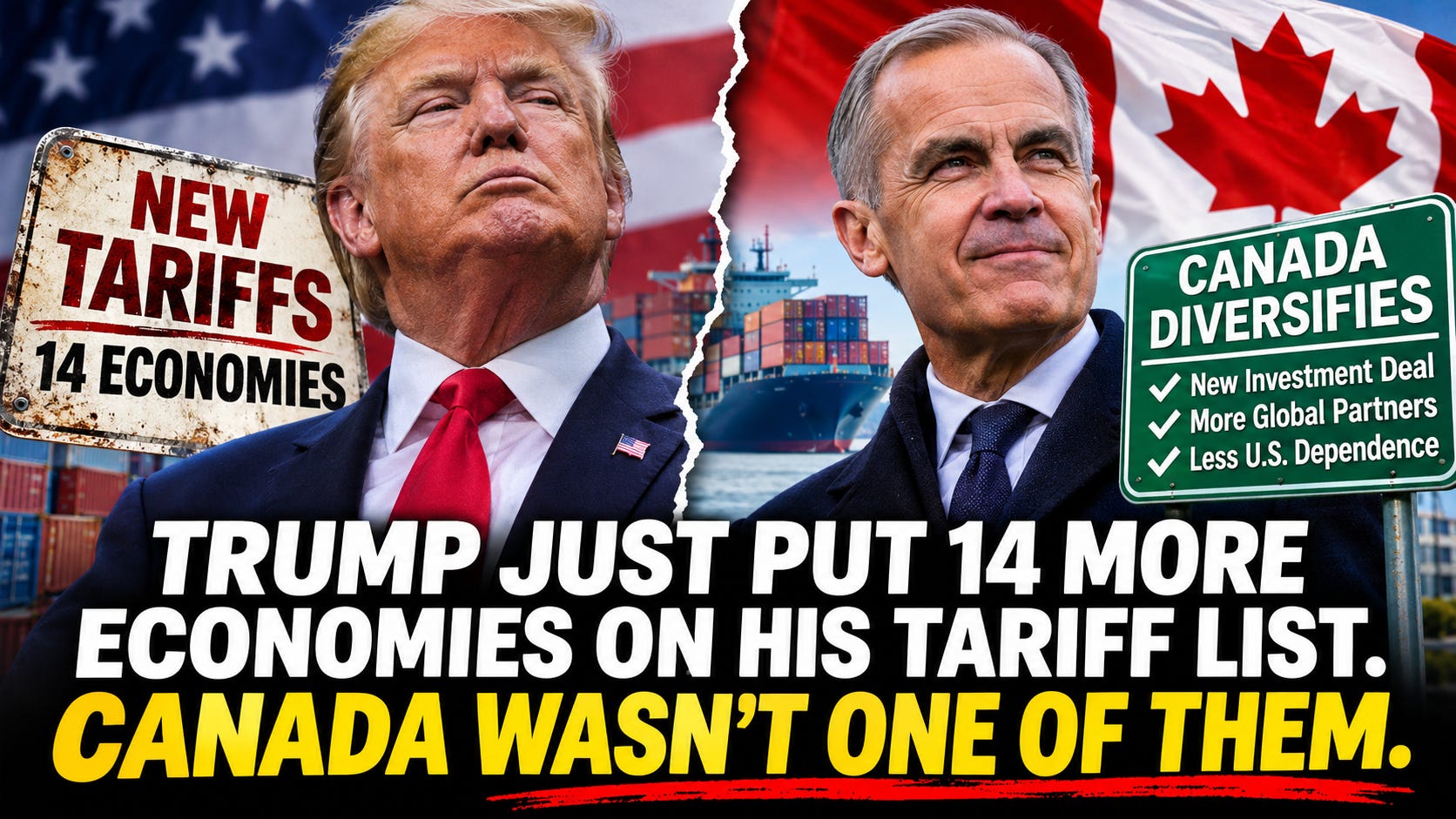
Here’s something I found interesting about Washington’s latest tariff announcement.
I went looking for Canada on the list.
We weren’t there.
On November 25, the Trump administration announced proposed tariffs targeting 14 economies, including some of America’s closest allies and largest trading partners.
Canada wasn’t one of them.
Before anybody breaks out the champagne, that doesn’t mean our tariff problems have gone away. It means this particular fight is with somebody else.
And there are plenty of somebody elses.
The European Union. China. Japan. South Korea. India. Vietnam. Switzerland. Taiwan. Bangladesh. Cambodia. Indonesia. Malaysia. Singapore. Thailand.
Apparently, Washington hasn’t run out of people to pick fights with.
A new reason to impose tariffs
This time, the justification is something Washington calls structural excess manufacturing capacity.
The United States Trade Representative spent eight months investigating foreign manufacturing practices and concluded that government subsidies, industrial policies and other practices were hurting American industry.
There are legitimate concerns about government-subsidized overproduction. Canada has concerns about that, too.
But Washington’s preferred solution is, once again, tariffs.
Some of the proposed rates:
Vietnam… up to 35%
India… up to 25%
China… up to 20%
European Union… 15%
Japan… up to 15%
South Korea… up to 15%
Existing duties, exemptions and trade agreements complicate what American importers would ultimately pay.
These aren’t finalized tariffs. There is a consultation process and a hearing scheduled for January 25.
But the direction of American trade policy certainly hasn’t changed following the midterm elections.
Meanwhile, at the American checkout counter
On the very same day Washington announced these proposals, Americans received another piece of economic news.
Inflation, measured by the Personal Consumption Expenditures Price Index, had reached 3.8% in October, up from 3.6% in September.
Core inflation reached 3.3%.
Those are American government figures reported by Reuters.
Now, I’m not suggesting tariffs are responsible for every penny of American inflation. The economy is considerably more complicated than that.
But adding import taxes while Americans are already struggling with rising prices strikes me as an odd way to address affordability.
I’ve been banging this drum for months.
The American importer pays the tariff.
What happens after that depends on how much the foreign supplier absorbs, how much the importer absorbs and how much ends up in the price Americans pay.
The money doesn’t magically arrive at the U.S. Treasury from a foreign government’s bank account.
Someone in that supply chain has to cough it up.
And American shoppers are often among those someones.
Twenty-four hours earlier in Ottawa
While Washington was preparing its latest tariff announcement, Canada’s Foreign Affairs Minister, Anita Anand, was signing an agreement with Qatar.
The Canada-Qatar Foreign Investment Promotion and Protection Agreement is intended to encourage investment in both countries and provide Canadian businesses with greater certainty when investing in Qatar.
A few numbers worth knowing.
Canada and Qatar traded $355.2 million in merchandise in 2025.
Qatari direct investment in Canada stood at $339 million.
Qatar has an economy worth approximately $300 billion and one of the world’s largest sovereign wealth funds.
This agreement didn’t materialize overnight. It follows negotiations that began in January and Mark Carney’s visit to Qatar, the first by a sitting Canadian prime minister.
Does signing an investment agreement guarantee billions of dollars will suddenly arrive in Canada?
Of course not.
But it creates opportunities that weren’t there before.
And dealing with Qatar doesn’t mean overlooking its troubling human rights record, either. Diversifying our economic relationships shouldn’t mean abandoning our values.
Canada doesn’t have to wait for America
Something has bothered me about the suggestion that Canada should simply wait for American politics to improve.
Wait for the midterms.
Wait for the new Congress.
Wait for the next presidential election.
Wait for Americans to come to their senses.
That’s an awful lot of waiting for a country that has its own government, natural resources, businesses, workers and access to international markets.
The latest American tariff announcement is another reminder that we cannot schedule Canada’s economic future around American elections.
We should continue negotiating with Washington. Geography and economics make that necessary.
But every new customer, every new investment partner and every new export market gives Canada a little more room to manoeuvre.
That’s what I want to see.
Not Canada abandoning America, but Canada gradually reducing America’s ability to dictate our economic future.
Washington just gave 14 more economies a reason to think about their dependence on the United States.
We’ve already been thinking about ours.
And thankfully, we’re doing something about it.
Elbows Up.
The Recap…
Washington just proposed tariffs on 14 economies. Canada wasn’t on the list.
American inflation has climbed to 3.8%, and another round of import taxes is being prepared.
Meanwhile, Canada has signed a new investment agreement with Qatar.
Two neighbours. Two very different approaches to doing business.
The Gut-Punch…
Canada doesn’t need America to change its direction. Canada needs to keep changing its own.
Source credit
Independent research and verification:
United States Trade Representative… November 25 tariff proposals
Reuters… Trump unveils new tariffs over excess industrial capacity, undeterred by midterms defeat
Global Affairs Canada… Canada-Qatar investment agreement, November 24
Canadian Press… Canada and Qatar sign agreement to boost investment
If you enjoy thoughtful conversations, Canadian stories, and the occasional smart-ass observation about the world we’re living in, you’re in the right place.
Subscribe free and get new stories, insights, and observations delivered directly to your inbox.
No paywall.
No spam.
No nonsense.
Leave anytime with a single click.
I promise not to take it personally.
I see every new trade agreement as another anchor for our countries sovereignty. I try to imagine the hours put into world trade agreements by PMCarney and his team, and in such a short time! I have read about some 50 % tariffs for Jan- but perhaps it was said on a Tuesday..