

I don’t care whether you love Bitcoin, hate Bitcoin, own Bitcoin, or still think crypto is something your grandson does in the basement.
That isn’t the story.
The story is much simpler.
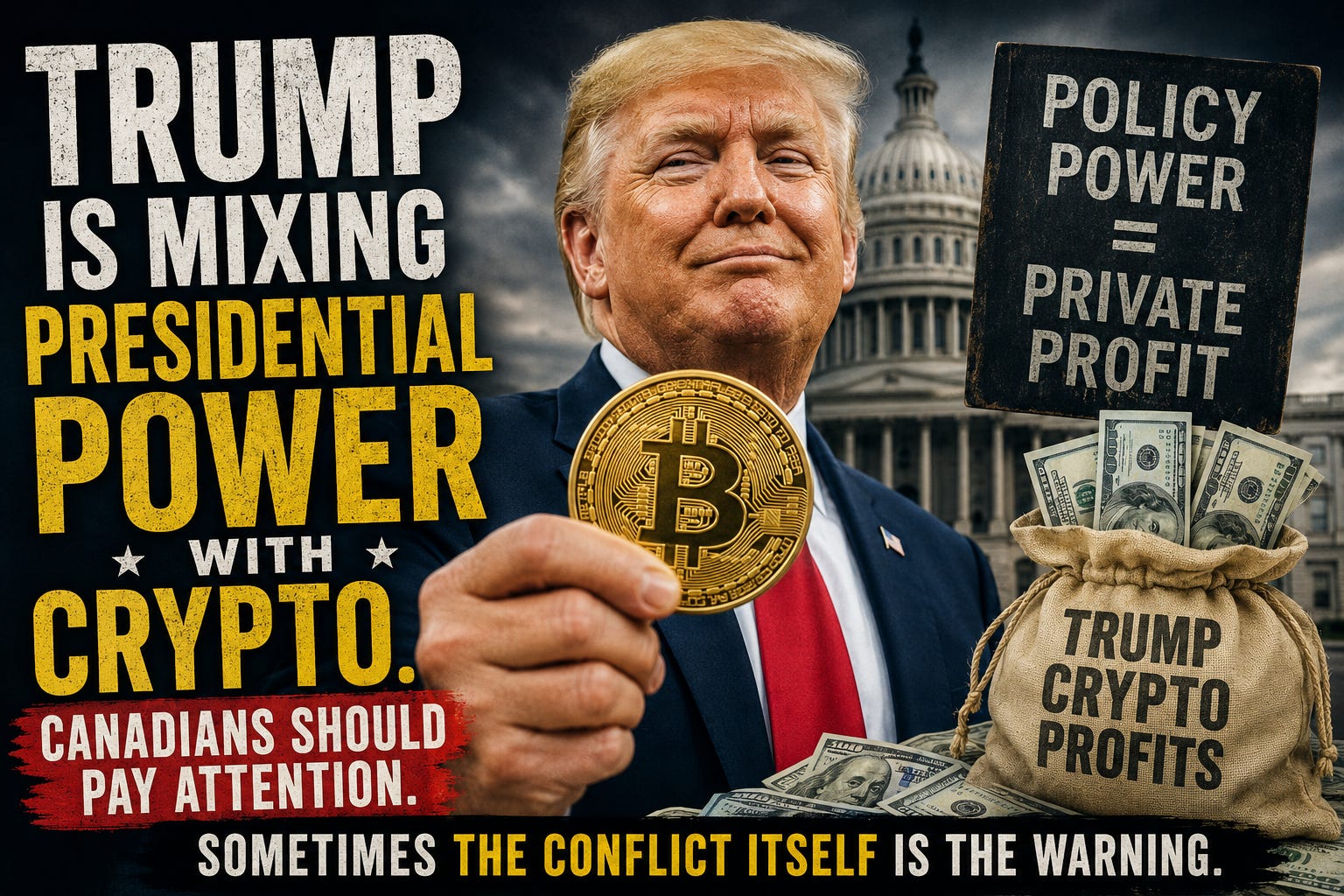
The President of the United States is using the power of the American presidency to promote an industry from which he and his family have made an extraordinary amount of money.
And somehow we’ve reached the point where that sentence needs explaining.
Donald Trump reported receiving more than US$1.4 billion in 2025 from his family’s cryptocurrency ventures, including World Liberty Financial and the Trump meme coin, according to financial disclosures reviewed by Reuters.
Now Trump is also using the presidency to push policies favourable to cryptocurrency.
That doesn’t automatically prove anything illegal.
But holy hell, it ought to make people pay attention.
This Isn’t Some Little Side Investment
We’re not talking about Trump owning a few shares of Coinbase in his retirement account.
The Trump family helped create World Liberty Financial, a cryptocurrency business.
Trump and Melania launched meme coins.
And the money involved isn’t pocket change.
Reuters reported that Trump received more than US$1.4 billion from family crypto ventures in 2025 alone.
Then in August, the U.S. Office of the Comptroller of the Currency granted conditional approval for a national trust bank charter to World Liberty Financial.
That allows a Trump-family-affiliated cryptocurrency company to expand its stablecoin business under federal banking oversight. Reuters reported World Liberty’s USD1 stablecoin had reached about US$4 billion in market capitalization, while the operation had already produced significant earnings for the Trump family.
Think about that for a second.
The president’s family owns a major interest in an industry.
The federal government regulates that industry.
And the president appoints many of the people running the federal government.
You don’t need a PhD in ethics to understand why somebody might raise an eyebrow.
Then Trump Started Changing Government Crypto Policy
In March 2025, Trump signed an executive order establishing a Strategic Bitcoin Reserve and a separate U.S. Digital Asset Stockpile.
Initially, the Bitcoin reserve was to be stocked primarily with Bitcoin already owned by the federal government through criminal and civil forfeitures.
But the order went further.
It instructed the Treasury and Commerce departments to develop strategies for acquiring additional Bitcoin, provided those purchases were budget-neutral and imposed no additional cost on taxpayers.
That’s important.
Because the United States wasn’t simply saying:
“People should be free to buy Bitcoin.”
The American government was formally recognizing Bitcoin as a strategic reserve asset.
That’s an entirely different animal.
And markets notice things like that.
Then Came the Legislation
On August 19, Trump appeared at the White House surrounded by executives from major cryptocurrency companies and urged Congress to pass the industry’s preferred crypto legislation.
The Washington Post reported that the proposed Clarity Act would create a federal regulatory framework for digital assets… something the crypto industry has been lobbying heavily to obtain.
And here’s the uncomfortable bit.
Trump’s own businesses could benefit from broader acceptance and adoption of cryptocurrency.
The Post reported his 2025 crypto-related income at more than US$1.4 billion.
That’s where this stops being an argument about whether Bitcoin is good or bad.
Suppose the Canadian prime minister owned a large private company selling electric cars.
Then imagine Ottawa changed regulations to encourage electric-car adoption.
Then the prime minister held a meeting in his office surrounded by electric-car executives demanding Parliament pass legislation favourable to the industry.
Would Canadians shrug and say…
“Nothing to see here?”
Not bloody likely.
We’d be climbing the walls.
And Trump Can Move Markets Simply By Talking
Here’s another reason this matters.
Presidents move markets.
Especially this president.
Bitcoin jumped more than 13% in five days recently after Trump called for clearer digital-asset regulations.
By August 25, Bitcoin had climbed above US$80,000, with Reuters reporting it had gained about 16% following Trump’s call for clearer crypto regulation and roughly 28% during August.
Other financial forces were involved… including movements in the U.S. dollar and Treasury markets… so Trump certainly wasn’t the only reason Bitcoin moved.
But that’s precisely why conflicts of interest matter.
A president doesn’t need to secretly push a button marked…
MAKE MY INVESTMENTS GO UP.
Presidential announcements influence expectations.
Expectations influence markets.
Markets influence fortunes.
And this particular president has financial interests connected to the market he’s talking about.
That’s the issue.
Here’s Something Even More Interesting
Trump made enormous money from crypto.
But Reuters found that his investment managers moved much of the resulting wealth into something decidedly less revolutionary:
ordinary stocks and bonds.
Trump’s holdings in traditional financial investments increased from an estimated range of US$225 million to US$608 million at the end of 2024 to between US$703 million and US$2.6 billion by the end of 2025.
There’s a certain beauty to that.
Sell the future.
Bank the proceeds in the old-fashioned stuff.
I’ll leave you to decide what that means.
Americans Aren’t Missing This Either
This isn’t merely Democrats complaining about Trump.
A Reuters/Ipsos poll conducted August 14–17 found that 63% of Americans believed Trump and his family had inappropriately profited from cryptocurrency ventures since he returned to office.
More surprising?
About half of Republicans surveyed said they believed Trump’s policy decisions were influenced by his private business interests.
When half the people on your own political team think your personal financial interests may be influencing government policy, perhaps “witch hunt” isn’t quite the complete explanation.
Now Let’s Be Fair About Something
The original argument that sent me down this rabbit hole claimed rising cryptocurrency values themselves create trillions of dollars of new money and therefore directly cause consumer inflation.
I don’t buy that argument.
Market capitalization isn’t the same thing as money supply.
If Bitcoin rises enough that its total market value increases by $500 billion, the Federal Reserve didn’t suddenly print another $500 billion and hand it to Bitcoin owners.
Asset prices can certainly affect spending, borrowing, risk-taking and wealth inequality.
Crypto bubbles can create winners and losers.
They can create financial instability.
But claiming every trillion dollars added to Bitcoin’s market capitalization translates directly into an equivalent increase in money circulating through the economy is simply too neat.
Economics rarely gives us anything that convenient.
So I’m not going to sell you that story.
There’s a much bigger one sitting right in front of us.
The Bigger Story Is Power
Presidents are enormously powerful.
They appoint regulators.
They sign executive orders.
They influence legislation.
They control enormous federal agencies.
Their words move currencies, stocks, commodities and increasingly cryptocurrency markets.
That’s why modern democracies developed conflict-of-interest rules in the first place.
You don’t wait until somebody proves there was a brown envelope under the restaurant table.
You try to prevent situations where public decisions and private financial interests become tangled together.
Because once those two things become indistinguishable, public trust disappears.
And rebuilding trust is a hell of a lot harder than losing it.
Why Should Canadians Care?
Because we’re watching something larger than a cryptocurrency story.
We’re watching America experiment with something Canadians should understand very clearly:
What happens when political power and private business interests become increasingly difficult to separate?
Trump isn’t merely a president who happens to be wealthy.
He’s a president whose family businesses operate in sectors directly affected by decisions made by his administration.
Crypto is simply the clearest example.
And Canada happens to live next door to this experiment.
We’re tied into American banking.
American financial markets.
American trade.
American investment.
American currency movements.
American regulation.
When Washington sneezes, Canadian markets still reach for the Kleenex.
Which is one more reason Canada needs strong institutions, independent regulators and enough economic independence that every political experiment south of the border doesn’t automatically become our problem too.
Bitcoin may rise.
Bitcoin may crash.
Maybe twenty years from now we’ll all use it to buy groceries.
Maybe somebody will be trying to explain to their grandchildren why Grandpa once paid $120,000 for an electronic coin nobody could actually hold.
I have no idea.
But I know one thing.
A president shouldn’t have to be convicted of corruption before citizens are permitted to worry about a conflict of interest.
Sometimes the conflict itself is the warning.
The Recap…
Trump reported more than US$1.4 billion in crypto-related income in 2025.
His administration created a Strategic Bitcoin Reserve.
He’s pushing crypto-friendly legislation.
His family’s crypto company just received conditional approval for a federal trust-bank charter.
You don’t have to hate Bitcoin to wonder whether the President of the United States should be standing on both sides of that transaction.
The Gut-Punch…
The question isn’t whether Trump can make money from crypto.
The question is whether Americans can still tell where Donald Trump’s business interests end and the United States government’s interests begin.
And when even half of Republicans surveyed think his private interests may be influencing policy, that’s not a partisan question anymore.
Source Credit:
Research inspiration: “EXPOSED: How USA Corruption Destroys Everything.”
The original transcript was used as research notes only. Its claims were independently checked and the article was rewritten from scratch. The transcript’s claim that cryptocurrency market capitalization directly translates into equivalent money-supply growth and consumer inflation was not used, because the evidence provided does not establish that relationship.
Reporting and verification: Reuters, Reuters/Ipsos, The Washington Post, and the White House executive order establishing the Strategic Bitcoin Reserve.
If you enjoy thoughtful conversations, Canadian stories, and the occasional smart-ass observation about the world we’re living in, you’re in the right place.
Subscribe free and get new stories, insights, and observations delivered directly to your inbox.
No paywall.
No spam.
No nonsense.
Leave anytime with a single click.
I promise not to take it personally.
That is an interesting article. Thank you Fred. I don’t know much about crypto and I don’t think I trust it.
🇨🇦💙 Keep calm and Carney on. While Governor of the Bank of Canada, Carney faced intense pressure not only from U.S. authorities (including the Federal Reserve and the Treasury Dept. under President George W. Bush) but also from Canadian financial institutions, global rating agencies and domestic political/business leaders to relax Canada’s strict mortgage‑securitization rules and allow more U.S.-style asset‑backed securities into the Canadian system.
Carney absolutely refused - decisions later credited with helping Canada avoid the worst of the crisis while Iceland almost went bankrupt.
Today? Canada is insulated from a U.S. cryptocurrency crash because crypto is not legal tender in Canada, federal and provincial regulators treat it as a high‑risk speculative asset, and the core banking system is tightly supervised with strict capital and liquidity rules. Carney moved to tighten oversight with the 2026 Stablecoin Act (Bill C‑15)
Canadian investors can still invest in crypto but it’s their loss. Darwinism.