

Mark Carney can’t afford to confuse a political promise with a trade agreement.
Well, here’s an interesting development.
The American voters have just handed Donald Trump a political black eye.
Democrats won control of both the House of Representatives and the Senate in the November 3 midterm elections.
And before the election dust had even settled, one senior Democrat was talking about getting rid of Trump’s tariffs on Canada.
That’s welcome news.
But before we Canadians start celebrating, there’s a rather large elephant still sitting in the White House.
And he’s not leaving until January 2029.
The Democrats Have a Plan
Jamie Raskin, a Democratic congressman from Maryland, spoke with CBC News on November 4.
He’s currently the ranking Democrat on the House Judiciary Committee and is expected to become its chair when the new Congress takes office.
Raskin made it clear that Trump’s tariffs on Canada are on the Democrats’ agenda.
He wants Congress to move quickly, potentially within its first 100 days.
And he raised an important constitutional point.
Congress has the power to regulate international commerce and impose tariffs.
Trump has been exercising tariff powers through laws that delegate authority to the president.
The Democrats want to challenge that arrangement and restore some congressional control.
For Canada, that’s encouraging.
After nearly two years of threats, tariffs, insults and talk about becoming America’s 51st state, it’s refreshing to hear an American politician talking about restoring normal relations.
But talking and delivering are two different things.
Especially in Washington.
Trump Still Has a Veto
Here’s the problem.
Winning control of Congress doesn’t mean the Democrats can simply cancel Trump’s tariffs.
They can introduce legislation.
They can hold hearings.
They can investigate the economic damage.
They can force Republicans to publicly defend tariffs that are raising costs for American businesses and consumers.
But Trump can veto legislation that reaches his desk.
Overriding that veto requires a two-thirds majority in both the House and Senate.
That means Democrats would need significant Republican support.
Could they get it?
Possibly.
Republican politicians in states with close economic ties to Canada have watched the trade war hurt businesses and complicate their own political futures.
The midterm results give those Republicans something to think about.
But there’s a difference between worrying about tariffs and voting to defy Donald Trump.
We’ve seen that movie before.
The ending isn’t always encouraging.
January 1 Comes Before January 3
Now we get to the timing.
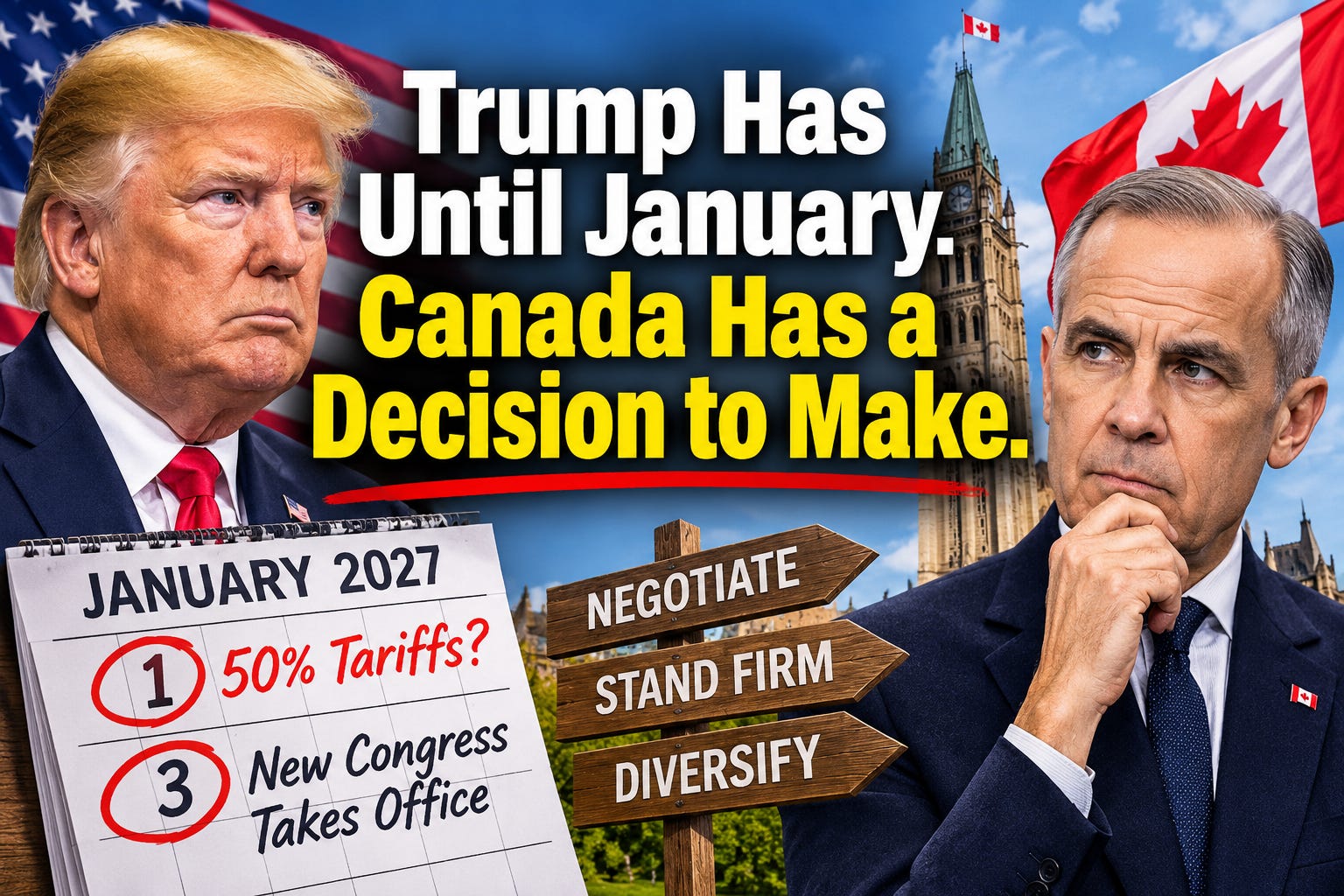
On August 24, Trump threatened to raise tariffs on Canadian cars, trucks and automotive parts to 50%, effective January 1, 2027.
He also included steel in the threatened increases, although Canadian steel already faces substantial tariffs.
The newly elected Congress doesn’t take office until January 3.
Two days later.
That’s quite a coincidence.
Was the timing deliberately chosen to put pressure on Canada before the Democrats take control?
We don’t know.
And I’m not going to pretend we do.
But the practical consequence is obvious.
Canada faces a major tariff threat before the politicians promising to challenge those tariffs even take their seats.
And once they do, legislation won’t happen overnight.
There will be committees, negotiations, votes and potentially a presidential veto.
Meanwhile, Canadian businesses need to make decisions about jobs, investment, production and their customers.
They can’t pay workers with promises from Congress.
Carney Hasn’t Stopped Negotiating
This is where Mark Carney’s position becomes interesting.
Trump has been talking about a possible trade agreement with Canada.
Carney has acknowledged progress in negotiations but hasn’t announced a completed deal.
And after the midterm elections, he welcomed the possibility of restoring freer trade while making clear that Canada would continue working toward an agreement.
That’s the sensible position.
Because Canada now has two developments happening at once.
The Trump administration is still negotiating.
And the incoming Democratic Congress is promising to challenge the tariffs.
Neither development guarantees success.
But both could influence the bargaining table.
The important thing is not to mistake a change in Washington’s political landscape for a completed victory.
The Keystone XL Question
There’s another wrinkle.
Trump has been talking about reviving Keystone XL as part of a broader trade arrangement.
We discussed that in my earlier article.
A pipeline might offer economic benefits, depending on the project, the financing, the approvals and the terms.
But there’s a difference between considering a commercially viable pipeline and giving Washington control over Canadian energy decisions.
Canada should evaluate any project on its merits.
Not because Trump wants another announcement.
And certainly not because someone in Washington has put a deadline on the calendar.
If a trade agreement offers genuine tariff relief without sacrificing Canadian sovereignty, it’s worth examining.
But if the price includes surrendering control over our resources, our trading relationships or our domestic policies, that’s a different matter.
We’ve already learned what happens when Canada becomes too dependent on one customer.
We don’t need to repeat the lesson.
Waiting for Congress Is a Gamble Too
Some Canadians will understandably say we should simply wait.
Let the Democrats take over Congress.
Let them fight Trump.
Let the Americans sort out their own mess.
I understand that argument.
After everything we’ve heard from Washington, patience with this administration is understandably running thin.
But waiting carries risks.
There’s no guarantee Congress will produce legislation that removes the tariffs.
There’s no guarantee enough Republicans will support it.
And there’s certainly no guarantee Trump will cooperate.
Even if Congress eventually succeeds, Canadian manufacturers could face months of additional uncertainty.
That’s real money.
Real investment.
Real jobs.
Standing firm doesn’t require standing still.
Canada can continue negotiating while refusing unacceptable demands.
Those aren’t contradictory positions.
That’s what competent governments are supposed to do.
The Bigger Lesson From This Election
There’s another part of this story that deserves attention.
American voters have just demonstrated that Trump doesn’t control everything.
Elections still matter.
Congress still matters.
And politicians who support damaging economic policies can face consequences.
That’s encouraging.
But we shouldn’t confuse American political opposition to Trump with a permanent return to the relationship Canada once enjoyed.
A Democratic Congress might remove tariffs.
Another president might bring them back.
A future administration might find a different excuse to restrict Canadian exports.
That’s why Carney’s efforts to diversify Canada’s trade relationships remain important.
We need more customers.
More Canadian processing and manufacturing.
Better transportation connections between our own provinces.
And more opportunities to sell Canadian products to countries that actually want to buy them.
Not because we hate Americans.
Because depending too heavily on any single country is lousy business.
Especially when that country keeps changing the rules.
Canada Doesn’t Have to Choose Between Two Bad Options
Here’s how I see it.
Canada doesn’t have to make a bad deal with Trump just because January 1 is approaching.
And Canada doesn’t have to refuse every possible agreement while waiting for Democrats to rescue us.
Those aren’t our only choices.
Carney can negotiate.
He can insist on enforceable commitments.
He can reject demands that compromise Canadian sovereignty.
And he can continue building relationships beyond the United States.
If Washington offers a fair agreement, consider it.
If Washington offers another ultimatum dressed up as a deal, walk away.
And if Congress eventually removes the tariffs, welcome that too.
But don’t build Canada’s economic future around what American politicians might do next year.
We’ve spent enough time waiting for Washington to behave itself.
The Recap…
Democrats won both chambers of Congress and are promising to challenge Trump’s tariffs on Canada.
That’s encouraging, but it isn’t a guarantee.
Trump’s threatened 50% tariffs on Canadian vehicles and parts are scheduled for January 1, two days before the new Congress takes office.
Even with Democratic majorities, removing the tariffs could require Republican support to overcome a presidential veto.
Carney has a difficult job ahead.
He must keep negotiating without accepting a bad deal, while continuing to reduce Canada’s dependence on the American market.
That’s not weakness.
That’s protecting Canada’s options.
The Gut-Punch…
Canada should welcome American politicians who want to restore fair trade.
But we shouldn’t bet our economy on their ability to deliver.
A promise from Congress isn’t a trade agreement.
And a deadline from Trump isn’t a reason to surrender.
Tariffs are negotiable. Sovereignty isn’t.
Sources Credit:
Associated Press… November 2026 U.S. midterm election results and Democratic control of Congress.
CBC News… November 4, 2026, interview with Rep. Jamie Raskin about removing tariffs on Canada.
Reuters… August 24, 2026, Trump’s threatened 50% tariffs on Canadian vehicles and automotive parts.
The Canadian Press / CityNews… November 5, 2026, how the midterm election results could affect Canada.
Global News… November 6, 2026, Mark Carney’s response to the Democrats’ proposed tariff action.
iPolitics… November 4, 2026, Dominic LeBlanc on Canada’s negotiating approach following the midterms.
If you enjoy thoughtful conversations, Canadian stories, and the occasional smart-ass observation about the world we’re living in, you’re in the right place.
Subscribe free and get new stories, insights, and observations delivered directly to your inbox.
No paywall.
No spam.
No nonsense.
Leave anytime with a single click.
I promise not to take it personally.
No bending the knee, no kissing the ring, no surrender. We have come way too far to give it all, or part of what we have so far achieved, up. Only, and only if the deal benefits Canada, should we even consider signing.
What a pickle situation to be caught up in. Personally I wouldn’t trust trump more than I would trust being stuck in a three cubit foot room with a nest of rattle snakes. The reason I say this is because of the question you mentioned Fred. Why has trump picked January 1st to threaten 50% tariffs just before the new congress kicks in January 3rd? Man that sets off alarm bells in my head. Who is he playing with? His political opponents or our country which he covets? To me none of these questions can be answered until he shows more of what cards he’s playing with. Carney thankfully is a very smart guy and I believe that what you wrote about in your previous article about how important it is to read the fine print. I think Carney, if he takes his time, can work his way through this situation. I would also like to see some of the trade agreements made with other countries not fast tracked necessarily but cemented with some forward movement. These are just my thoughts.