

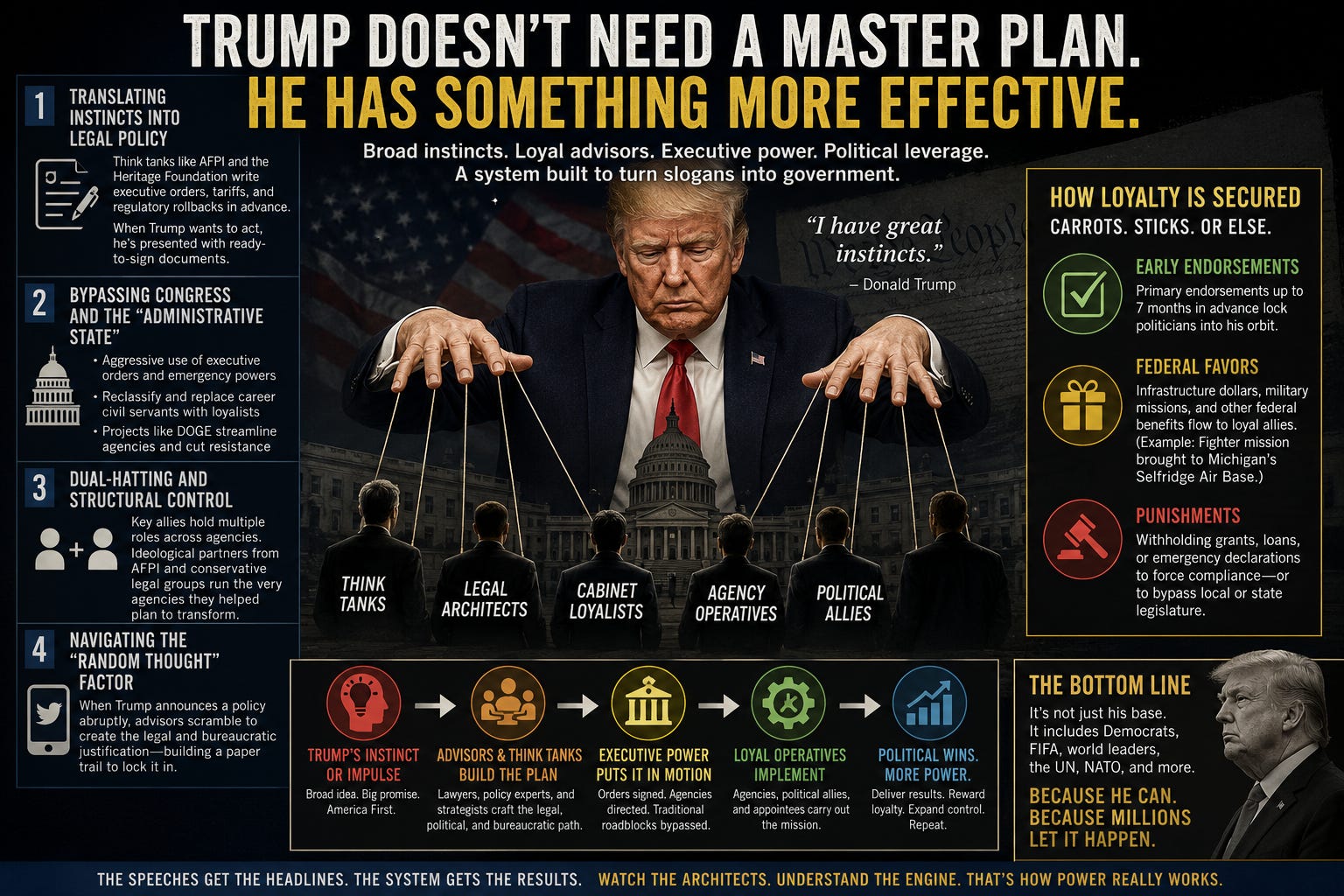
One of the biggest myths in politics is that every major government decision begins with the person sitting behind the Resolute Desk.
It rarely works that way.
Presidents set direction. Advisors build the machinery.
Donald Trump is no exception.
Throughout both of his administrations, Trump has shown that he prefers broad objectives over detailed policy design.
His public focus tends to be on simple themes…
America First
Tariffs
Border security
Reducing regulations
Cutting the size of government
Challenging international institutions
Expanding presidential authority
Turning those slogans into actual government policy requires an army of lawyers, policy specialists, think tanks, cabinet officials and political strategists.
That’s where the real work happens.
Think Tanks Don’t Run Government. They Build the Blueprint. Conservative organizations such as the Heritage Foundation…
and the America First Policy Institute spent years developing detailed policy proposals long before the 2024 election.
The best-known example is Project 2025, a lengthy policy blueprint prepared by Heritage Foundation contributors and other conservative organizations.
While Trump publicly distanced himself from parts of the project during the campaign, many of its themes overlap with policies his administration has pursued.
These organizations don’t govern.
They write plans.
When a president wants to move quickly, having years of legal work already completed becomes enormously valuable.
Instead of starting from scratch, officials can adapt existing executive orders, regulatory changes and legal arguments.
Executive Power Has Become the Preferred Tool
Modern presidents of both parties increasingly rely on executive authority when Congress is divided.
The Trump administration has taken that approach further by emphasizing executive orders, emergency authorities and aggressive interpretations of presidential power.
Areas where this has been most visible include…
immigration enforcement
tariffs and trade
federal workforce restructuring
regulatory rollbacks
Supporters argue this allows government to act quickly.
Critics argue it shifts too much power toward the White House.
Both can be true depending on the issue.
Reshaping the Federal Bureaucracy
One major goal has been changing how the federal civil service operates.
Plans developed by administration allies have proposed making it easier to remove certain career officials and replace them with political appointees who share the administration’s priorities.
Supporters believe this increases accountability.
Opponents argue it weakens the independence of the professional civil service.
That debate is likely to continue for years.
Loyalty Matters
Every administration appoints people it trusts.
The Trump administration has placed particular emphasis on selecting officials who strongly support the president’s agenda and are unlikely to resist it from within.
Several senior advisors and cabinet officials have long-standing relationships with conservative policy organizations that spent years preparing for another Trump presidency.
That alignment allows ideas developed outside government to move into government more quickly.
When Trump Changes Direction Overnight
One characteristic of Trump’s leadership style is its unpredictability.
Announcements have often appeared first on social media or during speeches before agencies received formal guidance.
That leaves staff scrambling.
Lawyers draft legal justifications.
Departments prepare implementation plans.
Officials work to convert a public statement into formal government policy.
It’s an unusual governing style, but one that became familiar during both Trump administrations.
Politics Still Runs on Rewards
Presidents have always used political influence to strengthen alliances.
Campaign endorsements.
Federal investment.
Military projects.
Infrastructure funding.
Every administration has political priorities.
Critics argue Trump uses these tools more openly and more transactionally than previous presidents.
Supporters see it as rewarding states and leaders who share his agenda.
Either way, political leverage remains part of how Washington operates.
This Isn’t About One Man
It’s tempting to believe one person controls everything.
Reality is more complicated.
Presidents rely on networks.
Think tanks.
Legal scholars.
Cabinet officials.
Political strategists.
Career staff.
Outside organizations.
The president provides direction.
The system turns that direction into government.
Whether someone supports or opposes Donald Trump, understanding that distinction matters.
The real question isn’t whether a president has ideas.
It’s who writes the instruction manual that turns those ideas into reality.
The Gut-Punch...
People often picture government as one person making every decision.
It almost never works that way.
The speeches grab the headlines.
The lawyers, policy writers, think tanks, and bureaucratic machinery write the rules that actually shape the country.
If you want to understand any presidency… not just Trump’s… watch the people building the engine, not just the person holding the steering wheel.
If you enjoy thoughtful conversations, Canadian stories, and the occasional smart-ass observation about the world we’re living in, you’re in the right place.
Subscribe free and get new stories, insights, and observations delivered directly to your inbox.
No paywall.
No spam.
No nonsense.
Leave anytime with a single click.
I promise not to take it personally.
. . . And so the big matter for Americans to ponder: Is it supposed to be about "loyalty to the Crown/Dictator" etc.? Or loyalty to something higher purpose (they used to say "The Constitution")? (and even in that case, what do they actually mean by that - is there a generally accepted meaning of the document, to the majority of Americans?)
Current actions suggest that there's at least two very mutually exclusive definitions about that Document and (more importantly) what it means to be "American."
And I think much of that existed 250 years ago, but the differences are only surfacing this strongly now.
So what would be interesting: If DJT suddenly said "I want ____" but that was something that much of his base didn't want, and/or was contradictory to the Constitution, would everyone just "do as they were told/ordered," or would they say "nah, I don't think so."
I echo Carol-Ann: "Not great thinkers there . . . ." as they dig themselves a whole deeper than ever - except with their "blinders on", I don't think they see it.
Not great thinkers there, or they wouldn't be in this mess.