

For months, many Canadians have treated the tariff battle as another political food fight.
Loud headlines. Tough talk. Then everyone calms down.
This week’s move suggests something different.
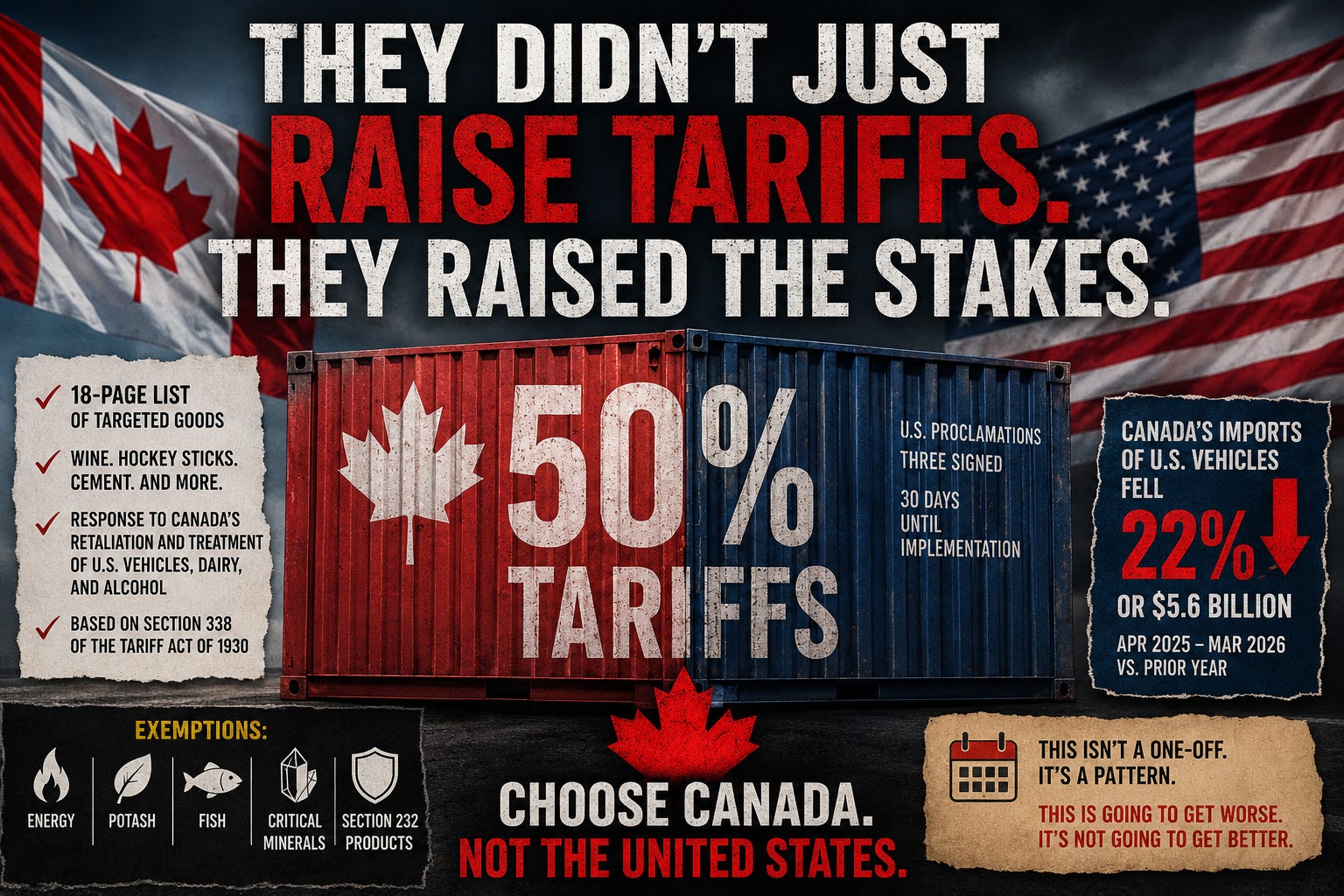
The United States has now signed three separate proclamations imposing 50% tariffs on a long list of Canadian exports.
The measures are scheduled to take effect in 30 days, and they don’t just target major industries. They reach into everyday products… from wine to hockey equipment to construction materials… across an 18-page list of affected goods.
That isn’t a symbolic gesture.
That’s a carefully aimed economic punch.
The official explanation is familiar enough. Washington says it’s responding to Canada’s actions on vehicles, dairy, alcohol, and other trade issues.
It also points to a reported 22% drop in Canadian imports of U.S. vehicles, equal to roughly $5.6 billion over the past year.
Whether you agree with that argument isn’t really the point.
The bigger question is this…
If North America already has a trade agreement, why keep reaching for new tariffs?
Canada and the United States are supposed to be operating under the USMCA. Yet new restrictions keep appearing anyway.
That changes the conversation.
Businesses don’t just worry about today’s tariff. They worry about tomorrow’s surprise.
Investment slows.
Expansion plans get shelved.
Companies begin asking whether North America is still a predictable place to build factories, hire workers, or sign long-term contracts.
That’s how uncertainty becomes an economic weapon.
One detail caught my attention.
Not everything is being hit.
Energy products, potash, fish, critical minerals, and products already covered under separate Section 232 measures were left off the list.
That tells me this wasn’t simply a broad punishment.
It looks more like selective pressure… protect the sectors Washington still needs while squeezing the ones that create maximum political and economic discomfort elsewhere.
That’s a very different strategy from across-the-board tariffs.
It says someone spent time deciding exactly where the pressure would hurt most.
And that should concern Canadians regardless of their politics.
The real lesson here isn’t about one proclamation.
It’s about dependence.
For decades Canada has relied heavily on one customer. That relationship delivered enormous benefits, but it also created enormous vulnerability.
When one customer can rewrite the rules whenever political winds change, your bargaining power shrinks.
That’s why diversification suddenly matters so much.
Selling more into Europe.
Expanding Asian markets.
Building stronger domestic supply chains.
Finding new investment partners.
Those ideas once sounded like nice extras.
Now they’re starting to look like economic insurance.
None of this means Canada should stop trading with the United States.
That would be impossible… and foolish.
The two economies are deeply intertwined and likely always will be.
But it does mean Canada needs more options than it has today.
Healthy partnerships work best when neither side feels trapped.
This dispute will eventually end.
Another one will follow.
The lesson isn’t that tariffs are permanent.
It’s that uncertainty has become permanent.
Canada can’t control every decision made in Washington.
It can control how exposed it chooses to remain.
That’s the part of this story that matters long after today’s headlines disappear.
The Recap…
Fifty-percent tariffs grab attention.
Dependence should grab even more.
Canada doesn’t need fewer friends. It needs fewer single points of failure.
That’s a lesson worth remembering long after this trade fight ends.
The Gut-Punch…
The biggest risk isn’t one tariff.
It’s discovering your largest customer also controls your biggest vulnerability.
Source credit:
Based on publicly reported U.S. tariff proclamations, trade data, and ongoing Canada–U.S. trade developments, synthesized from multiple news reports and official announcements.
If you enjoy thoughtful conversations, Canadian stories, and the occasional smart-ass observation about the world we’re living in, you’re in the right place.
Subscribe free and get new stories, insights, and observations delivered directly to your inbox.
No paywall.
No spam.
No nonsense.
Leave anytime with a single click.
I promise not to take it personally.
We re “deeply intertwined”. Sacred line. But what does that actually mean?I m sure for people versed in economics and business it s clear as day. For some Canadians, this being pushed against the wall is getting to a sticking point. For all the Prime Minister talks about maybe putting US booze back on the shelves if things go well with CUSMA, the decision to stop buying US is from us common folk, not the politicians who were flying after us to catch up.
And so what if we also drew a deeper line. Well a lot of us already are, but I bet the latest tariffs have persuaded many more to avoid more american goods. I cancelled netflix and amazon over. a year ago but what if more of us went there? Especially if we start getting great foreign films arriving here. Bring me Nordic Noir from the North!
And what is that inextricable stuff or services or jobs? What if that range keeps getting smaller and smaller? What do they boil down to? Maybe we could be fine on our own or at least choose the hurts we go through while recovering our independence.
This suggestion may seem simplistic but sometimes the most effective actions are the simplest ones. Canada should enact a, let's call it an "Export Tax", on all goods exported to countries imposing what are considered "unfair" tariff practices. Also, an environmental tax should be applied to all electrical exports in the same manner, to help in the fight against climate change and damage.