

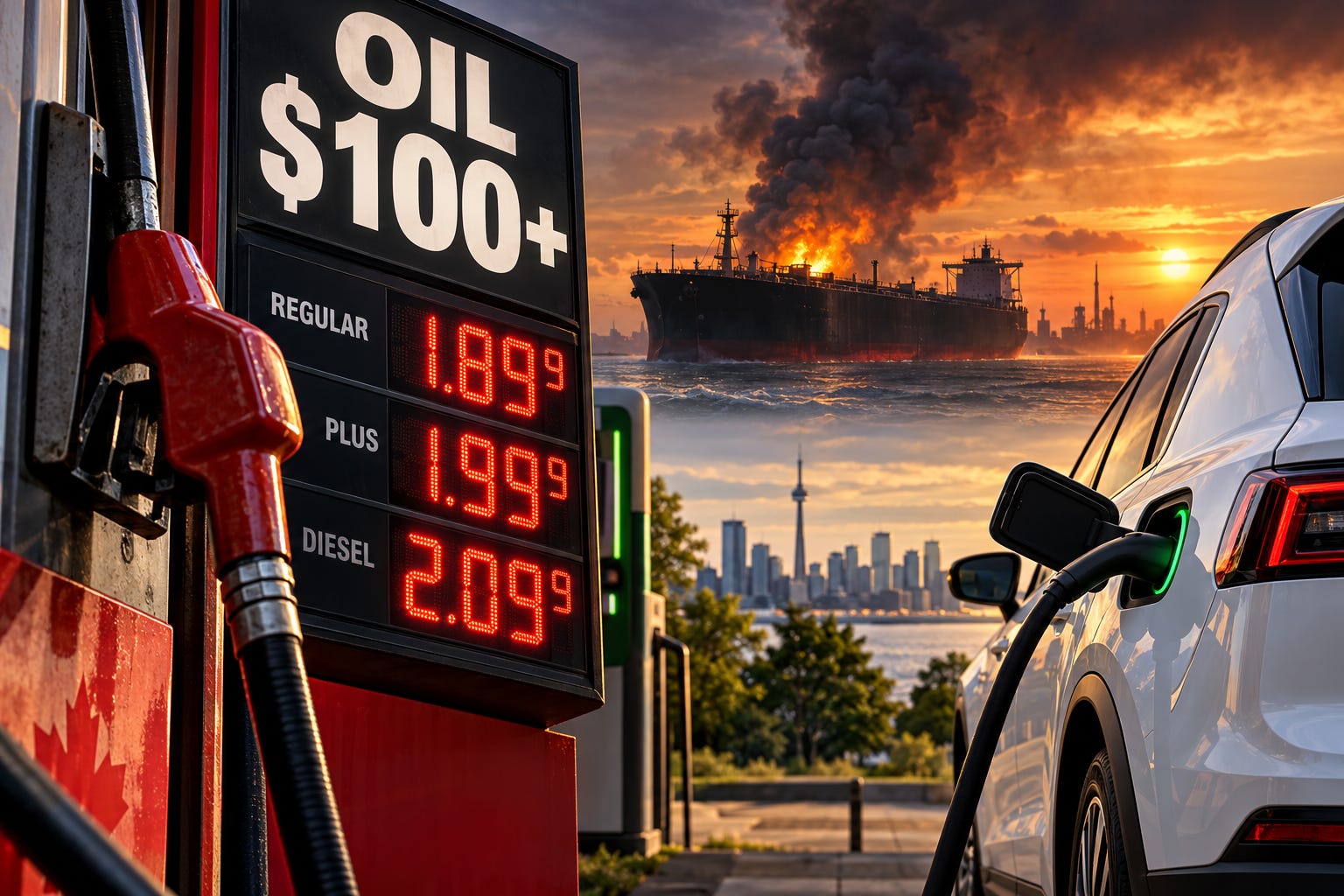
I came across a number that stopped me.
Not because it was enormous.
Because it explained something.
The International Energy Agency looked at what happens to the economics of electric vehicles when oil prices jump.
Their finding?
In most of the countries they studied, the operating-cost advantage of driving an EV instead of a gasoline vehicle increased by roughly 20% to 45% during the current oil-price shock.
In the United States, the estimated annual running-cost advantage for a home-charged EV jumped from about US$900 to US$1,300.
Nobody passed a law to make that happen.
Nobody introduced a carbon tax.
The oil market did it.
And that may be the most interesting part of this entire mess.
Oil just crossed $100 again
Brent crude settled Friday at US$104.32 a barrel.
Earlier this month it punched through $100 as fighting in the Middle East disrupted energy supplies and threatened shipping routes.
Prices have bounced around since…
because apparently the price of the stuff powering half the world’s transportation system should depend on whether somebody fires another missile before breakfast.
That alone ought to make us think.
Road transportation accounts for nearly half of global oil consumption, according to the International Energy Agency.
Which means an oil shock isn’t just an oil-company story.
It becomes a transportation story.
Then a trucking story.
Then a food story.
Then an airline story.
Then an inflation story.
Eventually it arrives at your house disguised as a grocery bill.
And here’s where things get interesting.
For years we’ve argued about whether governments should make fossil fuels more expensive to encourage people to use less of them.
Carbon taxes.
Fuel taxes.
Regulations.
Rebates.
Mandates.
Entire elections have been fought over this stuff.
Meanwhile, the international oil market occasionally wanders in and says…
Hold my beer.
Because when gasoline gets expensive enough, people don’t need a lecture about energy efficiency.
They get a calculator.
Suddenly electricity looks different
I’ve always thought there’s a weakness in the way we talk about electrification.
We make it sound like an environmental morality play.
Save the planet.
Reduce emissions.
Do your part.
Fine.
But there’s another argument that may eventually become much more powerful.
Stop buying so much energy whose price can be blown apart by a war thousands of kilometres away.
That’s not environmentalism.
That’s economic self-defence.
The IEA says electric vehicles worldwide displaced about 1.7 million barrels of oil per day in 2025.
China alone accounted for roughly one million barrels a day of that avoided oil demand.
And China is particularly interesting because it is also the world’s largest oil importer.
China didn’t build the world’s largest EV industry simply because somebody in Beijing suddenly hugged a tree.
Energy security matters.
If your transportation system depends less on imported oil, somebody else’s war has less power over your economy.
That’s a pretty damned useful feature.
Now look at Canada
Canada is in the strange position of being both a major oil producer and a country increasingly dependent on electricity.
And that isn’t me predicting some distant green revolution.
It’s already sitting in the Canada Energy Regulator’s numbers.
The CER’s latest Energy Future report models several different possibilities for Canada through 2050.
They disagree about plenty.
They agree on one thing.
Electricity demand goes up in every single scenario.
Depending on the assumptions, end-use electricity demand rises anywhere from 26% to 84% between 2023 and 2050.
Transportation is part of that increase.
So are buildings.
Industry.
Data centres.
AI.
Everything seems to be developing an appetite for electrons.
Canada therefore has two energy opportunities sitting in front of us at the same time.
We can continue producing and exporting oil while the world still wants it.
And we can build the living hell out of our electricity system so Canadians become less exposed to oil-price shocks.
Those ideas aren’t contradictory.
They’re what energy security looks like.
And that’s the part I think we’re missing
The argument about electrification is usually presented as oil versus electricity.
I’m beginning to think that’s the wrong argument.
For Canada, the smarter question is…
How much energy can we produce ourselves, and how much control can we keep over its price and delivery?
Oil can be exported.
Electricity can increasingly power transportation, heating, industry and technology at home.
Hydro.
Nuclear.
Wind.
Natural gas.
Whatever combination makes sense in each province.
Build the generation.
Build the transmission.
Build the interties.
Because the Canada Energy Regulator is already telling us electricity demand is coming whether politicians enjoy arguing about it or not.
And every time Brent crude blows through $100 because another part of the world catches fire, the economic case gets a little easier to explain.
You don’t have to hate oil.
Canada would be foolish to throw away a valuable resource people are willing to buy from us.
But we’d be equally foolish to remain unnecessarily dependent on it ourselves.
That’s the lesson hiding inside $104 oil.
The best energy system isn’t the one that wins an ideological argument.
It’s the one that keeps working when the world goes nuts.
Canada happens to have the resources to build one.
We should probably get on with it.
The Recap…
Oil jumped back above $100.
And something interesting happened.
The IEA says the running-cost advantage of EVs increased roughly 20% to 45% in most countries it studied.
Maybe the strongest argument for electrification isn’t climate.
Maybe it’s simply having fewer ways for somebody else’s war to reach into your wallet.
The Gut-Punch…
Canada doesn’t have to choose between selling oil and building electricity.
We can sell the world the barrel.
And stop letting the barrel run our lives.
Source credit
International Energy Agency, Electric Car Markets in a Time of Uncertainty and Global EV Outlook 2026; Canada Energy Regulator, Canada’s Energy Future 2026; Reuters energy-market reporting, September 2026.
If you enjoy thoughtful conversations, Canadian stories, and the occasional smart-ass observation about the world we’re living in, you’re in the right place.
Subscribe free and get new stories, insights, and observations delivered directly to your inbox.
No paywall.
No spam.
No nonsense.
Leave anytime with a single click.
I promise not to take it personally.