

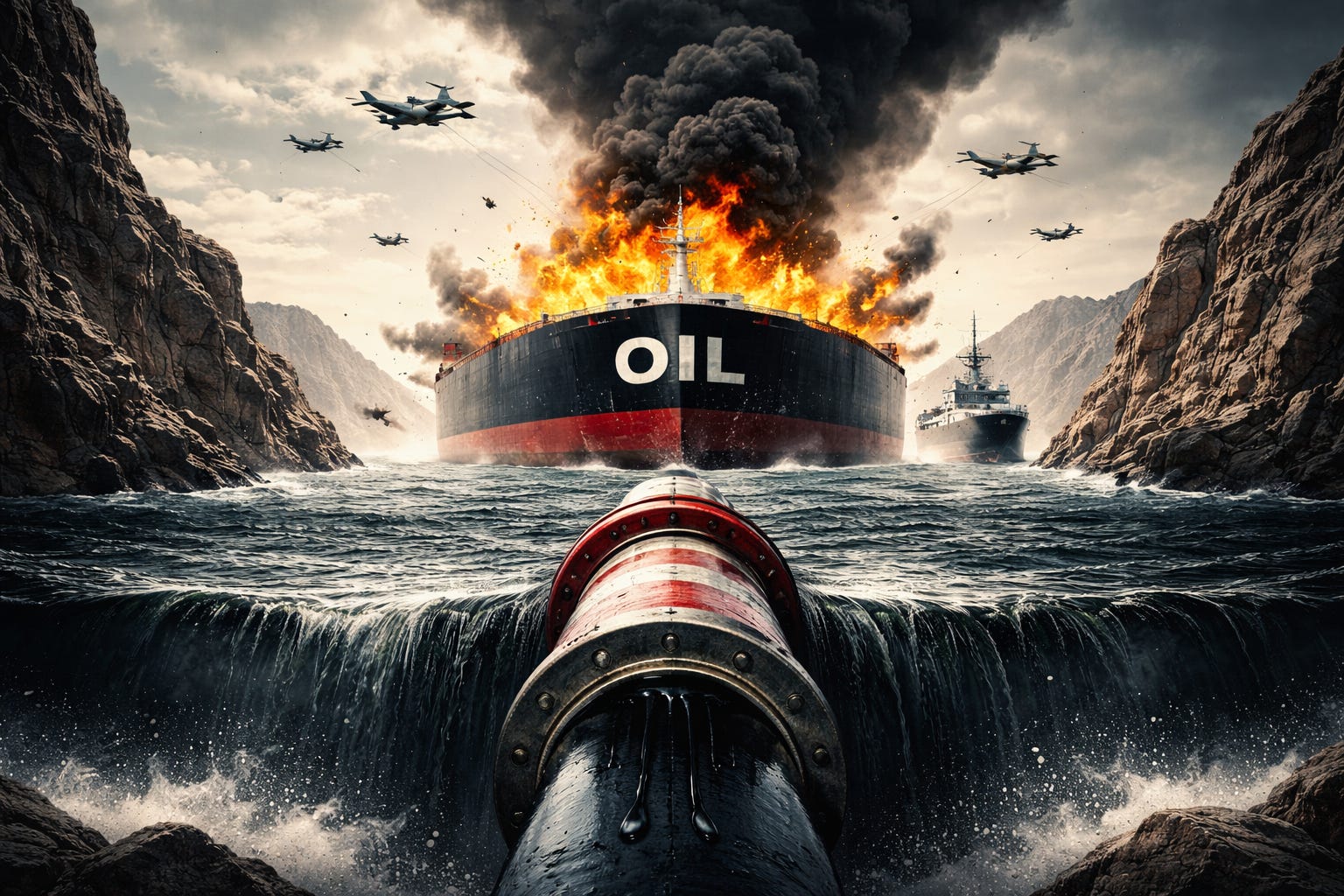
Sometimes the most dangerous place in the global economy isn’t a battlefield.
It’s a narrow stretch of water.
The Strait of Hormuz… the thin channel between Iran and Oman… is barely two miles wide at its navigable points. Yet every single day roughly 20 million barrels of oil pass through it, about one-fifth of the world’s total supply.
That makes it the single most vulnerable choke point in global energy.
And right now, it’s on fire.
In the past few days:
Multiple oil tankers have been attacked near the strait
Shipping companies have halted transit through the area
War-risk insurance coverage has been pulled
Around 150 ships are reportedly stuck waiting nearby
At least five vessels have been damaged and two people killed
Iranian officials have publicly warned that ships attempting to pass could be targeted.
Whether you call that a closure or a blockade hardly matters to markets.
The result is the same.
Oil stops moving.
And when oil stops moving, the entire global economy starts to shake.
Why This One Waterway Matters So Much
The Strait of Hormuz isn’t just another shipping route.
It’s the central artery of global oil supply.
Saudi Arabia alone ships more than 5 million barrels per day through the strait.
Qatar sends most of its liquefied natural gas exports through it as well.
There are limited alternatives.
Saudi Arabia has a pipeline that can move oil across the country to the Red Sea, but its spare capacity is only about 3.5 million barrels per day — far short of the roughly 20 million barrels normally flowing through Hormuz.
In other words, if the strait slows down, the world simply cannot reroute most of that oil.
Supply drops.
Prices spike.
The First Shock Is Already Showing Up
Markets reacted almost immediately.
Within days of the escalation:
Brent crude jumped past $83 per barrel
Analysts began modeling scenarios of $120–$150 oil
Severe disruption models push prices as high as $180–$200
Those numbers haven’t appeared since the 1970s oil crisis, when energy shocks triggered inflation, recession, and a decade of economic instability across the West.
History is whispering again.
Why the U.S. Still Gets Hit Hard
At first glance, the United States looks insulated.
It’s the largest oil producer in the world and imports far less from the Gulf than Asian economies like China or India.
But that’s the illusion.
Oil is a global price market.
When supply tightens anywhere, prices rise everywhere.
Gasoline in the United States has already climbed above $3 per gallon since the latest escalation began — and that’s before any sustained disruption.
If oil reaches $150 per barrel, the effect spreads through the entire economy.
Transportation costs rise.
Food prices follow.
Manufacturing becomes more expensive.
Air travel climbs.
Shipping costs spike.
Everything that moves gets pricier.
Which means almost everything gets pricier.
The Real Danger… Stagflation
Here’s where things get ugly.
Higher energy prices feed directly into inflation.
Central banks usually fight inflation by raising interest rates.
But if the economy is already slowing… which many indicators suggest… higher interest rates can push the economy straight into recession.
Economists call this trap stagflation.
It’s exactly what hit the U.S. and much of the Western world in the 1970s.
Growth stalls.
Prices keep rising.
And policy makers run out of easy solutions.
Some analysts now estimate that if Hormuz disruption lasts more than a month, global recession risk could climb above 70–75 percent.
Europe May Be Less Exposed Than Expected
Europe won’t escape the pain.
About 30 percent of Europe’s jet fuel supply travels through Hormuz.
But the continent has spent the last few years restructuring its energy systems — expanding Norwegian gas pipelines, building LNG import terminals, and increasing renewable capacity.
Those moves were initially seen as expensive overkill.
Now they look like insurance.
The countries most exposed to Gulf energy shipments are actually in Asia, not Europe.
What Happens Next
A total shutdown of the strait for months is unlikely.
Iran’s own economy relies on oil exports and would suffer from a prolonged closure.
But markets don’t need a full shutdown to panic.
Even partial disruption… drone attacks, tanker harassment, insurance withdrawal — can keep oil prices elevated.
If Brent crude remains above $85 for an extended period, traders will start assuming the disruption is structural rather than temporary.
And once that belief settles into markets, the economic consequences spread fast.
Inflation rises.
Central banks face impossible choices.
Political pressure builds for a diplomatic exit.
The Big Picture
The Strait of Hormuz is only a few miles wide.
But when it seizes up, the shockwave travels across the planet.
Energy prices spike.
Inflation surges.
Economic stability gets tested.
That’s the uncomfortable truth about globalization.
Sometimes the entire global economy depends on a strip of water narrow enough to see across.
The Recap…
One narrow waterway moves 20% of the world’s oil.
Now tankers are being attacked, shipping is halting, and insurance companies are pulling coverage.
If the Strait of Hormuz stays disrupted, oil prices could surge — and the economic shock won’t stay in the Middle East.
It lands in our fuel bills, grocery prices, and inflation rates.
The Gut-Punch…
When a two-mile waterway stalls, the global economy holds its breath.
Source Credit:
Source: Energy market analysis and geopolitical reporting on developments in the Strait of Hormuz and global oil supply routes.
🔎 The GeezerWise Standard
This space is built on disciplined thinking.
Facts over spin.
Verification before amplification.
Good-faith discussion over tribal noise.
I use AI tools to help shape my spoken drafts into clear writing.
The judgment, conclusions, and final message are mine.
If you’re new here, this explains how I decide what’s worth sharing:
How I Decide What’s Worth Sharing → [link]
💌 Subscribe at GeezerWise.com to receive future letters:
www.geezerwise.com/subscribe
— Fred Ferguson
GeezerWise
#CanadaStrong
Trump and Ben didn’t think this one through did they, idiots
Gas here has jumped sixty cents a gallon since Operation Epstein Diversion started.