

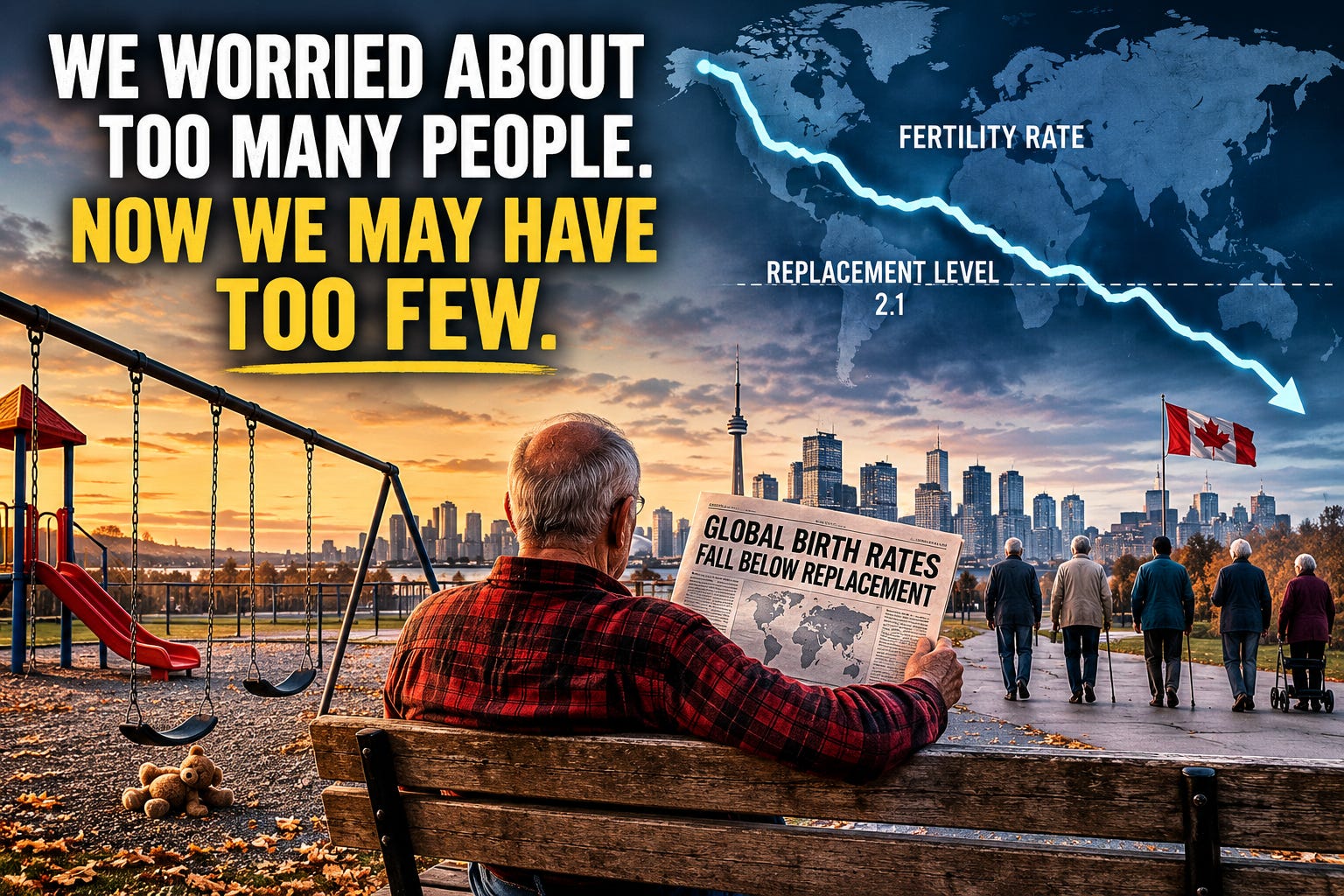
There are some stories that sneak up on you.
They don’t arrive with breaking news banners or politicians yelling into microphones.
They unfold slowly, decade after decade, until one day you look around and realize the world has quietly changed.
This may be one of those stories.
For years we were told humanity’s biggest problem was having too many people.
Overcrowding. Resource shortages. Population explosions.
Now the numbers are pointing in another direction.
Across much of the world, people simply aren’t having enough children to replace the generations before them.
Replacement fertility is about 2.1 births per woman.
Many developed countries are well below that mark, and some have fallen to nearly one child per woman.
That’s not a temporary blip.
It’s happening across Europe. It’s happening across East Asia.
It’s happening in much of Latin America and parts of the Middle East.
Even the United States has been below replacement levels for years and increasingly relies on immigration to sustain population growth.
China may be the biggest surprise of all.
After decades of the one-child policy, births have fallen dramatically despite government efforts to encourage larger families.
Europe tells a similar story.
The European Union recorded about 6.8 million births in the mid-1960s.
In 2023, that number was under 3.7 million.
Those aren’t small changes.
They’re demographic earthquakes.
An aging population means fewer workers supporting more retirees.
Governments collect less tax while healthcare and pension costs climb.
Labour shortages become harder to fill.
Economic growth slows. Entire communities begin shrinking instead of expanding.
That’s a very different conversation from the one many of us grew up hearing.
What’s interesting is that throwing money at the problem hasn’t produced dramatic results.
Countries have tried tax credits, baby bonuses, subsidized child care and generous parental leave.
Some programs help, but none have consistently restored birth rates to replacement levels.
The reasons appear to run deeper than household budgets.
Modern life has changed.
People marry later.
Careers last longer before families begin.
Housing costs have exploded.
Many adults value flexibility and personal freedom in ways previous generations rarely considered.
And social expectations change quietly.
When fewer friends, neighbours and relatives are raising children, having a large family stops feeling like the norm.
Whether you agree with those choices or not isn’t really the point.
They’re happening.
Canada isn’t immune either.
Like many developed countries, we face an aging population and a shrinking share of working-age people.
Immigration has become an important part of maintaining economic growth, but immigration alone doesn’t erase the underlying demographic trend.
Here’s what caught my attention most.
This isn’t a prediction about next year.
It’s about the next fifty years.
Demographics move slowly. Once birth rates remain low for several generations, reversing the trend becomes incredibly difficult.
Today’s kindergarten class determines tomorrow’s workforce, tomorrow’s taxpayers, tomorrow’s innovators and tomorrow’s caregivers.
You can’t build those overnight.
For decades the world prepared for endless growth.
It may soon have to learn how to manage something very different.
The Recap…
For decades we feared too many people.
Now much of the world has the opposite problem.
Low birth rates aren’t tomorrow’s issue… they’re already reshaping economies, healthcare, pensions and the future workforce.
Sometimes history changes without making much noise.
The Gut-Punch…
The biggest changes rarely arrive with a bang.
They arrive one missing generation at a time.
Source Credit:
Based on research discussing global demographic trends and fertility decline, including analysis of economist Nicholas Eberstadt’s work on worldwide depopulation and below-replacement birth rates.
If you enjoy thoughtful conversations, Canadian stories, and the occasional smart-ass observation about the world we’re living in, you’re in the right place.
Subscribe free and get new stories, insights, and observations delivered directly to your inbox.
No paywall.
No spam.
No nonsense.
Leave anytime with a single click.
I promise not to take it personally.
I can't see this lower birth rate trend reversing itself any time soon Fred. So many changes over decades have led to this. When I was a kid growing up in a middle class family, every one of my friends mothers were "housewives" who stayed at home and did not have to have a job outside of the house. Shifting of wealth upwards away from the middle class to the oligarchs meant that households needed two bread-winners, making it much more difficult to have and afford families.
Today, social media has a lot to do with relationships not developing as they used to that ended up with babies being born. I'm surprised how many young people I know have no meaningful romantic relationships, and how they don't seem to care all that much. I get the sense that our connected society don't know how to effectively communicate with eachother anymore.
So, tongue in cheek, considering the shortage or workers that this dilemma creates, maybe A.I. is the solution we need and the way to go.
The fight over abortion bans isn’t just about morality—it’s heavily tied to demographic politics. For a long time, I’ve viewed these restrictions as a direct response to anxieties over changing population numbers and an effort to maintain a white majority in a shifting world.