

The global order that governed the last 70 years is breaking apart.
Supply chains are being weaponized.
Tariffs are becoming geopolitical tools.
And middle powers like Canada are realizing something uncomfortable:
If you’re not shaping the system, you’re living inside someone else’s version of it.
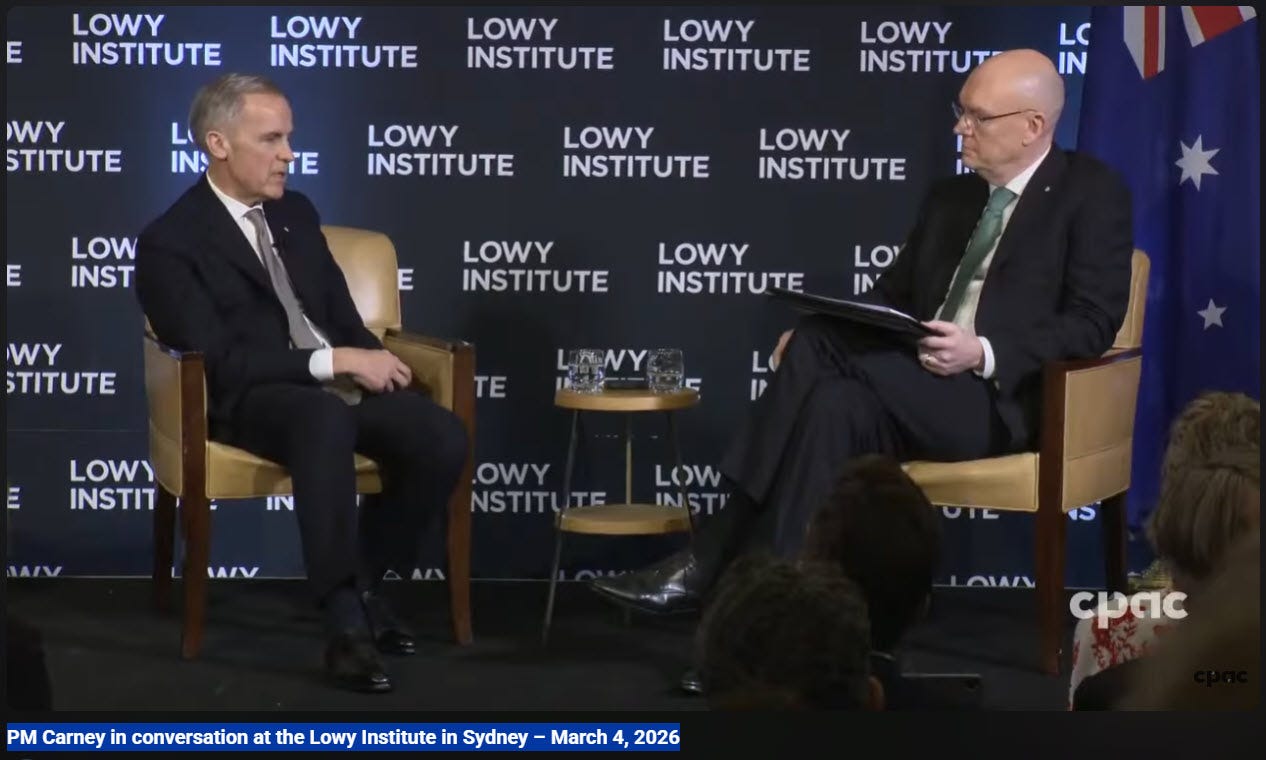
Earlier this week in Sydney, Prime Minister Mark Carney laid out how Canada sees the world shifting… and what countries like Canada and Australia plan to do about it.
The message was blunt…
The old order isn’t coming back.
Editor’s Note
What follows are my working notes and interpretation of remarks delivered by Prime Minister Mark Carney at the Lowy Institute in Sydney, Australia, on March 4, 2026.
This is not a transcript. I’ve distilled the key themes and arguments into a clearer narrative for readers who want the strategic picture.
If you prefer to watch the full discussion, you can view it here…
PM Carney in conversation at the Lowy Institute in Sydney – March 4, 2026
Also included…
PM Mark Carney addresses Australia’s parliament – March 5, 2026
— Fred Ferguson
GeezerWise
Open Letter to Canadians… and to the World
I’m writing this from a presentation in Sydney because the world has stopped pretending.
The global system that governed trade, diplomacy, and security for decades is not gently evolving.
It’s rupturing.
For years, international integration was treated as an unquestioned good. Countries built supply chains for efficiency, not resilience.
Markets expanded, institutions multiplied, and the assumption was that deeper economic ties would reduce geopolitical risk.
But the opposite is happening.
Major powers are now treating economic connections as tools of leverage.
Tariffs are used as pressure.
Financial systems are used as coercion.
Supply chains are used as vulnerabilities.
Countries that once believed integration guaranteed stability are now discovering something else…
Dependence can become a form of control.
Canada’s approach must reflect that reality.
We cannot wait for a world that no longer exists to return.
Instead, we must operate in the world as it is.
Sovereignty has changed
For most of the modern era, sovereignty meant control of borders, energy supplies, and national defense.
Those still matter.
But in the 21st century, sovereignty now also depends on access to critical systems that power modern economies and security.
A country that lacks secure access to semiconductors, artificial intelligence infrastructure, space-based communications, or digital payment systems is not fully sovereign.
Neither is a country dependent on fragile supply chains for vaccines, energy technologies, or critical minerals.
Governments and businesses spent decades optimizing global systems for efficiency.
Now we must optimize them for resilience.
Why middle powers must work together
Great powers have options that countries like Canada do not.
They can impose terms.
They can leverage markets.
They can compel outcomes.
Middle powers must take a different path.
Our strength lies in partnerships.
Canada is pursuing a strategy built on diversification and coalitions… networks of trusted relationships that reduce dependence on any single power.
These partnerships will not all look the same.
Different coalitions will form around different strategic sectors: defense, technology, energy, and critical minerals.
The goal is not isolation.
The goal is resilience.
Canada and Australia
The partnership between Canada and Australia demonstrates what this strategy looks like in practice.
Both countries possess large reserves of critical minerals essential for modern technologies and defense systems.
Together, our two nations already produce…
more than a third of the world’s lithium
roughly a third of global uranium
over 40 percent of iron ore production
By working together with trusted partners, we can ensure these resources strengthen democratic economies rather than create new dependencies.
Defense cooperation is also expanding.
Canada is investing heavily in its defense industrial base and building capabilities in areas ranging from artificial intelligence to aerospace technologies.
Partnerships with countries like Australia will allow us to develop these capabilities faster and more securely than either nation could alone.
The power of trust
Middle powers cannot always compel outcomes.
But we can convene.
Canada and Australia share two advantages that authoritarian powers often lack…
legitimacy and trust.
Our agreements tend to last because our commitments are credible.
When countries know a partnership will be honored, cooperation becomes easier and more durable.
This is why building coalitions of trusted nations matters.
These networks can deter aggression, protect supply chains, and strengthen economic resilience.
What comes next
The emerging global system will not be built all at once.
It will be constructed step by step.
Issue by issue.
Sector by sector.
Coalition by coalition.
Canada intends to be an active participant in shaping that system.
Not through nostalgia for the past, but through practical partnerships that reflect the realities of the present.
The world is entering a period of profound geopolitical change.
Canada will meet that moment with clear eyes, strong alliances, and a commitment to building a more resilient international order.
💌 Know someone who’d appreciate this?
Subscribe at GeezerWise.com to get future letters straight to your inbox.
Great article. It's so nice to be able to read sensible articles about the changing world we are trying to navigate. Thank you !
Seemed like a bit of a replay of the Davos speech...but it was definitely worth repeating!