

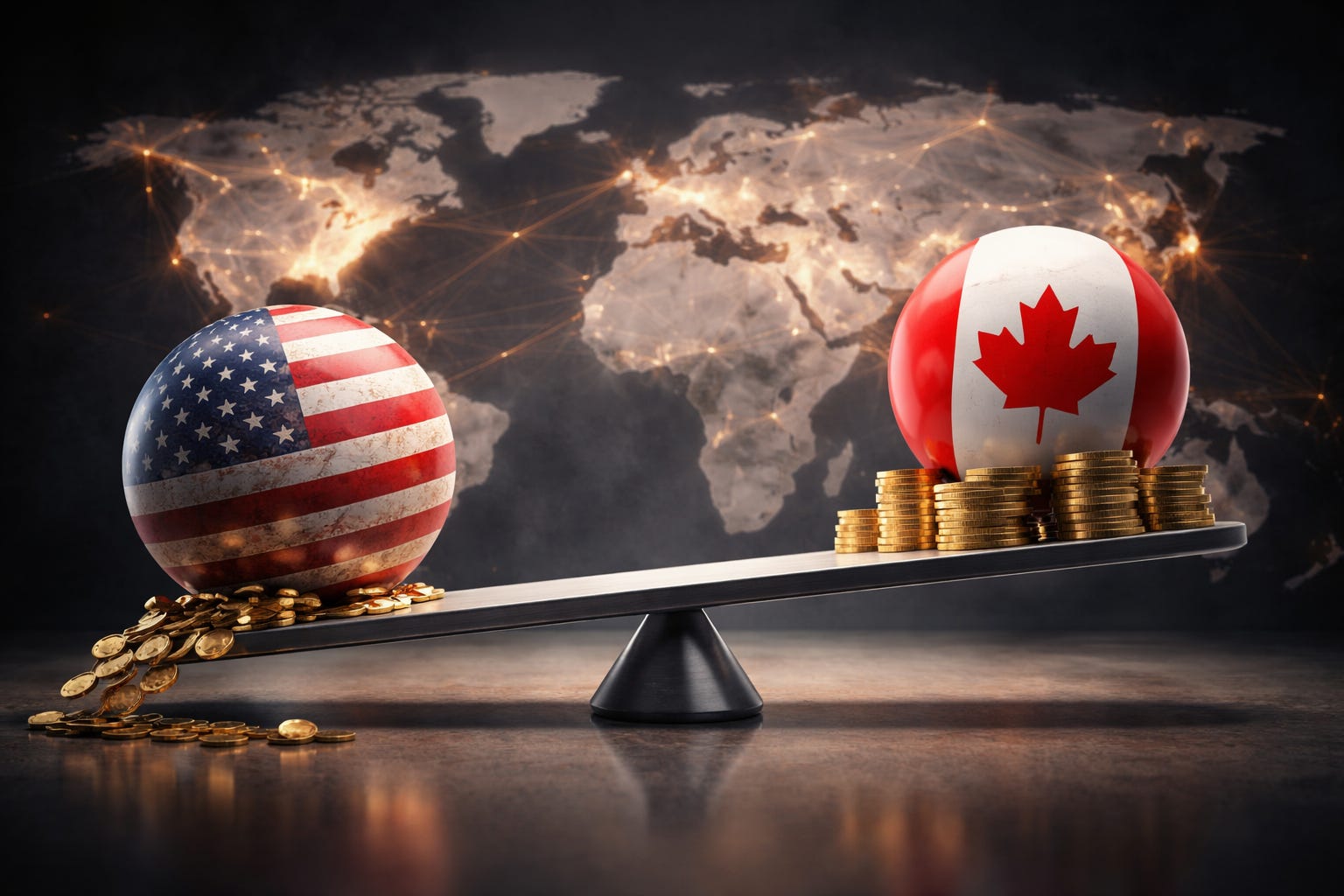
For decades the global economy revolved around one simple reality…
The American consumer was the engine.
The United States had the richest shoppers on Earth.
When Americans opened their wallets, factories across Asia, Europe, and Latin America turned on their machines.
That system powered globalization for forty years.
Now it’s starting to wobble.
Not because the world suddenly hates trade…
but because Washington decided to weaponize it.
Tariffs were supposed to shrink the U.S. trade deficit and bring manufacturing back home.
Instead, they’re producing a different chain reaction.
Prices go up.
Companies pay more for imported parts and materials.
Consumers buy less.
Businesses cut costs.
And when businesses cut costs, layoffs follow.
The early warning signs are already showing up.
Recent employment data in the United States has produced the weakest job numbers since the aftermath of the 2008 financial crisis. Markets have noticed too. Capital flows are beginning to shift as investors reassess where stability and growth actually live.
One of the biggest surprises?
Canada.
Foreign investment flowing into Canada has surged to its strongest level since 2007.
At the same time, Canadian equity markets quietly outperformed most of the developed world.
Among the ten largest stock markets on the planet, Canada ranked first in performance in 2025.
The United States placed eighth.
That’s not a small signal.
It means global capital is already repositioning.
Trade patterns are changing too.
For decades many Canadian companies relied heavily on selling almost everything to the United States. That dependency is now shrinking fast.
Recent data shows the number of Canadian firms exporting only to the U.S. has dropped by nearly half as businesses expand into Europe, Asia, and other global markets.
Ports are reflecting the shift.
The Port of Vancouver recently recorded its highest cargo volumes on record, driven by overseas trade rather than traditional U.S.-bound flows.
Meanwhile, global supply chains are adjusting to the new reality of American tariffs.
China’s exports, for example, surged early in 2026… despite weakening trade with the United States… because shipments are increasingly flowing to other regions instead.
In other words, the world is doing what markets always do…
finding another path around friction.
And that brings us back to the bigger picture.
The United States still has the largest economy in the world.
But the system that made it the center of global consumption is under pressure.
Tariffs don’t magically make foreign goods disappear.
They simply make them more expensive.
That squeezes consumers, reduces spending power, and forces companies to raise prices or cut jobs.
Eventually imports may fall… but not because domestic production suddenly exploded.
Imports fall because people can’t afford to buy as much.
Meanwhile the rest of the world continues trading with each other.
Europe is expanding internal supply chains.
Asian trade blocs are deepening regional commerce.
Emerging markets are building new export routes.
And countries like Canada… stable, resource-rich, politically predictable… suddenly look like very attractive places to park capital.
None of this means the United States is collapsing.
But it does mean the economic map is being redrawn.
The old model… where one country consumed everything and everyone else produced it… was never going to last forever.
What we’re watching now is the adjustment.
And while Washington fights trade wars, Canada is quietly doing something far less dramatic.
It’s diversifying.
New markets.
New supply chains.
New investment flows.
No shouting.
No chest-thumping.
Just the slow, steady repositioning of a country that finally understands the importance of not putting all its eggs in one basket.
Sometimes the smartest economic strategy isn’t domination.
It’s balance.
And balance is exactly where the global economy appears to be heading.
The Recap…
For forty years the global economy ran on one fuel source:
the American consumer.
That system is now under pressure.
Tariffs, shifting trade routes, and rising global investment in Canada are quietly redrawing the economic map.
Something bigger than politics is happening.
The Gut-Punch…
You don’t shrink a trade deficit by making your country richer.
You shrink it when people can’t afford to buy things anymore.
Source Credit:
Analysis based on public economic data and reporting from major financial outlets including Reuters, the Wall Street Journal, and international trade statistics.
🔎 The GeezerWise Standard
This space is built on disciplined thinking.
Facts over spin.
Verification before amplification.
Good-faith discussion over tribal noise.
I use AI tools to help shape my spoken drafts into clear writing.
The judgment, conclusions, and final message are mine.
If you’re new here, this explains how I decide what’s worth sharing:
How I Decide What’s Worth Sharing → [link]
💌 Subscribe at GeezerWise.com to receive future letters:
www.geezerwise.com/subscribe
— Fred Ferguson
GeezerWise
#CanadaStrong
Good report, Geezer. May the trend continue!
Fred,
Your argument about the quiet rewiring of global trade captures something real — but the deeper shift may be even bigger than tariffs.
What we are seeing is not simply a reaction to American trade policy. It is the gradual end of a single-consumer global system.
For forty years the world economy revolved around one gravitational centre: the American household. Global supply chains were optimised for feeding that consumer machine. When Washington disrupts that system — through tariffs, industrial policy, or geopolitical rivalry — the entire structure begins to reorganise.
And markets are very good at reorganising.
Capital does not care about political narratives. It cares about predictability, rule of law, and long-term resource security. In that environment, Canada suddenly looks extremely attractive: stable institutions, vast natural resources, energy independence, and direct access to both Atlantic and Pacific trade routes.
But Canada’s advantage is not just stability.
It is geography.
In a world fragmenting into regional supply networks — North America, Europe, and Asia — Canada sits at a strategic intersection between all three. That makes it less a peripheral economy and more a hinge economy.
That said, one caution is worth adding.
Canada’s prosperity in this moment depends heavily on forces outside its control: U.S. political volatility, Chinese industrial overcapacity, and Europe’s search for secure resources. If those forces stabilise, capital flows could shift again.
So the opportunity is real — but it is also temporary.
The question for Canada is whether it uses this window to build durable economic infrastructure: energy corridors, mineral supply chains, manufacturing capacity, and deeper trade integration with Europe and Asia.
If it does, Canada could become one of the key anchor economies of the next globalisation.
If it doesn’t, the capital now arriving will eventually move on.
Markets reward stability. But they reward strategic ambition even more.