

The 2026 FIFA World Cup was supposed to be an economic layup for the United States.
Big crowds. Packed hotels. Overflowing bars. Airlines cashing in. Tourism boards grinning like lottery winners.
Instead?
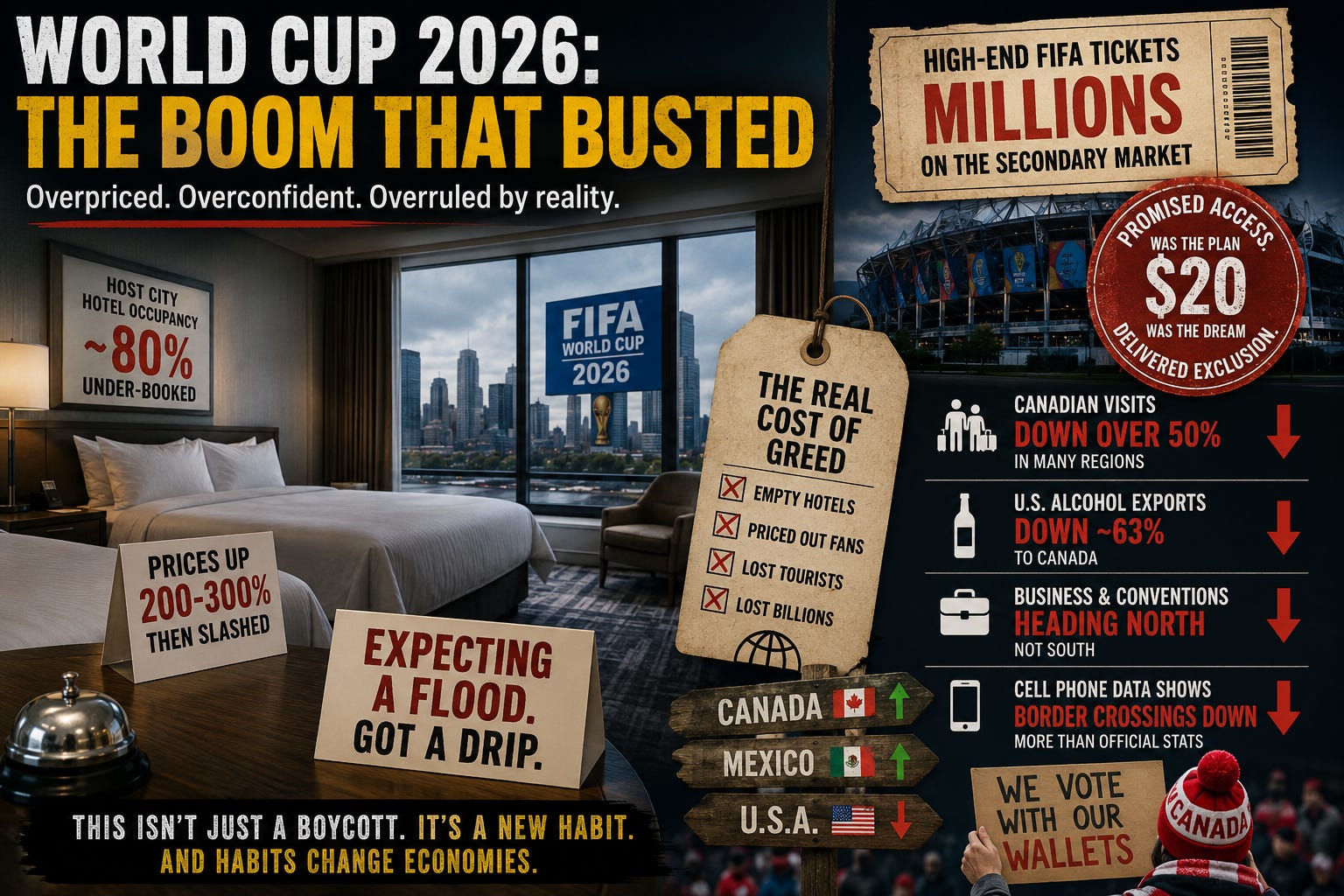
Some host cities are sitting on under-booked hotels during the biggest soccer tournament on Earth.
That’s not normal.
That’s a warning flare.
The problem isn’t that people suddenly stopped loving soccer. The problem is that everybody along the chain got greedy at the exact same time.
Hotels jacked prices 200–300% expecting a tsunami of visitors. FIFA locked up giant blocks of rooms, assuming demand would explode. Ticket systems drifted into algorithmic insanity where prices climbed far beyond what ordinary fans expected to pay.
Then reality showed up carrying a baseball bat.
Fans looked at the numbers and quietly backed away.
And Canadians? They didn’t just back away. Many changed habits entirely.
For more than a year now, Canadian travel into the U.S. has been dropping hard in some regions…
far beyond what officials originally admitted.
Cell phone mobility data reportedly showed the decline was deeper than traditional border statistics suggested.
That matters.
Because Canadians aren’t just tourists to the U.S. economy. We’re repeat customers. Predictable customers. The kind businesses build forecasts around.
And when predictable customers stop showing up, systems wobble.
You can already see the cracks.
U.S. alcohol exports into Canada reportedly dropped around 63% in some categories after provinces pulled American products from shelves and consumers started choosing alternatives.
Business conventions shifted north. Airlines adjusted routes. Hospitality forecasts started getting revised downward.
Quietly.
Without fireworks.
That’s the part people keep missing.
This isn’t some dramatic boycott with marches and megaphones anymore. It’s turning into muscle memory.
People simply started building different habits.
Different vacation plans.
Different products.
Different spending patterns.
Different assumptions about where they want their money going.
That’s much harder to reverse.
And meanwhile FIFA kept behaving like a hedge fund wearing a soccer jersey.
Dynamic pricing systems inflated tickets. Resale systems piled on top. Secondary markets pushed premium seats into absurd territory. FIFA reportedly profits from transactions on both sides of the exchange — meaning the inflation machine benefits the organizer almost no matter what happens.
At some point the sport stopped feeling global and started feeling gated.
The average fan got turned into an ATM.
And now the contradiction is impossible to ignore:
The world’s largest sporting event…
…with empty hotel rooms.
That shouldn’t happen.
Not unless the organizers fundamentally misread the room.
The old assumption was simple…
Host a mega-event → money floods in automatically.
But that formula only works if people can actually afford to participate.
Accessibility matters.
Trust matters.
Perception matters.
If visitors feel gouged, unwelcome, or financially squeezed, they don’t always protest.
Sometimes they just quietly stop coming.
That may be the biggest story underneath this entire World Cup mess.
Not anger.
Adaptation.
The United States spent decades assuming global demand would absorb almost any price, any friction, any political tension.
This tournament is exposing the limits of that assumption.
Because the rest of the world now has options.
And Canada, oddly enough, may be demonstrating a new kind of leverage here…
not through military power, not through loud political theatrics, but through millions of ordinary people making small financial decisions over and over again.
One different bottle.
One different flight.
One skipped convention.
One vacation rerouted elsewhere.
Individually?
Tiny.
Collectively?
Billions.
That’s the thing about consumer behavior.
Governments can argue.
Corporations can spin.
Politicians can posture.
But when people quietly change habits at scale?
The spreadsheet eventually tells the truth.
The Recap…
The 2026 World Cup was supposed to flood the U.S. with tourism money.
Instead?
Hotels are under-booked.
Fans are priced out.
And Canadians are quietly spending elsewhere.
Turns out you can’t squeeze every dollar out of people forever and still expect packed stadiums and full hotel towers.
The Gut-Punch…
The real danger to an economy isn’t always protest.
Sometimes it’s when millions of people stop arguing… and simply start choosing differently.
Source credit:
Research compiled from public reporting, tourism data, hospitality trends, FIFA pricing coverage, cross-border travel analysis, and economic observations gathered and summarized by Fred Ferguson (GeezerWise).
🔎 The GeezerWise Standard
This space is built on disciplined thinking.
Facts over spin.
Verification before amplification.
Good-faith discussion over tribal noise.
I use AI tools to help shape my spoken drafts into clear writing.
The judgment, conclusions, and final message are mine.
If you’re new here, this explains how I decide what’s worth sharing:
How I Decide What’s Worth Sharing → [link]
💌 Subscribe at GeezerWise.com to receive future letters:
www.geezerwise.com/subscribe
— Fred Ferguson
GeezerWise
#CanadaStrong
Good
I think another factor is visitors to the US worried they will be detained by ICE. If you can watch the game on TV in the safety of your own home, save your money and go in person to the next FIFA games. But how are ticket sales for the games in Canada? Or are the prices outrageous here too?