

The World Cup is supposed to be one of the easiest economic bets on Earth.
Millions of fans. Packed hotels. Full restaurants. Airports bursting at the seams. Cities cashing in.
That’s the sales pitch every time.
But the early numbers coming out of the 2026 World Cup tell a very different story.
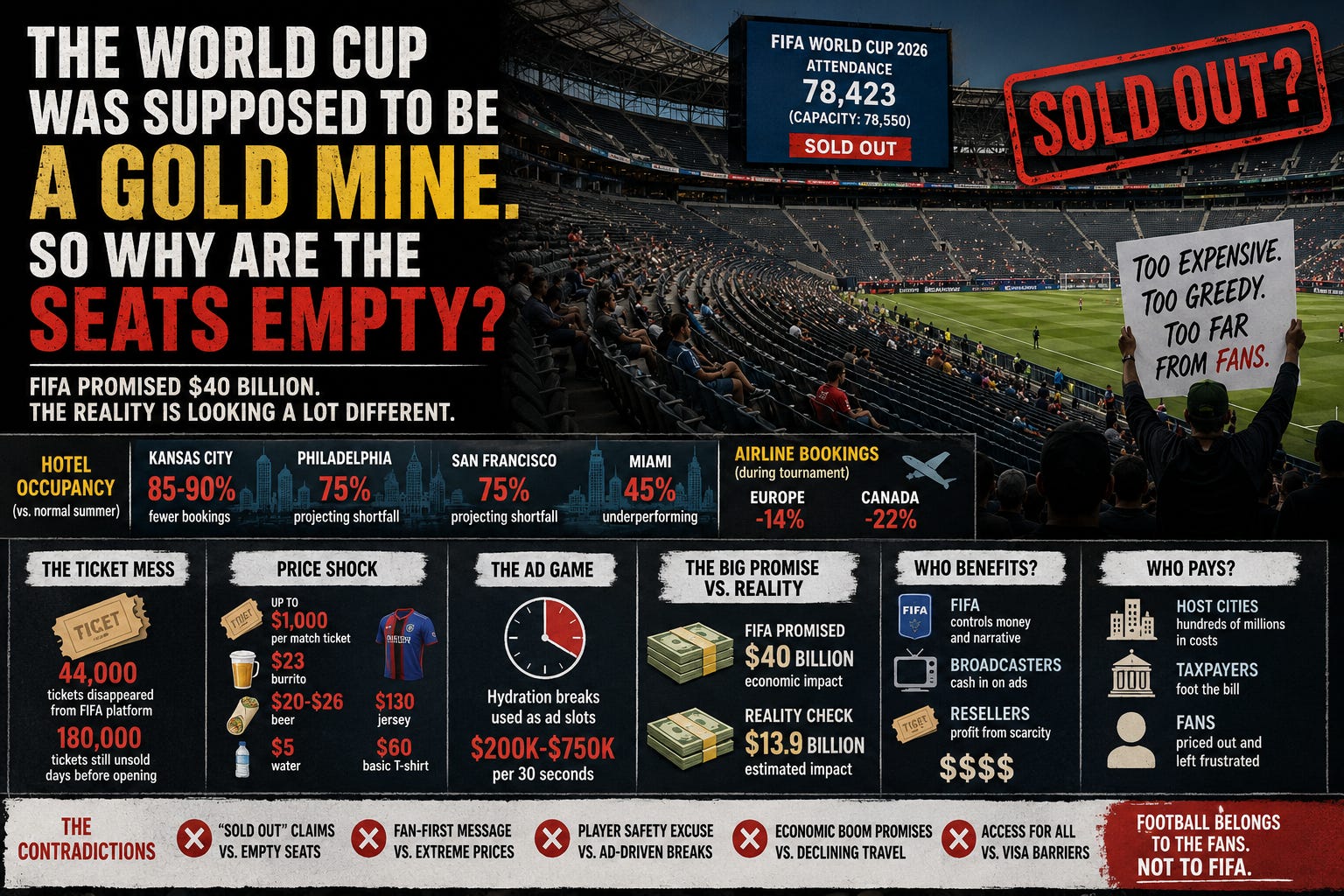
The tournament was expected to generate roughly $40 billion in economic activity across North America.
Instead, actual performance is looking much closer to $13.9 billion according to several emerging estimates.
That’s not a small miss.
That’s a completely different game.
The first warning signs came from the hotel industry.
In Kansas City, many hotels reported booking levels well below expectations. Similar shortfalls appeared in Philadelphia, San Francisco, and Miami.
Some hotels that raised prices expecting a flood of visitors ended up cutting rates in an effort to fill rooms.
That shouldn’t be happening during a World Cup.
The travel numbers aren’t helping either.
Airline bookings from Europe reportedly fell by double digits. Canadian travel also dropped sharply compared to expectations.
For an event that depends on international visitors, fewer people getting on airplanes is a serious problem.
Then came the stadium questions.
Fans watching on television noticed something FIFA probably hoped they wouldn’t.
Empty seats.
Lots of them.
That became awkward when official attendance reports continued describing many matches as essentially sold out.
Those two things don’t fit together very well.
The controversy deepened after reports that tens of thousands of tickets disappeared from official sales channels and later surfaced on resale markets.
Meanwhile, significant numbers of tickets remained unsold close to kickoff.
Whether investigations ultimately prove wrongdoing or not, the optics are terrible.
People begin asking simple questions.
If demand is so strong, why are there empty seats?
If games are sold out, why are tickets still available?
And if fans desperately want to attend, why are prices being slashed in some markets while resale platforms remain flooded with inventory?
The answers matter because ticket prices have become part of the problem.
Many families simply can’t afford the experience anymore.
Some match tickets climbed toward four figures. Add food, drinks, merchandise, parking, transportation, and accommodation and suddenly a family outing starts looking like a second mortgage payment.
A bottle of water costs money.
A beer costs more.
A jersey costs more.
Everything costs more.
At some point fans stop participating.
Not because they don’t love the sport.
Because they can’t justify the bill.
That’s where the bigger lesson appears.
FIFA isn’t really selling football anymore.
It’s selling inventory.
Every seat is inventory.
Every sponsorship is inventory.
Every television break is inventory.
Even hydration breaks have become advertising opportunities worth hundreds of thousands of dollars for half a minute of airtime.
When every decision revolves around extracting maximum revenue, eventually somebody gets squeezed out.
In this case, it appears to be the fans.
Meanwhile, host cities continue carrying enormous financial risk.
Security costs alone have climbed into the hundreds of millions. Infrastructure spending, transportation upgrades, policing, logistics, and event preparation all come with price tags that taxpayers rarely see highlighted in promotional brochures.
FIFA collects revenue.
Cities absorb risk.
That arrangement looks fantastic when projections’ come true.
It looks much less attractive when they don’t.
And that’s a growing concern because the historical record isn’t exactly reassuring.
Many previous World Cups and Olympic Games failed to deliver the promised economic jackpots. The headlines arrive first. The invoices arrive later.
What’s happening now may signal something larger than a disappointing tournament.
It may signal that the entire mega-event model is starting to crack.
People travel differently.
Governments impose more restrictions.
Visa barriers matter.
Political tensions matter.
Price sensitivity matters.
And fans increasingly refuse to be treated like unlimited sources of cash.
The World Cup remains one of the greatest sporting events on Earth.
The passion is still there.
The audience is still there.
The love of the game is still there.
But the business model may be running into reality.
And reality always wins eventually.
The Recap…
FIFA promised an economic bonanza.
Instead, hotels are reporting weak bookings, travel demand is softer than expected, and fans are questioning empty seats at supposedly sold-out matches.
The World Cup isn’t suffering from a football problem.
It’s suffering from a pricing problem.
The Gut-Punch…
The danger isn’t that fans stopped loving the game.
The danger is that the people running the game became so focused on monetizing every minute, every seat, and every sip of water that they forgot who the tournament was supposed to be for.
Source credit:
Research compiled from tournament attendance reports, hotel industry surveys, travel booking data, host-city financial disclosures, ticketing reports, and public World Cup economic projections.
🔎 The GeezerWise Standard
This space is built on disciplined thinking.
Facts over spin.
Verification before amplification.
Good-faith discussion over tribal noise.
I use AI tools to help shape my spoken drafts into clear writing.
The judgment, conclusions, and final message are mine.
If you’re new here, this explains how I decide what’s worth sharing:
How I Decide What’s Worth Sharing → [link]
💌 Subscribe at GeezerWise.com to receive future letters:
www.geezerwise.com/subscribe
— Fred Ferguson
GeezerWise
#CanadaStrong
A Quick Note About Getting in Touch
One thing I’d like to ask as GeezerWise grows...
Please keep questions, ideas, and conversations in the comments whenever possible.
That’s where I spend my time, and when a good question is asked publicly, everyone benefits from the discussion.
I can’t promise to reply to every comment, but I do read them, and many of my best ideas come directly from our conversations here.
Thanks for helping make GeezerWise a community where we all learn from one another.
We have travelled internationally for World Cups many times but would not go to USA.
You missed the impact of the phoney Peace Prize on fans.
FIFA appears more and more corrupt
I used to be a soccer referee in my community; all ages, genders, etc. As a woman, and just about the only adult woman ref in the city, I got nothing but chauvinistic/misogynistic grief from the male head of the ref association here, but it did not curb my love of the game. I didn't play as a kid, but both of my sons did and loved the sport too. The prices of tickets, travel, accommodations, meals, etc. are definitely pricing the event out of the grasp of most lovers of the sport. It's egregious. But I can't help thinking that many fans, despite their loyalty to the sport, are simply avoiding traveling to the US to watch it, knowing that their money is going into the US economy and therefore benefiting, even if indirectly, DJT. I can't help but agree with them.