

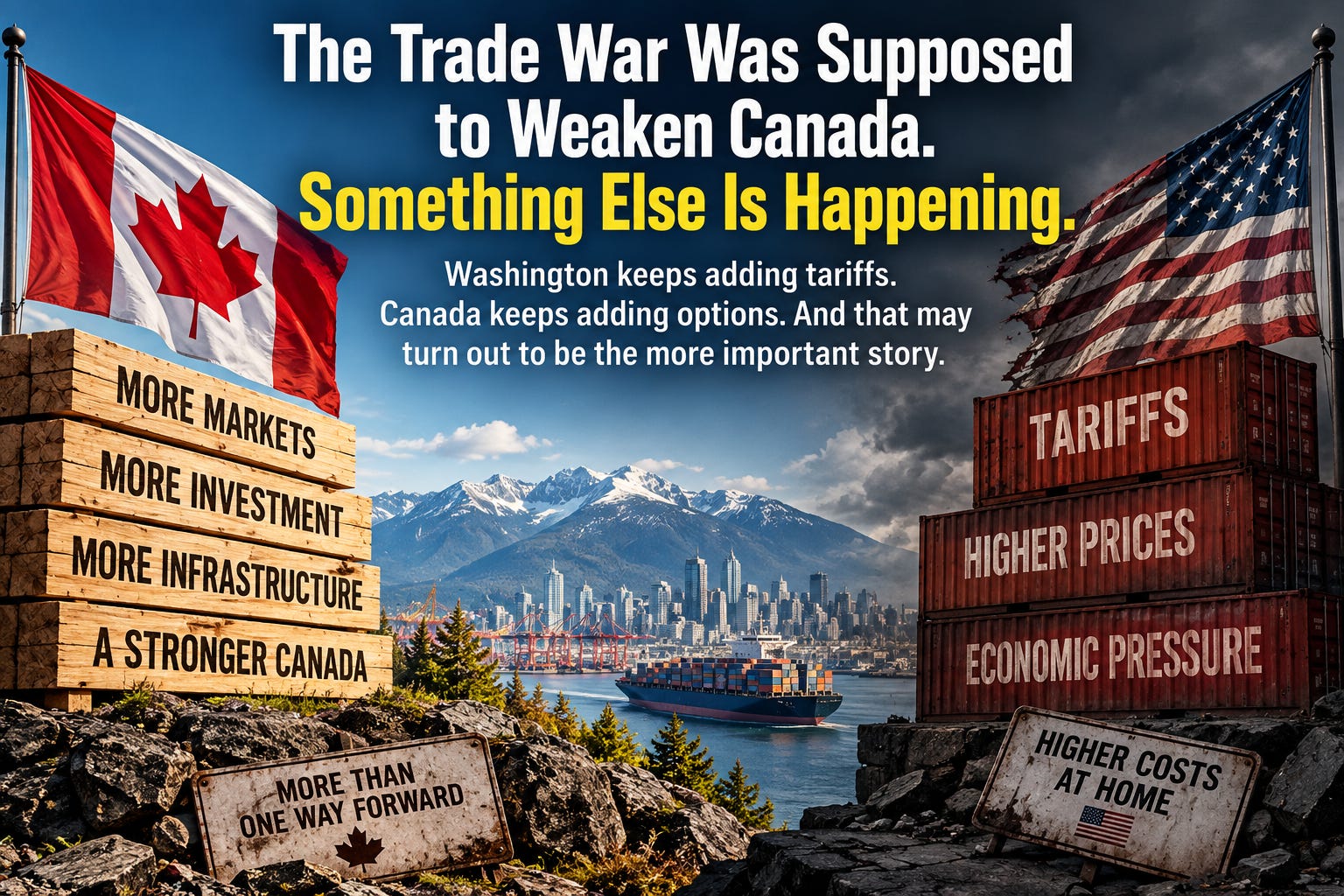
There’s something strange happening in this Canada–U.S. trade war.
Every time Washington announces another tariff, another threat or another round of economic punishment, we Canadians are supposed to react like the roof just blew off the house.
And yes, some Canadian industries are getting hurt.
Let’s not bullshit ourselves about that.
Steel. Aluminum. Forestry. Autos. Companies and workers caught directly in the crossfire aren’t reading economic statistics and celebrating.
But pull the camera back a little.
Because something else is happening at the same time.
Canada is becoming harder to corner.
And the United States is discovering that tariffs aren’t free just because somebody else’s name is written on them.
The Bill Doesn’t Disappear
Here’s the part about tariffs that Donald Trump has never managed to repeal with a speech…
A tariff is a tax on an imported product.
Someone importing that product into the United States pays it.
That doesn’t mean every penny automatically lands on the American consumer.
Companies can absorb some of it, suppliers can cut prices, currencies can move and supply chains can change.
But the cost doesn’t magically get mailed to Ottawa.
And right now there are some rather uncomfortable numbers coming out of the United States.
The U.S. Producer Price Index rose 5.4% over the 12 months ending in August, according to the Bureau of Labor Statistics.
Producer prices increased another 0.4% in August alone. Energy was particularly ugly… final-demand energy prices were up 24.4% from a year earlier.
Those aren’t Canadian numbers.
Those are American numbers.
And they matter because producer prices measure costs further up the economic food chain… before many of them eventually work their way toward households.
Tariffs aren’t the only thing driving those increases. Energy prices and the Iran conflict have been major factors too.
Pretending every increase was caused by tariffs would be every bit as silly as pretending tariffs cost Americans nothing.
But deliberately making imported goods more expensive while you’re already fighting inflation is one hell of an interesting economic experiment.
Especially when you’re the guinea pig.
Then There’s the Bond Market
This is where the story gets more serious.
The yield on the benchmark U.S. 10-year Treasury recently crossed 5% for the first time since 2023.
Reuters reported that inflation concerns, higher oil prices, heavy debt issuance and worries about America’s fiscal outlook were among the forces pushing yields upward.
Again, I’m not going to tell you Trump’s tariffs single-handedly caused that.
They didn’t.
But a 5% 10-year Treasury yield matters.
Higher Treasury yields tend to work their way through the economy.
Mortgages.
Car loans.
Business financing.
Government borrowing.
Suddenly the world’s largest economy is paying considerably more for money.
That’s not exactly the picture you’d expect if the country wielding all this economic power were emerging from the confrontation without costs of its own.
Meanwhile, Look North
Now we get to the Canadian side of this story.
Back in May, the Global Infrastructure Investor Association released its latest survey of major infrastructure investors.
Guess which country ranked as the world’s most attractive infrastructure investment market?
Canada.
Not the United States.
Canada.
The association represents investors managing almost C$3 trillion in infrastructure assets, and Canada moved ahead of Germany and the United States in its survey.
It was the first time Canada had overtaken its southern neighbour.
That’s worth sitting with for a minute.
We’re in the middle of a trade war with our largest customer.
We’re being hit with tariffs.
We’re being told repeatedly that Canada has no leverage and nowhere else to go.
And the people responsible for deploying trillions of dollars into infrastructure looked around the world and put Canada at the top of the list.
That doesn’t mean we’ve suddenly become economic Disneyland.
We haven’t.
Canada still has productivity problems. We still have regulatory problems.
We still need enormous amounts of infrastructure if we’re serious about selling more energy, minerals and manufactured products beyond the United States.
But money notices stability.
Money notices opportunity.
And money really notices when countries start building things.
Canada Changed the Question
This may be the biggest shift of all.
For decades Canada’s economic question was basically…
How do we maintain access to the American market?
That’s understandable.
They’re next door.
They’re enormous.
And in 2025, 71.7% of Canadian exports still went to the United States.
Nobody with a functioning calculator should suggest Canada can simply replace that market overnight.
We can’t.
But the question has changed.
Now we’re asking:
How do we keep the American market while making damn sure we’re never this dependent on it again?
That’s an entirely different economic strategy.
Canadian exports to non-U.S. markets increased 17.2% in 2025, according to reporting on Canada’s diversification push.
And Ottawa is now actively courting global capital for Canadian energy, mining, technology, transportation and infrastructure projects. Prime Minister Mark Carney’s government has been pitching investors on more than 160 projects as part of an effort to attract enormous amounts of new investment.
Whether all of those projects actually get built is another question.
Announcements aren’t bulldozers.
Investment conferences aren’t factories.
And political speeches don’t load ships.
I’ll judge the results when the money gets committed and the projects start moving.
But the direction is unmistakable.
Canada is trying to build alternatives.
And That’s Where Washington May Have Miscalculated
The assumption behind economic coercion is pretty straightforward.
Make resistance expensive enough and the other guy eventually gives you what you want.
That works beautifully if the other guy has nowhere else to go.
Canada’s answer has been to start building somewhere else to go.
More customers.
More trade relationships.
More domestic processing.
More infrastructure.
More investment.
More capacity to move Canadian products east, west and overseas instead of automatically pointing everything south.
None of that happens quickly.
And none of it makes the United States unimportant.
America will remain one of Canada’s most important trading partners because geography isn’t going anywhere.
But dependence and partnership are two very different things.
Canada is finally learning the difference.
This Isn’t Victory. It’s Leverage.
That’s why I’m not declaring Canada the “winner” of the trade war.
Trade wars are lousy things to win.
People lose jobs.
Businesses lose customers.
Consumers pay more.
Investment gets delayed.
Supply chains get scrambled.
Both countries can come out poorer.
The more interesting question is what Canada looks like after this mess.
If we emerge with more export markets, more domestic processing, more infrastructure, more international investment and less dependence on a single customer, something fundamental will have changed.
Because then the next American president who threatens Canada economically faces a different calculation.
Canada can say…
We’d rather trade with you.
We don’t have to depend entirely on you.
That’s leverage.
And leverage lasts a hell of a lot longer than a tariff announcement.
The Recap…
Washington keeps reaching for tariffs.
Canada keeps reaching for new customers, new investment and new infrastructure.
Meanwhile, U.S. producer prices are up 5.4%, the 10-year Treasury yield has crossed 5%, and global infrastructure investors have put Canada at the top of their attractiveness rankings.
This isn’t about declaring victory.
It’s about becoming harder to push around.
The Gut-Punch…
Canada doesn’t need to replace the United States.
We need to make sure the United States can never again mistake Canadian dependence for American ownership.
Source credit:
Research notes supplied from the transcript “The Real Reason Canada Is Winning The Trade War.” Key economic claims independently cross-checked against the U.S. Bureau of Labor Statistics, Government of Canada, Global Infrastructure Investor Association, Reuters and other current reporting.
If you enjoy thoughtful conversations, Canadian stories, and the occasional smart-ass observation about the world we’re living in, you’re in the right place.
Subscribe free and get new stories, insights, and observations delivered directly to your inbox.
No paywall.
No spam.
No nonsense.
Leave anytime with a single click.
I promise not to take it personally.
I think Drumpf's understanding of tariffs is worse than you have written. He thinks it's a tax on the EXPORTER to the US to be paid to the American Government. He can't seem to get it through his thick head that our American IMPORTERS pay the tariff.
He also has no clue about how closely tied our automotive industries are with parts and materials flowing back and forth across the borders with Canada and Mexico. He really has no clue about ANYTHING!