

For the last year, we’ve been told Canada was supposed to be the one sweating.
Tariffs were coming. Pressure was building. America was going to “rebalance” trade, protect its industries, and remind countries like Canada who still held the bigger stick.
That was the theory.
Reality had other plans.
Because while Washington was busy throwing tariffs around like confetti at a political rally, Canada quietly posted something nobody expected: a bigger trade surplus.
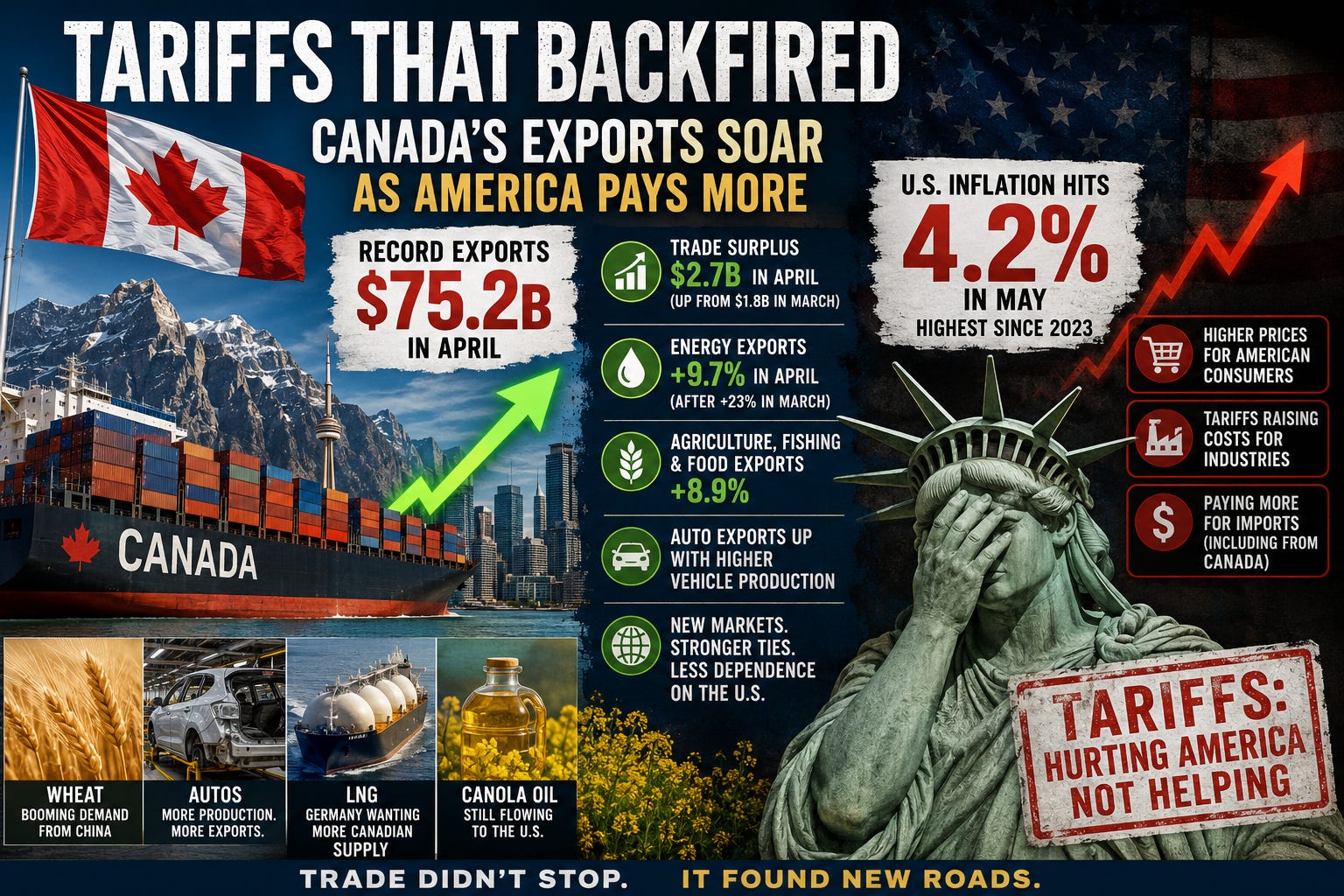
In April, Canada recorded a $2.7 billion trade surplus, up from $1.8 billion in March. Even more interesting? Canadian exports hit a record $75.2 billion.
That’s not survival.
That’s momentum.
And here’s the uncomfortable part for the tariff crowd south of the border:
This wasn’t just oil doing the heavy lifting.
That would’ve been the easy explanation.
Energy exports did jump again… up 9.7% in April after a massive 23% surge in March… but growth spread far beyond pipelines and pump jacks.
Agriculture, fishing, and food exports climbed 8.9%.
Canadian wheat exports surged as China stepped back into the picture and demand picked up.
Auto exports rose too, helped by increased vehicle production here at home.
Which creates one of those awkward little economic contradictions nobody likes talking about…
America tried to weaken Canadian manufacturing…
…and Canada wound up building and exporting more vehicles anyway.
That’s a bit like trying to sink someone’s fishing boat only to discover they bought a bigger engine.
The Quiet Thing Canada Did Right
Canada did something we probably should’ve done years ago.
We stopped assuming one customer was enough.
For decades, Canada leaned hard on the U.S. market. Convenient? Absolutely.
Smart long term?
Not really.
Because depending too heavily on one customer… especially one that changes policy every election cycle… is a little like building your retirement plan around a neighbour who changes moods every morning.
When tariffs arrived, Canada didn’t stop trading.
It started looking around.
China reopened demand for Canadian agriculture.
Germany began pushing for additional Canadian LNG supply as Europe keeps trying to reduce long-term energy vulnerability.
Trade didn’t disappear.
It rerouted.
That matters.
Because the story here isn’t really about one good month.
It’s about leverage.
The United States wanted more control over trade.
Instead, trading partners started learning how to work around the pressure.
That’s not rebellion.
That’s adaptation.
Meanwhile… Inflation Shows Up at America’s Front Door
Here’s the part Washington probably didn’t put in the campaign brochure.
U.S. inflation climbed to 4.2% in May, the highest level since 2023.
And tariffs have an annoying habit economists keep warning about…
They often make imports more expensive for the very people imposing them.
In plain English?
American consumers frequently end up paying part of the bill.
Higher costs move through supply chains.
Manufacturers pay more.
Retailers pay more.
Consumers eventually feel it in groceries, vehicles, household goods, and everyday life.
Protectionism sounds powerful in a speech.
It gets messier in a shopping cart.
And despite all the tough talk, America still relies on Canadian goods.
Canola oil still crosses the border.
Canadian energy still matters.
Auto parts still move back and forth because North American manufacturing was built as one giant ecosystem.
You can’t untangle decades of economic integration by yelling louder.
Canada Isn’t “Winning” Yet… But Something Has Changed
Before we start dancing in the streets waving giant maple leaves…
A reality check.
Canada still depends heavily on the U.S. economy.
If America catches a cold, Canada usually starts sneezing.
That hasn’t changed.
But something important has changed…
Canada appears to be learning how to reduce the risk.
Exports are becoming more diversified.
Trade relationships are widening.
Energy influence is growing.
Manufacturing is showing signs of life again.
And Canada’s economy is still expected to grow… with GDP estimated up 0.4% in April.
That may not sound dramatic.
But in a world where many expected tariffs to punch holes in Canada’s economy?
It matters.
A lot.
Because the bigger story here may not be that Canada suddenly became an economic superpower.
The bigger story is this…
The old model is cracking.
For decades, the global economy revolved around one giant engine… the United States.
Now the system looks increasingly like several engines sharing the load.
China.
Europe.
Canada.
Regional trade blocks.
New energy corridors.
More backup plans.
More options.
And once countries discover they have options…
they rarely go back.
The Recap…
Canada was supposed to be the one hurting from U.S. tariffs.
Instead?
Record exports. Bigger trade surplus. New buyers showing up.
Turns out tariffs didn’t stop trade.
They just changed where the business went.
The Gut-Punch…
America tried to remind Canada who held the power.
What it may have accidentally done instead… was remind Canada not to depend on one customer ever again.
Source credit:
Statistics Canada trade data, Canadian GDP estimates, U.S. inflation reports, and reporting on emerging Canada–Germany LNG discussions.
🔎 The GeezerWise Standard
This space is built on disciplined thinking.
Facts over spin.
Verification before amplification.
Good-faith discussion over tribal noise.
I use AI tools to help shape my spoken drafts into clear writing.
The judgment, conclusions, and final message are mine.
If you’re new here, this explains how I decide what’s worth sharing:
How I Decide What’s Worth Sharing → [link]
💌 Subscribe at GeezerWise.com to receive future letters:
www.geezerwise.com/subscribe
— Fred Ferguson
GeezerWise
#CanadaStrong
Fred, from where I sit it looks as though Canada has done the right thing diversifying away from the Disunited States. Did you see the survey about which country most countries think is the most dangerous? The USA came out top.
One thing about your writing, I like, is it is simple enough for laymens to understand! Canada may have a "highly educated" population (I beg to differ) but, the fact of the matter is canadian reading skills remains grade 3-9 level. This is why your writings matters! There is no fluff, no guff, with a bit of humor, factual, and to the point! People can and should read your work with ease and that matters, now more then ever! Because I share your work I now have people asking me about things you write and more! Knowledge matters and slogans, rhetoric, lies, and sound bites do not! Thanks for that!