

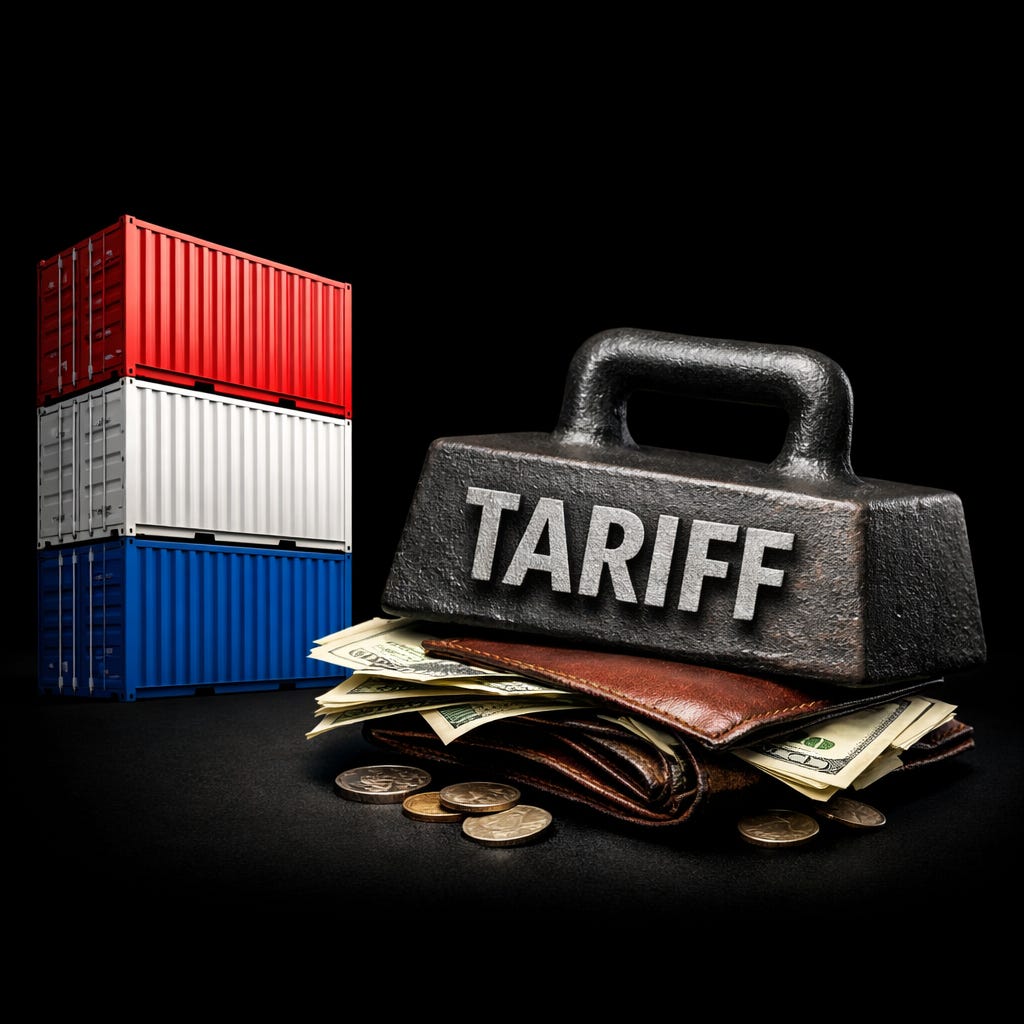
There’s a simple rule in life.
If someone tells you a policy will cost you nothing…
you should immediately check your wallet.
Because odds are… you’re already paying.
That’s exactly what just happened with U.S. tariffs.
New data from the Federal Reserve Bank of New York confirms that Americans paid nearly all of them. Not China. Not Europe. Not foreign corporations.
Americans.
The Numbers Are Brutal
The U.S. Treasury collected about $287 billion in tariffs in 2025… a massive jump from the previous year.
Independent analysis shows…
Americans paid 94% of tariff costs early in 2025
About 92% later in the year
Around 86% by November
Different institutions reached the same conclusion…
Federal Reserve
Congressional Budget Office
Tax Foundation
Harvard researchers
Kiel Institute in Germany
When economists across political systems agree, that’s not opinion. That’s gravity.
This policy amounted to the largest U.S. tax increase since 1993.
Except it wasn’t called a tax.
It was called patriotism.
How Tariffs Actually Work
Tariffs aren’t magic money from foreigners.
They’re taxes paid at the border by American importers.
Those companies then have two choices…
Eat the cost (lower profits)
Raise prices (consumers pay)
Either way… Americans lose.
We already saw the consequences.
General Motors reported about $1.1 billion in tariff-related losses
Procter & Gamble raised prices on household products
Consumer prices climbed in multiple categories
From early 2025 to early 2026…
Clothing prices rose 14%
Household furnishings rose nearly 4%
Cleaning supplies and paper goods rose about 5%
That’s not theory. That’s grocery bills.
The Household Hit
Estimates vary slightly, but they all point the same direction.
Average cost per household…
About $1,000 in 2025
Around $1,300 in 2026
Up to $1,751 annually under higher tariff levels
That money didn’t disappear.
It moved.
From families → to government revenue.
A direct wealth transfer.
The Economic Damage
Tariffs also created ripple effects across the economy.
Higher costs for manufacturers mean…
Lower competitiveness
Reduced investment
Lost market share
One estimate projected…
0.4 percentage point reduction in GDP growth
0.6 percentage point increase in unemployment
Up to 1.3 million fewer jobs by the end of 2025
That’s what economists call second-order effects.
Regular people call it layoffs.
The Global Competitive Problem
Here’s where it gets even worse.
Companies outside the U.S. often don’t face these tariffs when trading within free-trade zones.
That means…
A Canadian or European manufacturer buying the same imported parts may operate at lower cost than an American competitor.
Higher U.S. tariffs can unintentionally weaken domestic industry instead of strengthening it.
Economic nationalism sometimes ends up being economic self-sabotage.
The Legal Risk
There’s also a constitutional question hanging over everything.
Courts are debating whether the president even had the authority to impose these tariffs under emergency powers.
If the policy is struck down, estimates suggest the government could owe businesses up to $168 billion in refunds.
Which means taxpayers could pay again.
The Credibility Gap
The biggest issue isn’t just money.
It’s trust.
The tariffs were sold with a clear promise…
Foreign countries would pay.
Now multiple institutions… using different data… say the opposite.
When rhetoric and reality diverge this far, credibility takes damage.
And once credibility cracks, markets notice.
So do allies.
So do voters.
The Bottom Line
Tariffs can be useful tools in certain circumstances.
But pretending they’re free money from foreigners isn’t economics.
It’s marketing.
And this time, the bill landed exactly where economics said it would…
On American households.
The Recap…
The tariff story just blew open.
New data shows Americans paid almost all of them… not foreign countries.
This wasn’t economic strength.
It was a hidden tax.
That’s what actually happened.
The Gut Punch…
“Tariffs didn’t punish foreigners — they taxed Americans with better branding.”
Source Credit…
Source: Federal Reserve Bank of New York, CBO, Tax Foundation, academic tariff research (2025–2026).
🔎 The GeezerWise Standard
This space is built on disciplined thinking.
Facts over spin.
Verification before amplification.
Good-faith discussion over tribal noise.
I use AI tools to help shape my spoken drafts into clear writing.
The judgment, conclusions, and final message are mine.
If you’re new here, this explains how I decide what’s worth sharing:
How I Decide What’s Worth Sharing → [link]
💌 Subscribe at GeezerWise.com to receive future letters:
www.geezerwise.com/subscribe
— Fred Ferguson
GeezerWise
#CanadaStrong
I appreciate the clarity of your information for someone like me who doesn't study economics, and since your are Canadian, your "trust" quota is high.
Thanks for your posts.
Canada tried to tell you when Trump threatened tariffs at the beginning of 2025.... but no, tariffs were good for U.S.. Sorry to be right... Sorry, not sorry. 🇨🇦