

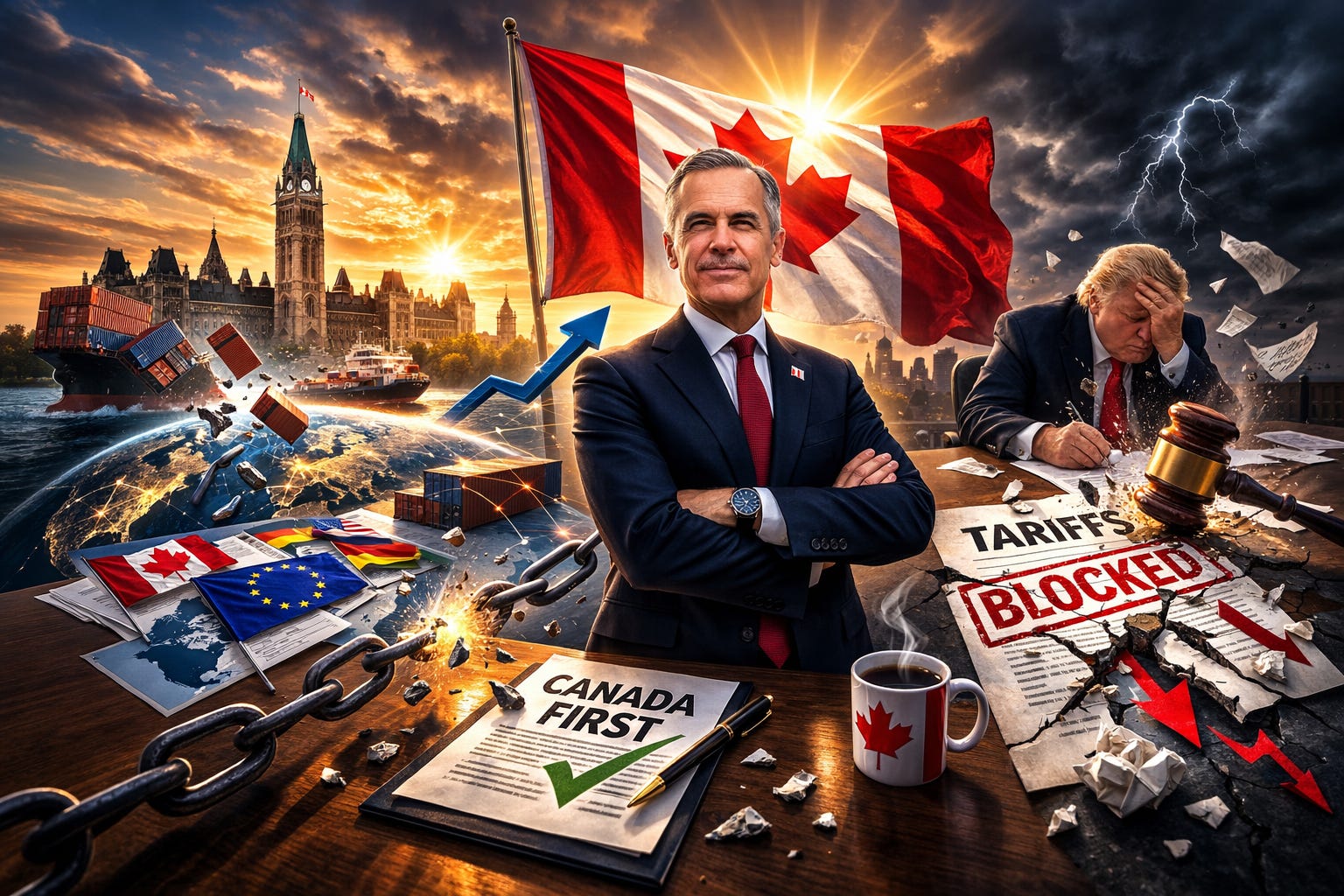
Sometimes the most important economic news isn’t about money.
It’s about power.
This week, the United States Supreme Court delivered a ruling that quietly rewrites the balance of authority in Washington… and it has ripple effects far beyond American borders.
The court determined that sweeping global tariffs imposed under emergency powers were never legally justified in the first place.
Not stretched.
Not questionable.
Not controversial.
Unauthorized.
That matters… a lot… because tariffs were being used as a geopolitical pressure tool. Countries were told to make concessions or face economic punishment.
Now the legal foundation under that threat just cracked.
What the Court Actually Did
In a 6–3 decision, the justices drew a clear constitutional line…
Trade policy… especially tariffs… belongs to Congress, not the president acting alone under emergency authority.
Emergency powers are meant for genuine crises. War. National collapse. Severe threats.
They are not a shortcut to bypass lawmakers because negotiations are inconvenient.
That distinction is bigger than trade. Once a court limits executive power in one area, lawyers immediately start asking where else those limits apply.
Immigration. Sanctions. Regulatory actions.
The ruling doesn’t just affect tariffs. It narrows the concept of unilateral presidential authority.
That’s the real headline.
The Money Shock
There’s also a massive financial aftershock.
Roughly $175 billion in tariffs were collected under the disputed authority.
Contrary to political messaging, tariffs are not paid by foreign governments.
They are paid by importers… which means businesses and consumers inside the country imposing them.
Now more than a thousand companies are lining up seeking refunds.
That process will take years and trigger more litigation, but markets reacted immediately.
Investors like predictability.
Courts just restored some.
Trade works best when rules are boring and stable… not announced on social media overnight.
Not All Tariffs Disappear
Some sector-specific tariffs remain in place because they were imposed under different statutes… steel, aluminum, and certain strategic industries among them.
But the broad “global leverage” tool just got weaker.
And that changes negotiating dynamics worldwide.
Canada’s Position Just Improved Overnight
For Canada, this ruling removes a major layer of uncertainty.
One of the biggest risks businesses faced wasn’t existing tariffs… it was unpredictability. The possibility of sudden policy changes with little warning.
That risk just dropped.
Exports tied to manufacturing, agriculture, and integrated supply chains become easier to plan around when policy volatility declines.
But there’s another reason this moment matters.
Ottawa didn’t rush into concessions while pressure was high.
That patience now looks smart.
Negotiating while someone is holding a legal threat over your head is bad strategy… especially if the threat turns out to be shaky.
Canada waited.
The court confirmed that caution was justified.
Europe Saw the Same Signal
European governments had already been diversifying trade relationships… expanding agreements with Asia, Latin America, and partners like Canada.
This ruling reinforces that strategy.
It also signals something important globally…
The United States presidency still has limits.
Even when politics feels chaotic, institutional guardrails can still activate.
Markets notice that.
Allies notice that.
Competitors notice that.
This Story Isn’t Over
The political pressure around trade policy isn’t disappearing.
Alternative legal routes exist. Future policies will still create friction.
But the toolbox just got smaller.
And negotiations going forward will look different because of it.
Strip away the noise and here’s the simple truth…
This wasn’t really about tariffs.
It was about whether one person could bend global trade rules alone.
The answer, at least for now, is no.
And for Canada, that’s breathing room.
The Recap…
The U.S. Supreme Court just shut down a major presidential trade weapon.
That decision doesn’t just affect America… it changes the negotiating landscape for Canada and Europe too.
And Ottawa’s decision to wait instead of panic suddenly looks very smart.
The Gut Punch…
“Don’t negotiate while someone’s pointing a gun at you… especially if the gun turns out to be illegal.”
Source Credit:
Source context: U.S. Supreme Court ruling analysis discussed in international economic commentary.
🔎 The GeezerWise Standard
This space is built on disciplined thinking.
Facts over spin.
Verification before amplification.
Good-faith discussion over tribal noise.
I use AI tools to help shape my spoken drafts into clear writing.
The judgment, conclusions, and final message are mine.
If you’re new here, this explains how I decide what’s worth sharing:
How I Decide What’s Worth Sharing → [link]
💌 Subscribe at GeezerWise.com to receive future letters:
www.geezerwise.com/subscribe
— Fred Ferguson
GeezerWise
#CanadaStrong
As time passes I have come to appreciate the roles that AI can have in news reporting.
But only, as you have, if it is used openly and with human supervision.
In particular, I like the multiple, daily posts, each summarizing a current headline.
Choosing which Substacks to pay for is a difficult choice.
But, your unusual format and the measured and open use of AI is making yours stand out.
Did it? What I hear was a very angry Trump talk about embargoes, killing countries.
I get it, he was angry, but he’s already used one of the dissenters “advice” for tariffs (Kavanaugh). He wants Canada. Expect really, really bad things . It won’t be against Europe, because of the Atlantic ocean, it will be against the Americas. Iran is getting a reprieve. Or maybe he’s going to attempt to take on both. He’s angry, he’s incapable of being rational when he’s not angry, never mind when he’s irate.