

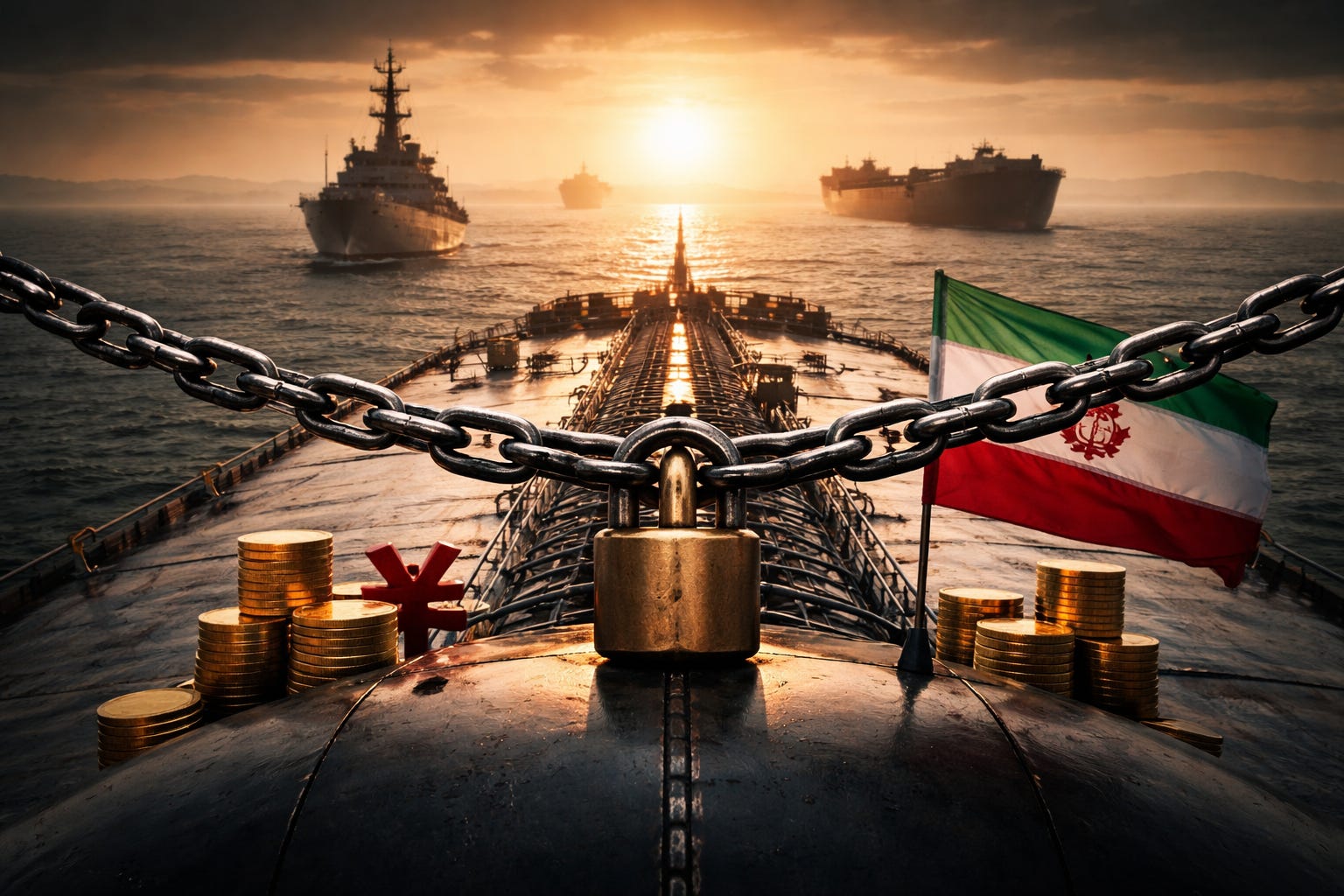
Let’s strip this down to what actually matters.
In early March 2026, Iran effectively took control of traffic through the Strait of Hormuz after U.S.–Israeli strikes.
Not officially on paper at first… but operationally, it was already happening.
Ships didn’t just pass through anymore.
They paid.
Roughly…
$0.50 to $1 per barrel
About $2 million per fully loaded supertanker
Payments accepted in Chinese yuan, Bitcoin, and Stablecoins
By late March, Iran formalized the system.
What started as control turned into a revenue machine.
Estimates…
~$20 million per day from oil tankers
Potentially $600–$800 million monthly with LNG included
That’s not a toll booth.
That’s a financial pipeline.
Now enter Donald Trump with a response.
Blockade the strait.
Intercept ships that paid Iran.
Seize them in international waters.
Sounds tough.
But here’s the problem…
The money already moved.
This is where the wheels come off.
Payments happen digitally, before ships even enter the strait.
Routed through Chinese banking (Kunlun Bank)
Outside SWIFT
Invisible to U.S. financial enforcement
By the time a U.S. destroyer stops a ship…
Iran already has the money.
So what’s the outcome?
The shipping company loses a $200M vessel
Iran keeps the $2M toll
China’s payment system proves it can’t be touched
That’s not enforcement.
That’s punishment after the fact… with no leverage left.
Now zoom out.
This move forces every shipping company into a brutal choice:
Pay Iran → risk U.S. seizure
Don’t pay → risk Iranian attack
Either way…
Ships slow down or stop.
And when oil slows down?
Prices don’t politely rise.
They jump.
Projections…
Oil could hit $110–$120 per barrel
Gas prices spike across the U.S.
The very thing this move is supposed to fix…
gets worse.
But the real story isn’t oil.
It’s currency.
Before this, switching to yuan wasn’t a no-brainer.
Companies hesitated…
Regulatory uncertainty
Dollar system dominance
Infrastructure friction
After this?
Different game.
If you’re getting punished for using yuan anyway…
why not go all in?
The cost of switching drops to zero.
That’s how systems change—quietly, then all at once.
From China’s perspective, this is a gift.
They already…
Import over 80% of Iran’s oil
Pay largely in yuan
Now they can frame the situation like this…
“We’re protecting trade.
They’re disrupting it.”
That narrative writes itself.
And when China steps in with naval escorts… as expected…
they don’t look like aggressors.
They look like stabilizers.
Meanwhile, allies start drifting.
The United Kingdom already signaled it won’t participate in the blockade.
European countries are building energy independence…
France expanding nuclear
Spain scaling hydrogen
Denmark investing in offshore wind
None of that depends on U.S. naval protection.
So they watch this unfold…
and quietly adjust.
Here’s the deeper shift most people miss.
This isn’t about a strait.
It’s not even about oil.
It’s about two systems colliding…
U.S.: control through physical force
Iran + China: bypass through digital finance
One blocks ships.
The other moves money around the blockade entirely.
Guess which one scales faster?
We’ve seen this before.
During sanctions on Venezuela…
Cut off from SWIFT
Switched to yuan and crypto
Built alternative rails
Now it’s the same playbook… just bigger stakes.
Different country. Same outcome.
So what actually happens next?
Shipping volume drops
Oil prices rise
Yuan adoption accelerates
Dollar influence weakens at the edges
Not overnight.
But direction matters more than speed.
And the direction just changed.
The Recap…
Iran turned a choke point into a cash machine.
The U.S. tried to shut it down… with ships.
But the money moved first… and moved elsewhere.
Now the system isn’t breaking.
It’s rerouting.
The Gut-Punch…
You can seize a tanker…
…but you can’t seize a payment system that already left you behind.
Source credit:
Analysis by House of El based on shipping intelligence data, sanctions enforcement patterns, and reported developments around Strait of Hormuz transit payments and U.S. interdiction strategy.
🔎 The GeezerWise Standard
This space is built on disciplined thinking.
Facts over spin.
Verification before amplification.
Good-faith discussion over tribal noise.
I use AI tools to help shape my spoken drafts into clear writing.
The judgment, conclusions, and final message are mine.
If you’re new here, this explains how I decide what’s worth sharing:
How I Decide What’s Worth Sharing → [link]
💌 Subscribe at GeezerWise.com to receive future letters:
www.geezerwise.com/subscribe
— Fred Ferguson
GeezerWise
#CanadaStrong
Just like every other move Trump makes and everything he comes in contact with, this one has turned to dog feces. Because he only acts in one way, rashly without consideration for the consequences, this blockade move will end up blowing up in his face as you described Fred.
Thanks to his authoritarian without compassion ways, Trump actually has the world cheering on Iran to put him in his place.
Never in my wildest dreams did I see Iran as the adult in the room on the world stage. The fanta shitgibbon couldn't have given China a.bigger gift than this stupid war, the stupider blockade of a blockade amd the stupidest reinforcement of the Yuan as a potential replacement of the dollar as the worlds reserve currency. There is absolutely zero forethought or analysis before he acts and when the results aren't what he expects he dou he's down on being the stupideriest leader in the world. We are so screwed.