

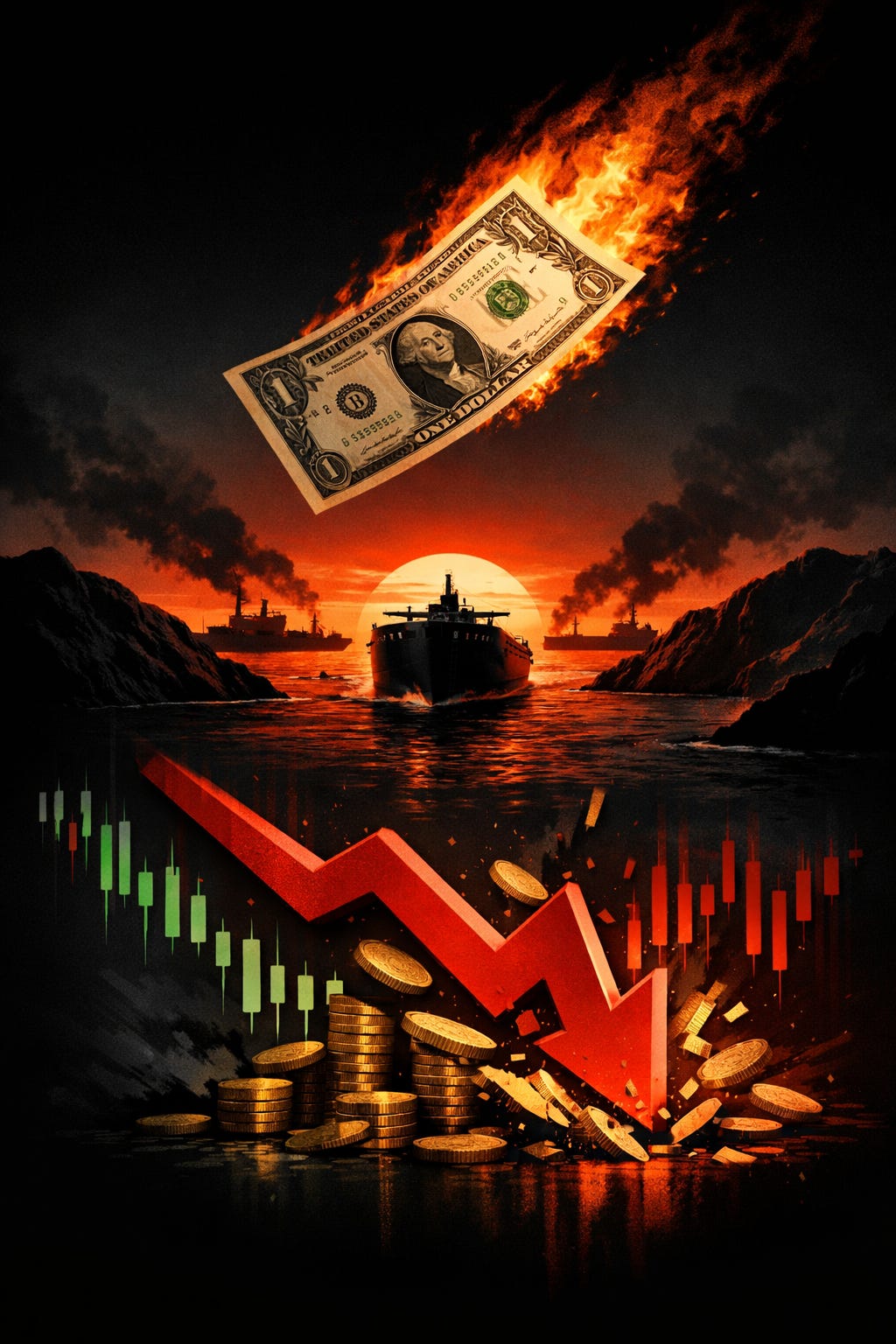
Everyone talks about oil when the Strait of Hormuz is threatened.
But the real danger isn’t just oil.
It’s what happens to the financial system when a country like Japan suddenly can’t get energy.
And that’s where things get interesting… and potentially ugly.
Japan imports roughly 90% of its total energy.
More than 95% of its oil passes through the Strait of Hormuz.
If that corridor is disrupted, Japan doesn’t just pay higher prices.
It faces a structural problem: keeping the lights on.
Japan has about three months of oil reserves. After that, the economy begins to seize up. Transportation slows. Factories idle. Electricity becomes uncertain.
And electricity matters.
About 36% of Japan’s power generation comes from imported LNG.
No LNG shipments, no electricity.
No electricity, no industrial economy.
That’s the starting point of the domino chain.
The Energy Shock
The market reaction started almost immediately.
In the first week of fighting:
European gas prices jumped 70–75%
Shipping rates from the Middle East surged to roughly $500,000 per day from around $30,000
Oil prices spiked about 16%
Freight costs rose 15–20%
Those numbers feed straight into inflation.
Energy touches everything… transportation, manufacturing, food production, electricity.
Europe already expects household energy bills in the UK to approach £2,500 per year if prices stay elevated.
Canada doesn’t escape either.
We sell crude oil, yes… but we also buy refined fuels and operate in the same global pricing system.
When energy spikes in Europe and Asia, it spikes everywhere.
Japan’s Central Bank Trap
Japan’s real crisis isn’t only energy.
It’s monetary policy.
The yen has weakened toward 157 per US dollar, approaching the psychologically dangerous 160 level.
That leaves the Bank of Japan facing two bad options.
Raise interest rates to defend the currency and fight inflation.
Or keep rates low and watch the yen fall further.
Both choices carry consequences.
Higher interest rates risk slowing Japan’s fragile economy.
But letting the yen fall pushes import costs — especially energy — even higher.
That combination is the classic nightmare economists call stagflation.
Slow growth plus rising prices.
The Carry Trade Time Bomb
For years, global investors borrowed cheap Japanese yen and used it to buy higher-yielding assets around the world.
US stocks.
European bonds.
Emerging market debt.
This strategy is called the yen carry trade.
It’s enormous… and it quietly provides liquidity across global markets.
But it only works if Japanese borrowing costs stay extremely low.
If the Bank of Japan raises rates during an energy crisis, that trade unwinds.
Investors suddenly have to repay yen loans.
To do that they sell assets.
Lots of assets.
US bonds.
European debt.
Stocks everywhere.
That kind of synchronized selling can ripple across markets quickly.
The Treasury Market Problem
Japan also happens to be the largest foreign holder of US Treasury bonds.
About $1.2 trillion worth.
Its government pension fund alone holds roughly $400 billion in Treasuries.
If Japan needs to defend the yen… or raise cash during an energy emergency… those bonds could be sold.
Even a portion hitting the market quickly would push US borrowing costs higher.
That matters because the United States finances its government through those bonds.
Higher yields mean higher interest payments.
At a time when spending is already elevated.
Why This Matters Globally
Energy shocks rarely stay confined to one sector.
They move through the system.
First oil.
Then inflation.
Then interest rates.
Then currencies.
Then bonds.
Then stock markets.
Japan’s situation illustrates how tightly everything is connected.
An energy disruption in the Middle East can end up affecting…
Asian currencies
European energy markets
American borrowing costs
All within the same financial chain.
The Real Risk
Economists sometimes talk about “cascading risk.”
That’s when multiple fragile systems interact at the same time.
Energy markets.
Currency markets.
Bond markets.
Right now, several of those pieces are under stress simultaneously.
Japan’s dependence on imported energy makes it one of the first countries exposed.
But if the financial mechanisms tied to that energy shock begin to unwind… especially the carry trade… the consequences spread quickly.
Because in modern markets, nothing moves alone anymore.
The Recap…
Energy crises don’t stay in the energy sector.
Japan imports 90% of its energy, and most of it passes through the Strait of Hormuz.
If that flow is disrupted, the consequences won’t stop in Asia.
Currencies, bond markets, and global investment flows could all feel the shock.
This story is bigger than oil.
The Gut-Punch…
When energy stops moving, money starts running.
Source Credit:
Based on public statements from the Bank of Japan, market data from Morgan Stanley and Nomura research, and international energy market reports.
🔎 The GeezerWise Standard
This space is built on disciplined thinking.
Facts over spin.
Verification before amplification.
Good-faith discussion over tribal noise.
I use AI tools to help shape my spoken drafts into clear writing.
The judgment, conclusions, and final message are mine.
If you’re new here, this explains how I decide what’s worth sharing:
How I Decide What’s Worth Sharing → [link]
💌 Subscribe at GeezerWise.com to receive future letters:
www.geezerwise.com/subscribe
— Fred Ferguson
GeezerWise
#CanadaStrong
🇨🇦💙 What if Japan sells billion$ in US bonds and starts paying for imports in Chinese Yuen? This could be the global crisis that tanks the US dollar and gets the world back to WTO rules based trade?
With the current national debt nearing $39 trillion, and Trump blowing through $$ faster than the Titanic taking on water, this seems absolutely plausible in the near future. Additionally as the #2 holder of US debt, China, while not quite in the dire straights (no pun intended) as Japan, is I read 2 days ago; getting nervous over the current Trumpian War. That first domino could be teetering at this very moment.