

We’ve spent the last year talking about the price of AI.
The electricity.
The water.
The subsidies.
The giant warehouses full of humming machines eating enough power to light up small cities.
But now there’s another question creeping into the conversation… and this one feels like something out of a science-fiction movie.
What if the problem isn’t what you can hear…
What if it’s what you can’t?
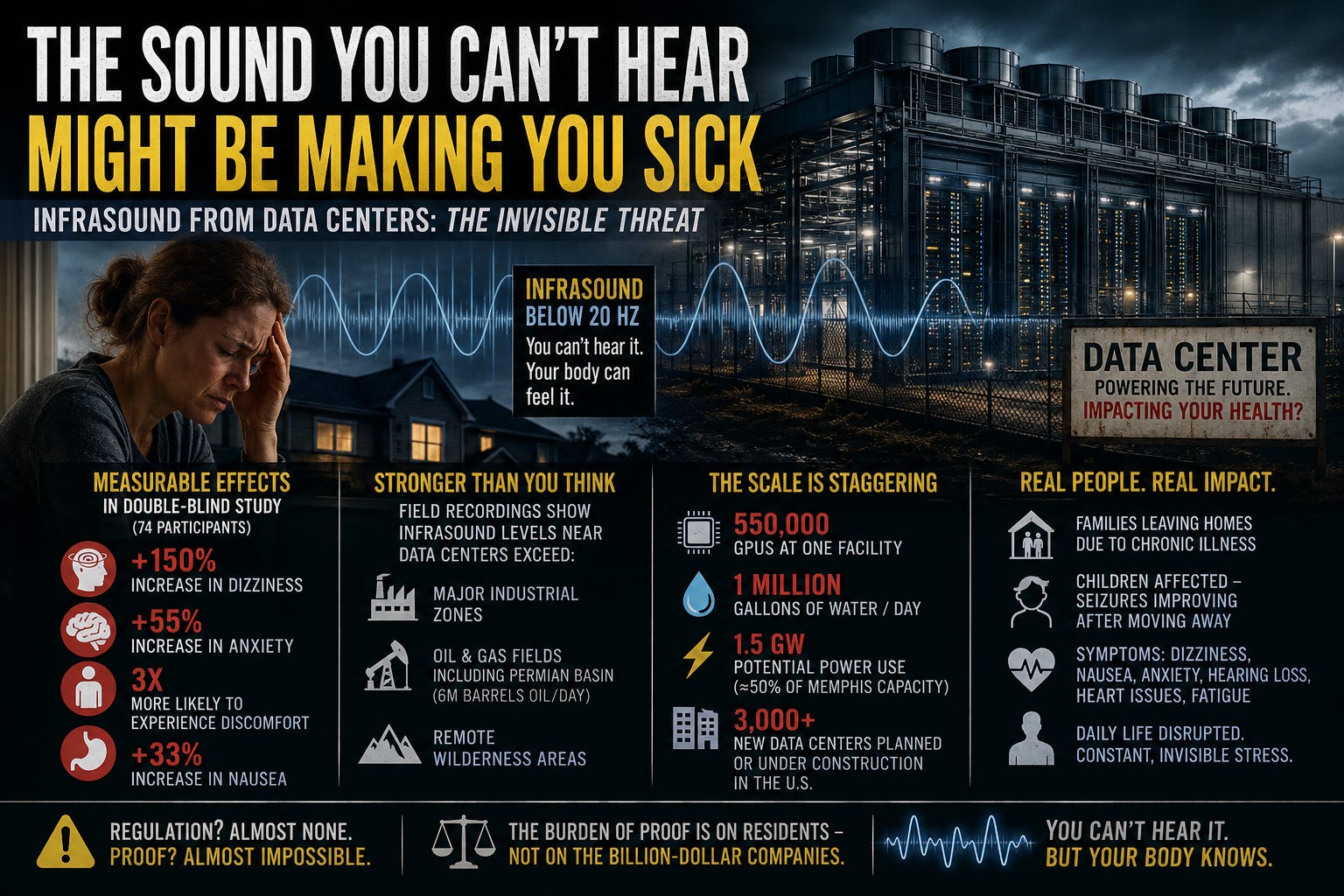
Researchers and residents near major data centers are raising concerns about something called infrasound… extremely low-frequency vibrations below 20 Hz. Humans generally can’t hear it, but that doesn’t mean the body ignores it.
In plain English?
Your ears may miss it.
Your nervous system might not.
And if early evidence holds up, this could become the next big environmental fight nobody was prepared for.
The complaints started sounding strangely familiar
In communities near new data centers, people began reporting the same kinds of problems:
Dizziness.
Nausea.
Vertigo.
Anxiety.
Hearing problems.
Heart palpitations.
Constant fatigue.
Some families described feeling physically uncomfortable inside their own homes without understanding why.
Others eventually moved.
In one case, reports suggested a child’s seizures improved after leaving an area near a facility.
Now, to be clear… correlation is not proof.
That matters.
But here’s where this story gets uncomfortable.
The complaints started stacking up in different places from different people who had never spoken to each other.
That tends to get attention.
Then somebody started measuring it
Instead of dismissing the complaints as internet hysteria or neighbourhood paranoia, investigators began recording environmental sound patterns near multiple facilities.
The results raised eyebrows.
Field recordings reportedly showed stronger low-frequency vibration around some data centers than in major industrial areas… even stronger than parts of oil and gas regions.
That’s not a small claim.
We’re talking about infrastructure often sold to communities as “clean tech.”
Quiet.
Modern.
Harmless.
Meanwhile, nearby residents were saying the walls felt like they vibrated.
One description stuck with me:
Imagine your house quietly humming in a language your body understands… but your ears don’t.
That’s the unsettling part.
You can’t point at it.
You can’t prove it.
And most regulators aren’t even measuring it.
The experiment that changed the conversation
Up until recently, critics could dismiss this as anecdotal.
People complain about wind turbines.
Factories.
Traffic.
Construction.
Fair enough.
But a small double-blind experiment added something different: measurable symptoms.
Researchers exposed participants to infrasonic conditions without people knowing what they were being exposed to.
Out of a cleaned study group of 74 participants, researchers reportedly found:
150% increase in dizziness
55% increase in anxiety
Three times higher discomfort
33% increase in nausea
There was also an increase in lethargy, although researchers treated that one cautiously.
Small study?
Yes.
Final proof?
No.
But this is where the conversation changes.
We’ve moved from…
“People are complaining.”
To:
“Something measurable may actually be happening.”
That’s a very different discussion.
Meanwhile, AI infrastructure is exploding
And here’s the timing problem.
This isn’t happening while data center growth is slowing.
It’s happening while the accelerator is jammed to the floor.
More than 3,000 new data centers are planned or already under construction in the United States alone.
Some are absolutely massive.
One high-profile facility reportedly runs around 550,000 GPUs, consumes about one million gallons of water per day, and could eventually require 1.5 gigawatts of electricity… roughly half the power capacity of Memphis.
Think about that for a second.
We are building industrial infrastructure at warp speed while still arguing about whether we understand all the biological side effects.
That feels familiar.
We did this with asbestos.
Lead.
Smoking.
Polluted rivers.
“Looks fine. Build first. Study later.”
History has a nasty habit of billing us after the party.
Here’s the real problem
Even if people are getting sick…
How do they prove it?
That’s the trap.
There are few rules around infrasound.
Little baseline monitoring.
Minimal regulation.
And almost no requirement for companies to collect meaningful environmental vibration data before construction.
Which means the burden gets flipped onto ordinary people.
You feel awful.
Your house shakes.
You can’t sleep.
But proving the cause?
Good luck.
One argument already showing up in disputes sounds like this:
“There’s no proof the vibration wasn’t already there.”
Convenient.
Especially when nobody measured anything beforehand.
That’s not science.
That’s a loophole.
Society wants AI… just not next door
This is where the contradiction lives.
We all use the internet.
Cloud storage.
AI.
Streaming.
Digital banking.
Every click lives inside a data center somewhere.
Society wants the convenience.
Governments want the investment.
Tech companies want speed.
But local communities are increasingly asking a fair question…
Who pays the price?
The power grid?
Residents?
Water supplies?
Property values?
Public health?
Because if even part of this research proves true at larger scale, the fight over data centers changes overnight.
This stops being a zoning issue.
It becomes a health issue.
And those fights tend to get expensive.
The bottom line
I’m not here to tell you the science is settled.
It isn’t.
But I am saying this:
When people in different places start reporting similar symptoms…
When measurements begin showing unusual patterns…
When experiments start detecting measurable effects…
And when thousands of new facilities are about to be built anyway…
Maybe the grown-up response isn’t dismissal.
Maybe it’s:
“Slow down. Measure first.”
Because invisible problems have a nasty habit of becoming very visible later.
And if your house is shaking from something you can’t even hear?
That’s not exactly the kind of future Big Tech put in the brochure.
The Recap…
We worried about AI data centers draining power and water.
Now there’s a new concern: the sound you can’t hear.
Early research suggests low-frequency vibrations from data centers may be linked to dizziness, anxiety, nausea, and chronic discomfort.
3,000+ new facilities are coming.
Feels like one of those things we probably should understand before we build first and ask questions later.
The Gut-Punch…
The scary part about invisible problems is this:
By the time people finally believe them…
The concrete is already poured.
Source credit:
Research notes compiled from reporting, field recordings, experimental findings, community complaints, and publicly discussed infrastructure expansion data related to AI and hyperscale data centers.
🔎 The GeezerWise Standard
This space is built on disciplined thinking.
Facts over spin.
Verification before amplification.
Good-faith discussion over tribal noise.
I use AI tools to help shape my spoken drafts into clear writing.
The judgment, conclusions, and final message are mine.
If you’re new here, this explains how I decide what’s worth sharing:
How I Decide What’s Worth Sharing → [link]
💌 Subscribe at GeezerWise.com to receive future letters:
www.geezerwise.com/subscribe
— Fred Ferguson
GeezerWise
#CanadaStrong
A suggestion for those wanting to follow this, consider checking out Erin Brockovich. Yes, that Erin Brockovich. She's here on substack and she's already on the data center case.
Very informative post Fred! It had me thinking back to times when people were being advised not to build homes near power grids, because they were potentially cancer causing. These centers far exceed power grids, so ya, people shouldn't be so anxious to want them in their cities. I don't want any near me, however, when visiting other provinces, exposure is more likely. Sounds very risky to me. I have lived in cities, but, tiny towns are sounding more & more inviting to me. We have managed a long time without AI, I'm sure we can still manage. Then the water factor, will our Great Lakes be at risk? Oh, & I swam in ALL The Great Lakes haha