

The shortest wars sometimes leave the longest scars.
That’s because the damage isn’t always measured in destroyed buildings or military casualties.
Sometimes it’s measured in trust.
And trust is a lot harder to rebuild.
The recent U.S.-Iran conflict may have lasted only a few months, but the fallout is still spreading through the global economy.
The battlefield was in the Middle East.
The consequences are showing up everywhere from Frankfurt to Beijing.
Most people focused on the missiles.
The smarter money watched what happened afterward.
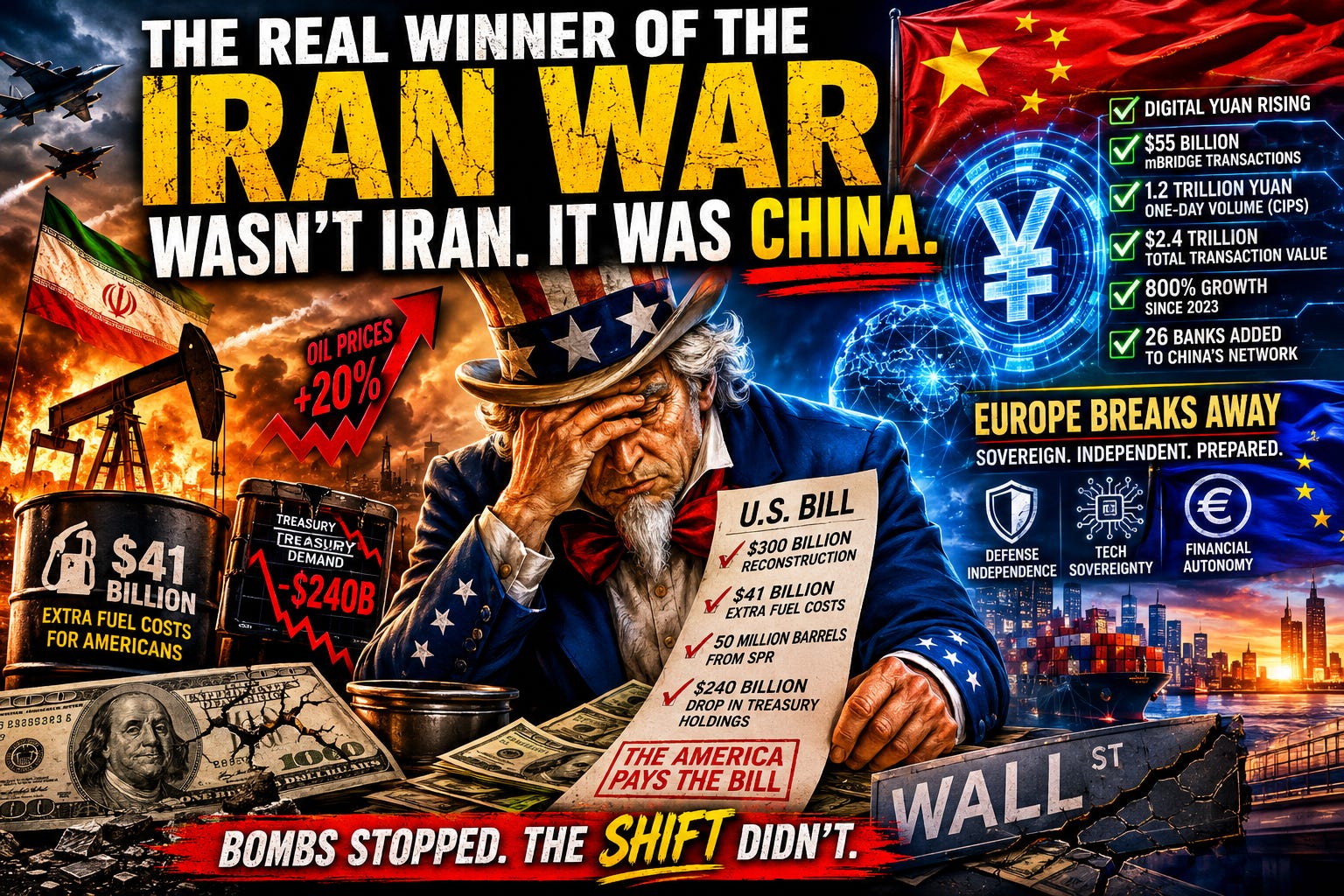
The war disrupted traffic through the Strait of Hormuz, one of the most important energy choke points on Earth.
At its peak, roughly 20 percent of global oil supplies were affected.
Energy prices jumped.
Inflation followed close behind.
American households alone were hit with an estimated $41 billion in additional fuel costs.
To stabilize markets, the United States reportedly drew down another 50 million barrels from its Strategic Petroleum Reserve.
But the oil shock was only the beginning.
The bigger story was what happened behind the scenes.
Long before this conflict began, countries around the world had been looking for ways to reduce their dependence on U.S.-controlled financial systems.
The dollar still dominates global trade, but cracks had already started appearing in the foundation.
This war accelerated that process.
China seized the moment.
While attention was focused on military operations, Beijing expanded its alternative payment networks at remarkable speed.
China’s digital yuan ecosystem continued growing, processing trillions in transaction value.
Cross-border systems expanded.
New banks joined the network.
What was once considered an experiment is increasingly becoming infrastructure.
That’s a very different thing.
Experiments can fail.
Infrastructure gets used.
China’s cross-border payment systems are no longer being discussed as future possibilities.
They are operating now, handling real transactions and attracting real participants.
That should get people’s attention.
Europe noticed too.
The war exposed a problem many European governments have quietly worried about for years… dependence.
Dependence on American technology.
Dependence on American defense systems.
Dependence on American financial networks.
The result has been a noticeable shift toward building more sovereign European capabilities across multiple sectors simultaneously.
Not because Europe suddenly became anti-American.
Because relying on a single supplier feels a lot riskier than it used to.
Then came another warning sign.
Foreign demand for U.S. Treasury debt weakened sharply.
Roughly $240 billion in foreign holdings disappeared in a single month according to the figures being reported.
Treasury yields climbed to levels not seen in nearly two decades.
That matters because America finances a significant portion of its spending through debt.
When fewer buyers show up, borrowing gets more expensive.
And expensive debt eventually becomes everyone else’s problem.
Meanwhile, inflation pressures remained elevated.
The European Central Bank responded with higher rates.
Markets remained uneasy. Investors who expected a massive relief rally after the peace agreement never got one.
That may be the most revealing detail of all.
Markets often forgive temporary disruptions.
They are far less forgiving when they suspect structural change.
And that’s what investors appear to be wrestling with.
The peace deal ended the shooting.
It didn’t reverse the trends.
In fact, some of them accelerated.
The strangest twist may be how the conflict ended.
The United States reportedly agreed to support a reconstruction package worth hundreds of billions of dollars…
while the core dispute that triggered the conflict remains unresolved and subject to further negotiations.
That leaves an uncomfortable question hanging in the air.
What exactly changed?
Iran survived.
China expanded its financial reach.
Europe accelerated its independence plans.
And America picked up a massive bill.
That’s not a judgment.
It’s an observation.
The most important lesson here isn’t about Iran.
It’s about momentum.
For years, people have talked about de-dollarization as if it were a distant possibility.
Now we’re seeing something different.
Countries aren’t just discussing alternatives.
They’re building them.
Payment systems.
Settlement networks.
Technology platforms.
Trade arrangements.
The infrastructure of a more fragmented world is being assembled piece by piece.
The United States remains the world’s largest economic power.
The dollar remains the world’s dominant currency.
Neither of those facts changed overnight.
But dominance doesn’t disappear all at once.
It erodes gradually.
A little trust lost here.
A little diversification there.
A few backup systems become permanent systems.
And eventually the world looks different than it did before.
That’s why the aftermath matters more than the war itself.
The missiles made headlines.
The infrastructure changes may end up making history.
The Recap…
America ended the war.
China expanded its payment networks.
Europe accelerated its independence plans.
And global investors started asking a question they weren’t asking a few years ago…
What happens if the world no longer wants all its eggs in the American basket?
The Gut-Punch…
The biggest thing America lost wasn’t oil, money, or military equipment.
It was a little more trust.
And trust is the one asset you can’t rebuild with a reconstruction fund.
Source credit:
House of El research compiled from reported developments surrounding the U.S.-Iran conflict, global energy markets, international financial systems, China’s digital yuan expansion, European strategic autonomy initiatives, and post-conflict market reactions.
🔎 The GeezerWise Standard
This space is built on disciplined thinking.
Facts over spin.
Verification before amplification.
Good-faith discussion over tribal noise.
I use AI tools to help shape my spoken drafts into clear writing.
The judgment, conclusions, and final message are mine.
If you’re new here, this explains how I decide what’s worth sharing:
How I Decide What’s Worth Sharing → [link]
💌 Subscribe at GeezerWise.com to receive future letters:
www.geezerwise.com/subscribe
— Fred Ferguson
GeezerWise
#CanadaStrong
Thanks Fred! Ya, orange man, I read somewhere, wanted other countries to kick in billions to rebuild Iran, apparently everyone is refusing. If you intentionally beat all the windows out of my house, why would I consider paying for damage you did, not, gonna happen, YOU have to fix them! It's childs play. How can one person be so freakin dumb as to even ask?!
While Russia and America are at war with everything China is Building Everything.