

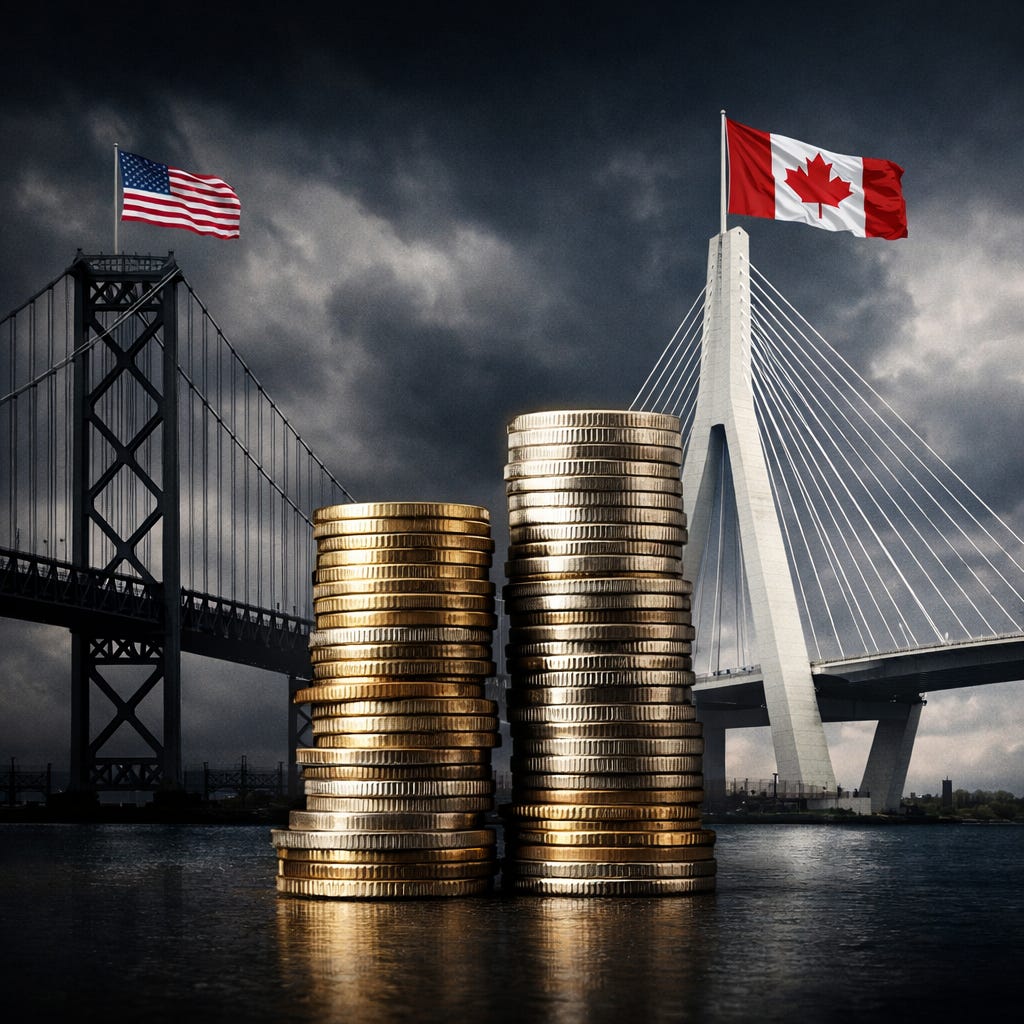
Most Canadians assume international infrastructure decisions…
are about economics, trade, or national strategy.
Sometimes they are.
Sometimes they’re about who owns the toll booth.
The new Gordie Howe International Bridge between Windsor and Detroit is nearly complete. It’s a massive project designed to ease congestion, strengthen supply chains, and modernize one of the most critical trade corridors in North America. Roughly a quarter of all Canada-U.S. goods trade crosses that region.
But just as the project approaches opening, political noise erupted from Washington… including threats suggesting the bridge might not be allowed to proceed normally.
That raised a simple question.
Why?
So let’s walk through the money trail.
About five kilometres away from the new crossing sits the Ambassador Bridge… a privately owned structure that has handled commercial traffic between Canada and the United States for decades.
Unlike most border crossings, it isn’t government-owned. It belongs to a billionaire family business that collects toll revenue from trucks moving between the two countries.
A modern competing bridge threatens that revenue. Fewer trucks on the old bridge means less income for its owners.
That’s basic market competition.
Here’s where it gets interesting.
Reports indicated that the chairman connected to the Ambassador Bridge operation met with the U.S. Commerce Secretary. Shortly afterward, political pressure regarding the new Canadian-funded bridge surfaced publicly.
The bridge owner’s family has also been a significant political donor in the United States and has spent millions on lobbying over the years, including opposition efforts against the new crossing project.
Again… none of that is illegal on its face. Lobbying and political donations exist in every democracy.
But timing matters.
When government decisions suddenly align with the financial interests of major donors, people start asking questions.
And those questions aren’t unreasonable.
Because the Gordie Howe bridge isn’t just another piece of infrastructure. It’s strategically important to both countries’ auto industries.
Delays or interference could disrupt supply chains, increase manufacturing costs, and create congestion that affects thousands of jobs on both sides of the border.
In other words, the stakes go far beyond one company’s toll revenue.
U.S. lawmakers have discussed measures that would prevent federal officials from interfering with the bridge opening…
Unless Congress or Michigan’s governor approves it. Whether those efforts succeed is uncertain, especially in a polarized political environment.
But the broader issue is bigger than one bridge.
It’s about how political influence works when massive private wealth intersects with public policy.
If a handful of ultra-wealthy donors can shape decisions that affect millions of workers, manufacturers, and consumers, people are going to notice.
And Canadians… historically polite but not naive… are noticing more than they used to.
The irony here is almost poetic.
The bridge is named after Gordie Howe, a hockey legend famous for playing hard in the corners.
Right now, Canada may need a little of that same attitude.
Not hostility.
Just clarity.
Because when politics starts looking suspicious, the old rule still applies…
Follow the money.
The Recap…
A billionaire-owned bridge. Political donations. And sudden threats about a new Canada-U.S. crossing.
This story isn’t about trade policy.
It’s about influence — and who really benefits when infrastructure decisions get politicized.
The Gut Punch…
“When public policy lines up perfectly with private profit, it’s not paranoia to ask why.”
Source Credit:
Source: Public reporting from CBC News, The New York Times, and U.S. congressional statements on the Gordie Howe International Bridge dispute.
🔎 The GeezerWise Standard
This space is built on disciplined thinking.
Facts over spin.
Verification before amplification.
Good-faith discussion over tribal noise.
I use AI tools to help shape my spoken drafts into clear writing.
The judgment, conclusions, and final message are mine.
If you’re new here, this explains how I decide what’s worth sharing:
How I Decide What’s Worth Sharing → link
💌 Subscribe at GeezerWise.com to receive future letters:
www.geezerwise.com/subscribe
— Fred Ferguson
GeezerWise
#CanadaStrong
This is the age of "neo robber-barrons". Same tactics - worker intimidation, union breaking, political influence( this particular case bleeds into the political interference realm), monopolies , aggressive business tactics. In the early 20th century this was primarily seen in transportation of people and commodities. Now we see it in information and communication control, to a degree not even imagined in the turn of the 20th century era. Today's robber barons manipulate information through the use of social networks and AI to a degree that most of us can't identify what's real and what's not. The information age has ushered in the death throes of legitimate trust.
There’s trump with his hand out for someone else’s money. Grifting again