


Politics can change slowly for years… and then suddenly change in a week.
The latest national polling suggests Canada may be entering one of those moments.
Two separate polls released this week show the same trend: the governing Liberals opening a large lead over the Conservatives — and the gap between the two leaders widening even faster.
According to a new Nanos poll, the numbers look like this…
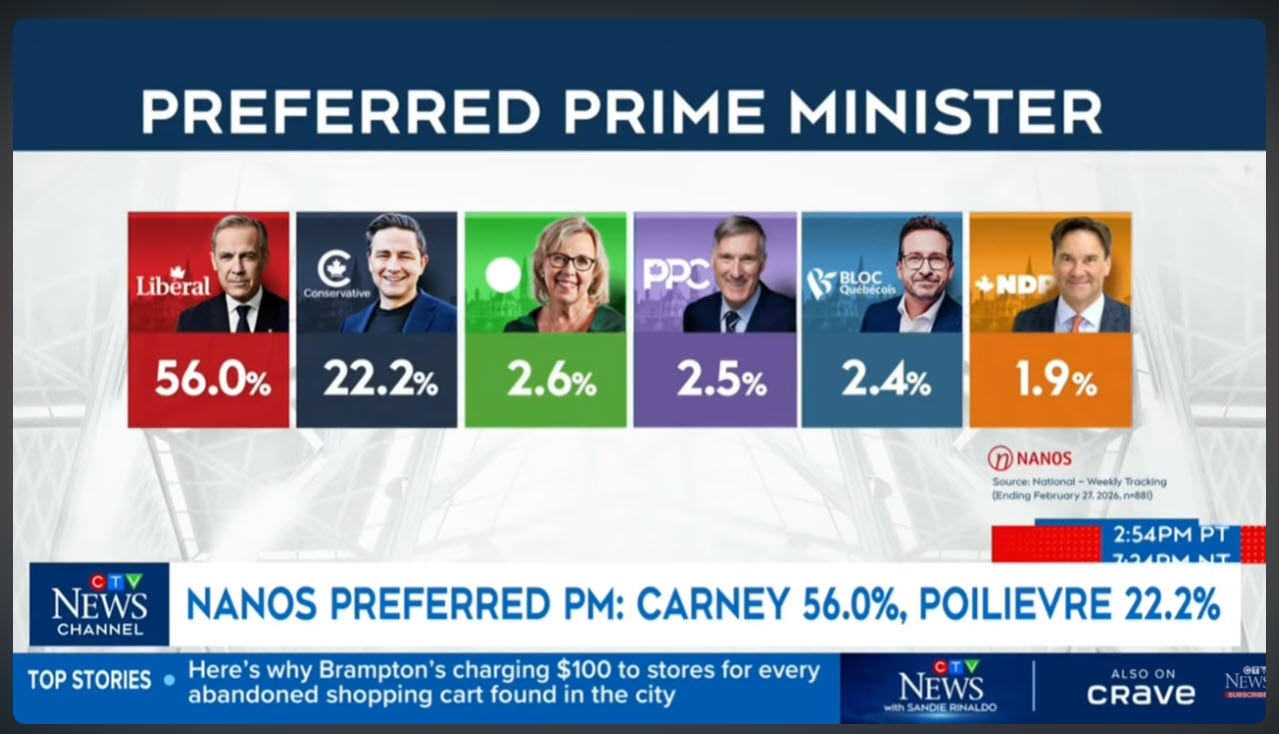
Preferred Prime Minister:
Mark Carney: 56%
Pierre Poilievre: 22%
That’s a 34-point gap.
On party support, the numbers are also moving sharply…
Liberals: 43.6%
Conservatives: 33.2%
But another poll shows an even bigger swing.
A Leger poll reported in the National Post puts support at…
Liberals: 49%
Conservatives: 35%
That’s a 14-point lead… the largest Liberal advantage in roughly a decade.
You can spin numbers in politics.
But you can’t spin numbers like that.
Something is shifting.
Why the Numbers Are Moving
One factor being noticed by pollsters is the pace of international agreements coming out of Ottawa.
In the past, if a Canadian prime minister came home with a trade agreement, it would dominate the headlines for days.
Right now it feels like new deals appear every few weeks.
Mark Carney has been travelling heavily since the G7, meeting foreign leaders and pursuing economic partnerships. The result is a steady stream of announcements that reinforce a message of international engagement.
That matters politically.
Especially to voters near the centre of the political spectrum.
Canada has a large block of voters who don’t live on the ideological edges. They drift slightly right or slightly left depending on the issue. When those voters feel stability and competence from a government, they tend to stay where they are.
Polls suggest many of them are doing exactly that right now.
The Conservative Leadership Problem
But polling numbers rarely move because of only one party.
Sometimes the opposition helps the process along.
After losing the last election, the Conservative Party held a leadership review for Pierre Poilievre.
The review produced a headline result…
87% support for the leader.
At first glance, that looks overwhelming.
But the mechanics matter.
The vote took place in Calgary, with roughly 2,500 in-person delegates participating.
That means the decision largely reflected the party’s most committed activist base…
many drawn from Western Canada, particularly Alberta.
Party members elsewhere in the country had far less influence over the outcome.
The result… a leadership endorsement that looked strong internally but didn’t necessarily reflect the broader coalition Conservatives need to win nationally.
Canada doesn’t elect governments from one region.
It elects them coast to coast.
The Leadership Contrast
The contrast with the Liberal leadership race last year is striking.
When Justin Trudeau stepped aside, the Liberal Party held a rapid leadership vote.
Members across the country were allowed to vote online.
More than 100,000 ballots were cast.
Mark Carney won decisively… but more importantly, he won support from members in every region of the country.
That difference matters in national politics.
A leader chosen by a broad national membership enters office with a wider internal mandate.
A leader chosen primarily by a party’s most ideological faction can struggle to connect outside that base.
Polls suggest that may be happening now.
The Geography Problem
Here’s the blunt reality of Canadian federal politics.
Alberta is already heavily Conservative.
In many ridings, the Conservative candidate would likely win even if the name on the ballot were unfamiliar.
But national elections aren’t decided in Alberta.
They’re decided in…
Ontario
Quebec
British Columbia
Atlantic Canada
If a party focuses too heavily on energizing its safest strongholds, it can lose ground in the regions that actually determine government.
That appears to be the strategic tension facing the Conservatives right now.
A Growing Political Ripple
There are already small signs of pressure inside the opposition.
Three Conservative MPs have crossed the floor to join the Liberals.
Other MPs now face a tougher question in their own ridings… how closely they want to tie themselves to the party leadership if national numbers continue to slide.
Meanwhile, the governing Liberals suddenly find themselves in a far more comfortable position.
When the opposition is weak, governments can govern.
And right now the opposition has little incentive to trigger an election.
The Strategic Question
Which leads to the obvious political dilemma.
If the polls stayed exactly where they are today, a federal election could produce a large Liberal majority government.
So the question becomes simple…
Do you call an election while the numbers are strong?
Or do you keep governing and hope the momentum holds?
Some political strategists… including Ontario Premier Doug Ford… have argued that when polls look this good, you go early.
You lock it in.
But Mark Carney’s approach so far suggests something different.
He appears focused on governing rather than rushing to the ballot box.
In politics, that’s always a gamble.
Because polls are snapshots.
Not guarantees.
What the Numbers Really Mean
Polls don’t predict the future.
But they do measure mood.
Right now, the mood of the country appears to be drifting back toward the political centre.
And if that trend holds, Canada’s next election could look very different from the last one.
Politics rarely stands still.
But every once in a while, the ground shifts beneath everyone’s feet.
This week’s numbers suggest that may already be happening.
The Recap…
New national polls just dropped… and they’re shaking Canadian politics.
One shows a 34-point gap between the two leaders.
Another shows the Liberals up 14 points nationally.
Something big may be shifting in the political centre of the country.
That’s what the numbers actually mean.
The Gut-Punch…
Winning your base is easy.
Winning Canada is harder.
Source:
Based on recent Nanos and Leger national polling data reported in Canadian media.
🔎 The GeezerWise Standard
This space is built on disciplined thinking.
Facts over spin.
Verification before amplification.
Good-faith discussion over tribal noise.
I use AI tools to help shape my spoken drafts into clear writing.
The judgment, conclusions, and final message are mine.
If you’re new here, this explains how I decide what’s worth sharing:
How I Decide What’s Worth Sharing → [link]
💌 Subscribe at GeezerWise.com to receive future letters:
www.geezerwise.com/subscribe
— Fred Ferguson
GeezerWise
#CanadaStrong
I think the hope of the right across the globe that they would ride Trump’s coattails to power is completely delusional. The level of disgust at what he’s doing is profound. I saw this happen in Spain. Sanchez came out immediately and said no to the war. And the PP and Vox came out and attacked him for it. But he has huge support from the country.
We know how calling a snap election turned out for us in Ontario. We are stuck with the man who is trying to gut healthcare and education. Not a fan of Dougie or what he does.