

Something doesn’t add up.
When the people asking for money won’t explain what they’re fixing… you don’t have a budgeting problem… you’ve got a credibility problem.
Here’s what we actually know.
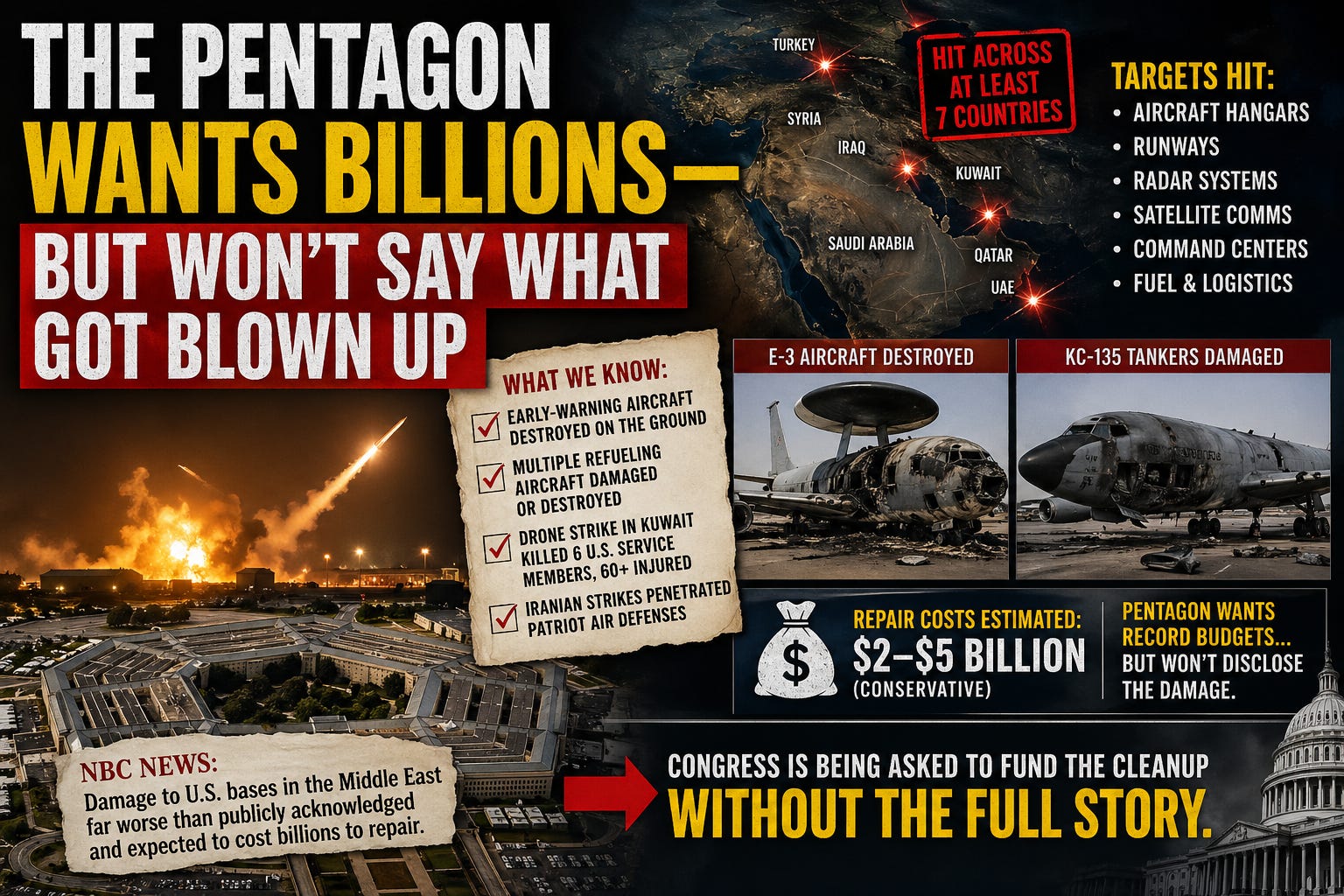
After U.S. and Israeli strikes on Iran on February 28, Iran responded with coordinated missile and drone attacks targeting American bases across the Middle East. Not one or two sites… at least seven countries were hit.
And not just symbolic targets either.
We’re talking…Aircraft hangars
Runways
Radar systems
Satellite communications
Command centers
Fuel and logistics infrastructure
In plain English? The stuff that actually makes a military work.
Now here’s where it gets interesting.
Nearly two months later, multiple U.S. officials and congressional aides are saying the damage is far worse than what’s been publicly acknowledged… and could run into the billions.
But the Pentagon?
Not talking.
Let’s Break Down What Got Hit
A few highlights…
A U.S. early-warning aircraft (the kind that acts like a flying radar tower) was destroyed on the ground during a missile and drone strike in Saudi Arabia.
Multiple refueling aircraft… critical for extending combat range… were damaged or destroyed.
A drone strike in Kuwait killed 6 U.S. service members and injured over 60.
Iranian strikes penetrated air defense systems… including bases protected by Patriot missiles.
That last one matters more than most people realize.
If older, non-stealth aircraft and relatively simple drones can get through… that’s not just a bad day… that’s a systems problem.
The Real Cost Isn’t Just Buildings
People hear “billions in damage” and think construction crews and concrete.
That’s not what this is.
Military infrastructure isn’t something you rebuild like a strip mall.
You’re dealing with…
Classified communication systems
Advanced radar arrays
Hardened aviation facilities
Specialized aircraft replacement timelines
You don’t just order that off Amazon and have it next Tuesday.
Even conservative estimates put repairs somewhere between $2 billion and $5 billion.
And that’s before you factor in operational disruption.
Here’s the Part That Should Bother You
The Pentagon is now asking for a record-high budget.
At the same time…
They won’t fully disclose the damage
They won’t detail what was lost
They won’t clearly explain repair needs
Meanwhile, congressional aides are saying they’ve been asking for weeks and getting nothing specific back.
That’s not normal.
In a typical situation, lawmakers get classified briefings with exact details before approving funding.
Right now?
They’re being told, essentially…
“Trust us. Send the money.”
Why the Silence?
Because the narrative matters.
The original goal of the strikes was to show strength… quick action, controlled escalation, and minimal blowback.
But if the response caused…
Aircraft losses
Successful penetration of defenses
Casualties
Multi-billion dollar damage
Then the story shifts from dominance… to mutual damage.
And that’s a harder sell.
Bigger Picture (This Is Where It Gets Real)
This isn’t just about the Middle East.
Every dollar spent repairing bases there is a dollar not spent somewhere else.
And the U.S. isn’t juggling one problem…
Ukraine support
European deterrence
Pacific planning (China)
Middle East stability
Same budget. Same resources. Multiple fronts.
Something eventually gives.
The Strategic Problem Nobody Wants to Say Out Loud
If relatively unsophisticated weapons can…
Hit multiple bases
Damage high-value aircraft
Bypass layered defenses
Then forward-deployed bases near hostile regions aren’t as secure as advertised.
That changes the math.
Not just for Iran… but for any future conflict.
What Happens Next?
Probably this…
Congress pushes harder for answers
Partial disclosures come out… carefully worded, not the full picture
Real costs show up later through contracts and budget expansions
Independent analysis (satellite, open-source) fills in the gaps
In other words… the truth leaks out slowly, in pieces.
The Bottom Line
You don’t ask for billions while refusing to explain what broke.
That’s not oversight.
That’s a blank cheque with a polite smile attached.
The Recap…
Something’s off.
Bases hit across multiple countries.
Aircraft destroyed.
Troops killed.
And now the Pentagon wants billions… without explaining the damage.
That’s not transparency… that’s a trust test.
The Gut-Punch…
If the damage was “manageable,” they’d show the numbers.
When they don’t… the numbers are the story.
Source Credit:
Based on reporting cited from NBC News and supporting analysis summarized from provided research notes.
🔎 The GeezerWise Standard
This space is built on disciplined thinking.
Facts over spin.
Verification before amplification.
Good-faith discussion over tribal noise.
I use AI tools to help shape my spoken drafts into clear writing.
The judgment, conclusions, and final message are mine.
If you’re new here, this explains how I decide what’s worth sharing:
How I Decide What’s Worth Sharing → [link]
💌 Subscribe at GeezerWise.com to receive future letters:
www.geezerwise.com/subscribe
— Fred Ferguson
GeezerWise
#CanadaStrong
Collect insurance on all destroyed bases and embassies. No rebuilding. After total insurance claims the pentagon gets ½ trillion and the rest goes to taxpayer coffers. Regime can not touch it. If they can’t rebuild that cuts down on colonialism
At the end of the line, it is individuals lining their pockets under the pretext of covering the losses.