

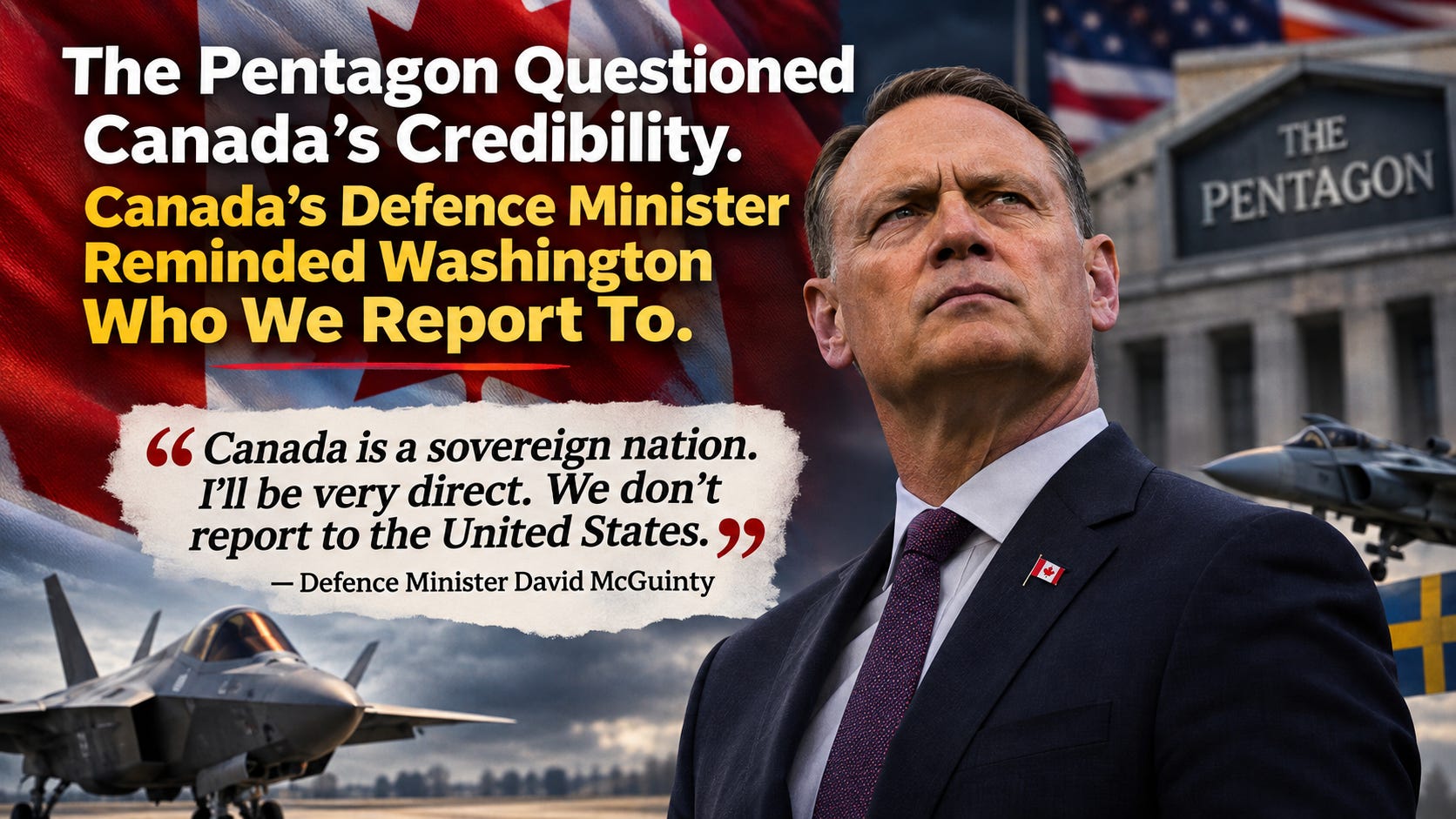
There are moments when a politician says something that doesn’t require a lengthy explanation.
Canada’s Defence Minister, David McGuinty, delivered one of those moments this week.
“Canada is a sovereign nation. I’ll be very direct.
We don’t report to the United States.”
No diplomatic gymnastics. No carefully constructed paragraph designed to avoid offending Washington.
Just a reminder of something that should never have needed repeating.
Canada is an independent country.
And our defence minister answers to Canadians.
What Got Washington’s Nose Out of Joint?
According to reporting by Associated Press, Axios and The Washington Post, the Pentagon has raised concerns about Canada’s credibility as a defence partner.
Among Washington’s complaints is Canada’s ongoing review of its planned purchase of American-made F-35 fighter jets.
There are also reports that U.S. Defence Secretary Pete Hegseth has directed restrictions on certain military engagements with Canada.
That deserves our attention.
However, we shouldn’t confuse restrictions on certain military activities with the collapse of our entire defence relationship.
Canada and the United States remain NATO allies and partners in NORAD. There is no established evidence that these latest reported restrictions have dismantled those arrangements.
But the political message coming from Washington is troubling enough on its own.
Let’s Be Fair About Canada’s Defence Record
I’m not going to pretend Canada has been doing everything right.
Successive Canadian governments, both Liberal and Conservative, have allowed our military to go without equipment, personnel and infrastructure it desperately needed.
We’ve postponed purchases, dragged procurement decisions through years of bureaucracy and relied heavily on the American defence umbrella.
Washington has legitimate grounds for asking Canada to contribute more to continental defence.
I’ve made that argument myself.
But asking Canada to take greater responsibility for its defence is one thing.
Expecting Canada to surrender its freedom to decide how it accomplishes that is something entirely different.
The F-35 Is a Fighter Jet. Not a Loyalty Test.
Canada originally committed to acquiring 88 American-made F-35 fighter aircraft.
The aircraft offers considerable military capabilities. Its advanced technology and interoperability with allied forces are legitimate arguments in its favour.
Nobody needs to pretend otherwise.
But buying a fighter jet isn’t like buying a new pickup truck.
We’re talking about decades of maintenance, software support, replacement parts, training, upgrades and relationships with foreign suppliers.
The purchase price is only the beginning.
Canada’s review of the F-35 procurement raises questions about long-term costs, industrial benefits, operational requirements and dependence on foreign suppliers.
Sweden’s Saab Gripen has been part of that broader discussion.
Whether Canada ultimately chooses the F-35, the Gripen or some combination of aircraft should depend on what best serves Canada’s military and national interests.
Not on which decision makes the Pentagon happiest.
And no, Canada doesn’t need to buy an inferior aircraft simply because it’s not American.
We need to make an informed decision based on Canadian requirements.
That’s what responsible governments are supposed to do.
There’s a Difference Between Interoperability and Dependency
Washington has legitimate concerns about interoperability.
Canadian and American forces need to be able to communicate, coordinate and operate together, particularly when defending North American airspace.
That matters.
But interoperability doesn’t automatically require every piece of military equipment to come from the same country.
NATO includes countries operating American, British, French, German, Swedish and other military equipment.
The alliance exists because sovereign countries agree to cooperate in their collective defence.
It doesn’t exist to guarantee sales for American defence contractors.
Canada should take technical and operational concerns seriously.
But those concerns should be evaluated by military professionals, not turned into a political loyalty test.
Canada Is Looking Beyond Washington
The fighter jet review isn’t happening in isolation.
Canada has been exploring broader defence relationships with European and other international partners.
From submarines and surveillance aircraft to missile systems and domestic manufacturing opportunities, Canada has good reasons to examine what other countries can offer.
This isn’t about cutting America out of every Canadian defence purchase.
That would be foolish.
It’s about ensuring America isn’t our only meaningful option.
We’ve already learned what happens when we become excessively dependent on one customer for our exports.
We’ve watched tariffs become political weapons.
We’ve watched established trading relationships become bargaining chips.
We’ve heard threats against our economic independence and even our existence as a sovereign country.
Why wouldn’t those experiences influence how we approach military procurement?
A dependable defence supply chain isn’t simply about getting the best equipment today.
It’s about knowing we can maintain, repair and operate that equipment tomorrow, regardless of who occupies the White House.
Presidents change.
Military equipment stays in service for decades.
Washington Can’t Have It Both Ways
For years, American administrations have complained that Canada wasn’t doing enough to defend itself.
Now Canada is increasing its defence commitments and examining how to build stronger military capabilities.
That should be welcomed.
But greater Canadian responsibility also means greater Canadian decision-making.
It means evaluating suppliers.
It means negotiating industrial benefits.
It means developing domestic capabilities where practical.
And sometimes it means buying something from somebody other than America.
Canada owes its military better equipment.
Canada owes its citizens responsible spending.
Canada owes its allies the commitments it has agreed to honour.
Canada does not owe American manufacturers every defence contract.
There’s a difference.
McGuinty Got This Right
What I appreciated about David McGuinty’s response was its simplicity.
He didn’t need to threaten the United States.
He didn’t need to announce the end of our military relationship.
He didn’t need to turn a disagreement into a diplomatic circus.
He simply established who Canada answers to.
We can remain America’s neighbour.
We can remain America’s ally.
We can continue defending this continent together.
None of those things requires us to become America’s subordinate.
That distinction shouldn’t be controversial.
But apparently, in today’s Washington, it needs explaining.
The Recap…
The Pentagon has questioned Canada’s credibility as a defence partner.
Canada’s defence minister responded by reaffirming Canadian sovereignty.
Washington has expressed concerns about Canada’s F-35 procurement review.
Canada has legitimate reasons to examine military equipment from alternative suppliers.
Interoperability with American forces remains important, but it doesn’t require exclusive dependence on American manufacturers.
Canada’s defence procurement decisions must ultimately serve Canadian national interests.
The Gut-Punch…
Washington wants Canada to take more responsibility for its own defence.
Fair enough.
But taking responsibility means making our own decisions, choosing our own suppliers and determining our own national interests.
You cannot demand that Canada stand on its own two feet and then complain when it stops asking your permission to walk.
Elbows Up.
Source Credit:
The Guardian… Canada says it does not report to the United States
The Washington Post… Reported restrictions on the U.S.–Canada defence relationship
FACTS, NOT FABLES.
If you appreciate independent Canadian commentary that puts facts before feelings and Canadian sovereignty before political loyalties, consider subscribing to GeezerWise.
Canada is worth understanding. Canada is worth defending.
If you enjoy thoughtful conversations, Canadian stories, and the occasional smart-ass observation about the world we’re living in, you’re in the right place.
Subscribe free and get new stories, insights, and observations delivered directly to your inbox.
No paywall.
No spam.
No nonsense.
Leave anytime with a single click.
I promise not to take it personally.
Even though Hegseth is the attack dog in this situation, this reeks of Stephen Miller
I’d bet dollars to doughnuts they’re afraid of losing control of the procurement process itself