

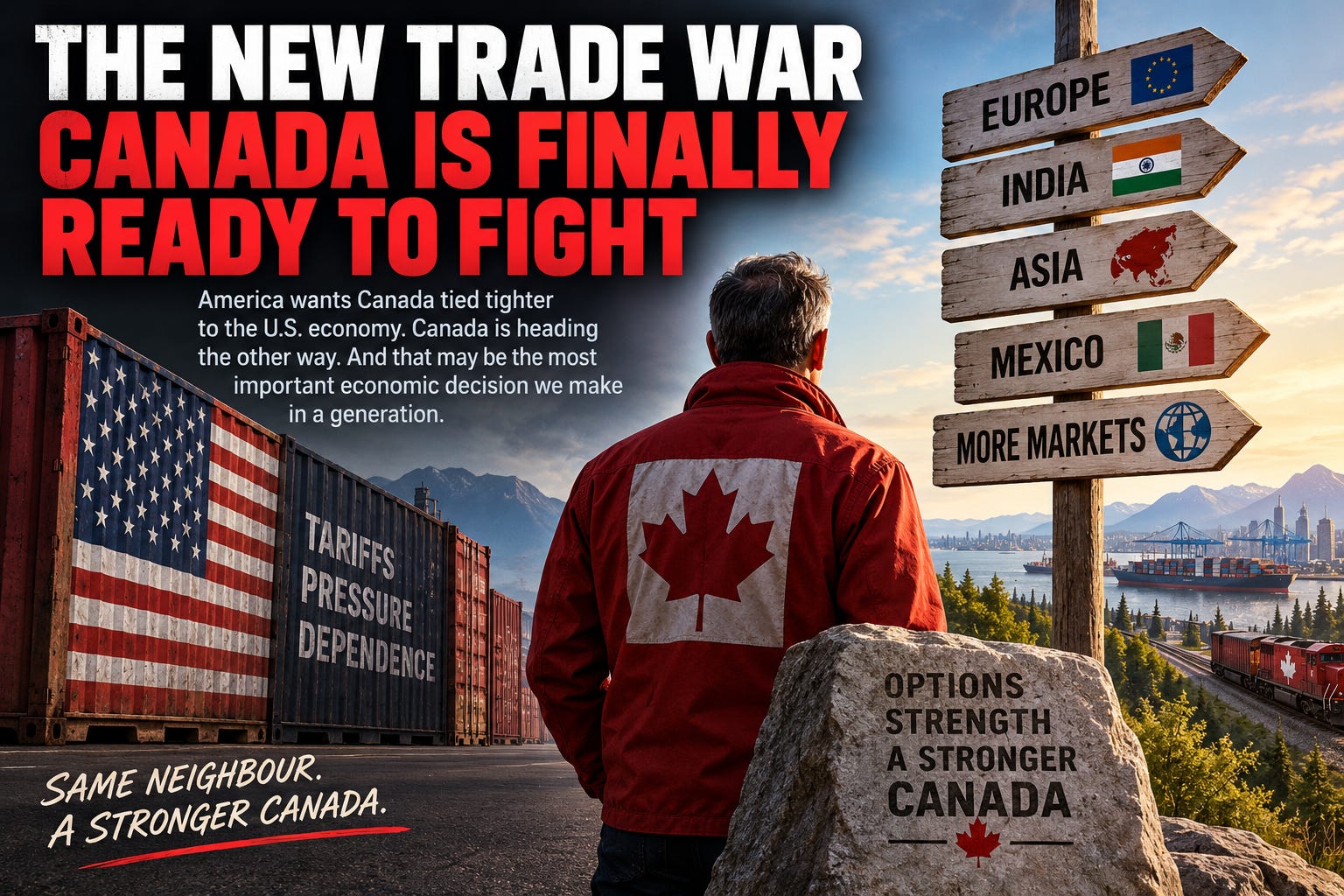
Something important just happened.
An American official basically admitted what Canadians have spent months figuring out.
Canada and the United States aren’t arguing over a tariff anymore.
We’re arguing over two completely different economic futures.
U.S. Trade Representative Jamieson Greer described Canada’s approach pretty plainly.
Canada wants more trade agreements.
Europe.
India.
Other countries around the world.
And according to Greer, that’s different from the direction the United States is taking.
Well, thank you very much.
Because that clears up a hell of a lot.
Canada isn’t trying to replace America.
We’re trying to make damn sure America can never again be our only serious option.
And apparently Washington doesn’t much like that.
Canada learned the hard way
For decades, our economic strategy was pretty simple.
Build an enormous trading relationship with the United States.
Make supply chains work across the border.
Sell them what they need.
Buy what we need.
Get rich together.
It wasn’t perfect.
But it worked remarkably well.
Then Donald Trump demonstrated the weakness nobody wanted to talk about.
Dependence becomes leverage when the other guy decides to use it against you.
A tariff can suddenly appear.
An industry can suddenly be threatened.
An agreement that businesses used to plan billions of dollars of investment can suddenly become uncertain.
And Canada discovered that having your biggest customer next door is wonderful.
Until that customer starts behaving like your landlord.
That’s why Mark Carney’s message matters.
The old relationship of ever-deeper economic integration with the United States is finished.
Not trade.
Not geography.
Not friendship between Canadians and Americans.
Dependence.
That’s the part that has to end.
Then Greer said something even more interesting
Greer talked about Chinese automobiles and potential Chinese investment in Canada.
His position was straightforward.
If Canada wants to pursue those relationships, that’s Canada’s right.
But they may be inconsistent with American trade policy.
Think about what that means.
Canada makes a sovereign economic decision.
The United States makes a different one.
Fine.
That’s what sovereign countries do.
But Canada cannot build its economic future around the assumption that every Canadian trade decision must first satisfy Washington.
We tried putting most of our economic eggs in one enormous red, white and blue basket.
We’ve now discovered the basket has opinions.
This is why diversification suddenly matters
All those Canadian trade missions, infrastructure announcements and new relationships can look like disconnected stories.
They’re not.
Europe.
Asia.
India.
Mexico.
Energy infrastructure.
Ports.
Rail.
Critical minerals.
Domestic processing.
Canadian manufacturing.
They’re pieces of the same strategy.
Options.
I’ve been beating this drum for months because I think it’s the single biggest change happening in Canada.
Canada doesn’t need to stop trading with the United States.
That would be stupid.
They’re next door.
They’re enormous.
They need things we produce.
We need things they produce.
Business is business.
Former prime minister Jean Chrétien made essentially that point in the material I was watching.
Americans don’t buy Canadian products because they’re doing us a favour.
They buy them because they need them.
And Canadians don’t buy American products as an act of charity either.
That’s trade.
Which brings us to something else Chrétien raised.
Canada has cards too
Oil.
Natural gas.
Electricity.
Potash.
Resources the American economy uses every single day.
Chrétien raised the possibility that, if this trade war became serious enough, Canada could consider export taxes on strategic commodities.
Notice what he wasn’t proposing.
Don’t shut off the oil.
Don’t turn off the electricity.
Don’t stop shipping potash.
That’s chest-thumping nonsense that could hurt Canadians as badly as Americans.
An export tax is different.
If Washington decides Canadian goods entering America should become more expensive because of American tariffs, Ottawa has tools capable of making strategically important Canadian exports more expensive too.
Would that be painless?
Hell no.
Could America retaliate?
Absolutely.
That’s why I’d call it the break-glass option.
You don’t smash the glass because somebody annoyed you Tuesday morning.
But you don’t announce beforehand that the hammer has been permanently removed either.
Leverage only works when the other side believes you might use it.
And Canadians have another card Washington can’t control
Our wallets.
Nobody needs Ottawa’s permission for this one.
Every Canadian gets to decide where the next dollar goes.
Canadian product available?
Buy Canadian.
No Canadian alternative?
Look at Europe.
Japan.
South Korea.
Mexico.
Australia.
Anywhere we have reliable trading partners producing what we need.
I’m not talking about checking the birthplace of every bloody tomato before making a sandwich.
I’m talking about direction.
Millions of ordinary purchasing decisions eventually become billions of dollars.
Canada is a major customer of the United States.
Customers have leverage too.
Here’s what I think Canadians need to understand
This isn’t about hating America.
I don’t.
It isn’t about ending trade with America.
We won’t.
And it isn’t about waiting for Donald Trump to disappear and hoping everything magically snaps back to 2019.
That would be the biggest mistake of all.
Trump exposed a vulnerability.
Another president could use it.
Another Congress could use it.
Another crisis could expose it.
Once Canada understands that, the answer becomes pretty obvious.
Don’t build an economy that requires the goodwill of one country.
Build one with choices.
Sell Canadian energy to more customers.
Process Canadian minerals here.
Manufacture more Canadian products here.
Build ports.
Build rail.
Build electricity connections.
Build relationships with Europe and Asia.
Sign trade agreements.
Find customers.
And when America wants to trade fairly with us?
Wonderful.
We’ll be here.
But next time Washington decides Canada needs to be reminded who’s boss, the answer should be very different.
We’re not your economic dependency anymore.
We’re your customer.
We’re your supplier.
We’re your neighbour.
We’re your trading partner.
And we’re a sovereign country with somewhere else to go.
That may be the new trade war Canada is finally ready to fight.
Not by closing ourselves off from the world.
By opening ourselves to more of it.
The Recap…
The U.S. trade representative just said something Canadians should hear.
Canada wants more trade with Europe, India and the rest of the world.
America is taking a different path.
Good.
Because Canada’s answer to American economic pressure shouldn’t be isolation.
It should be options.
The Gut-Punch…
America’s biggest advantage over Canada was never its tariffs.
It was our dependence.
Every new customer Canada finds makes that weapon a little weaker.
Source credit:
Research notes based on public comments and clips involving U.S. Trade Representative Jamieson Greer, Prime Minister Mark Carney and former prime minister Jean Chrétien, as presented in the source transcript. Claims and commentary in the original video were used as research leads rather than reproduced as reporting.
If you enjoy thoughtful conversations, Canadian stories, and the occasional smart-ass observation about the world we’re living in, you’re in the right place.
Subscribe free and get new stories, insights, and observations delivered directly to your inbox.
No paywall.
No spam.
No nonsense.
Leave anytime with a single click.
I promise not to take it personally.
Missed the boat on this one. Everything you wrote is true except you left out the most important US objective. Subjugation, control over hemispheric resources and critical minerals. Us dominance and military control of the hemisphere. These are the American objectives. Free trade is incongruent with these objectives. So from this framework Canadian actions to diversify and survive as a sovereign independent nation demand trading more internally and with the rest of the world. Securing global non US investments as we build up our global export opportunities is a further important step to national security. That is the only framework that should be applied. Canada is in an existential war of sovereignity survival against a bully imperialistic autocratic regime. The saving grace and there are 2. 1. The US presidrnts designs and imperialistic ambitions are not understood or supported by the majority of the American people (whose voice only matters if they take back control from the oligharchy). 2. Canada drawing closer economic ties with the EU and other middle powers and entering into security agrerments with these partners may strengthen our sovereignity and thwart US imperialistic designs. This is the reality and its darker than your analysis based on rational actors when the truth is rationality is not seeing the world in the rear view mirror. The world is more dangerous than ever with strong undertones of might makes right and this is the kens that needs to be applied. The rearview is history.
Well put Fred. Thank you.