

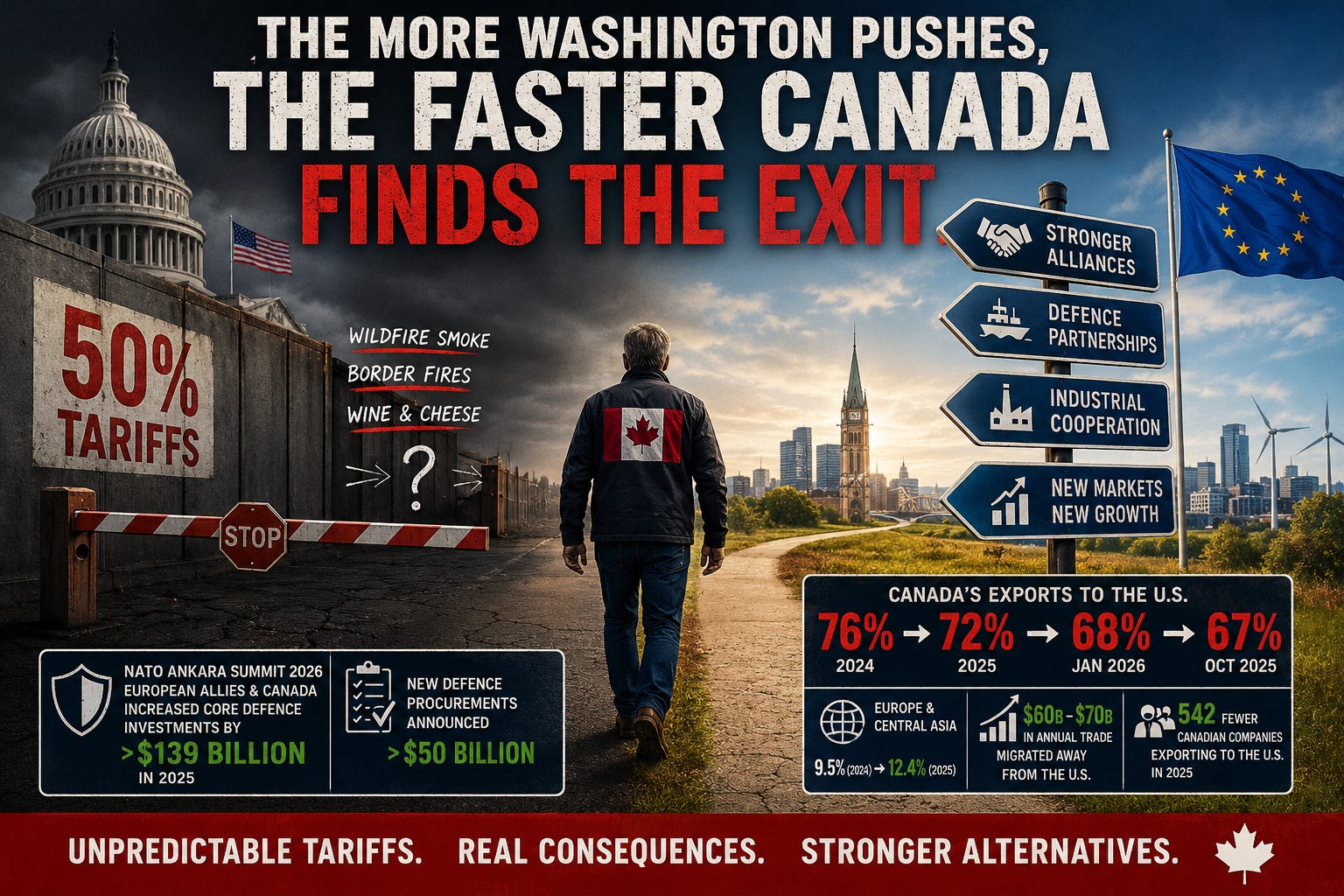
If someone keeps making it harder to do business with them, sooner or later you stop trying.
That’s where Canada finds itself.
The latest round of U.S. tariffs wasn’t just bigger.
It was stranger.
In the span of a few days, the reasons for imposing them reportedly changed several times… from wildfire smoke to border fires to retaliation over Canadian trade measures on American products.
When the explanation changes faster than the policy, it starts looking less like strategy and more like improvisation.
Meanwhile, Canada has been quietly doing something far more important.
It’s building alternatives.
For decades, the United States was Canada’s overwhelmingly dominant customer.
That relationship isn’t disappearing overnight, but the numbers suggest it’s steadily shrinking.
Merchandise exports headed south have fallen from roughly 76% of Canada’s total in 2024 to about 68% by early 2026, while Europe’s share has been climbing.
That’s not a coincidence.
Canadian companies have been expanding into new markets.
Exports to countries like Germany and the Netherlands have grown, and billions of dollars in trade are shifting away from the U.S. market.
Hundreds fewer Canadian firms now rely on exporting south of the border than they did just a year earlier.
Every new tariff makes those decisions easier.
Imagine owning a store where your biggest customer walks in every morning wondering whether today’s prices will be double yesterday’s.
Eventually, that customer starts shopping somewhere else… not because they want to, but because they can’t build a business around uncertainty.
That’s exactly what unpredictability does.
Trade isn’t built on speeches.
It’s built on trust.
The timing makes this even more interesting.
Only weeks before this latest tariff escalation, Canada was strengthening defence and industrial partnerships with European allies at NATO’s Ankara summit.
Those agreements weren’t just about military hardware.
They were about supply chains, manufacturing, technology, procurement, and long-term economic cooperation.
Canada also committed to working toward NATO’s goal of spending 5% of GDP on defence by 2035 alongside its allies.
Those relationships matter.
When countries start building ships together, buying aircraft together, developing technology together, and investing in each other’s industries, they create partnerships that last for decades.
That’s much harder to unwind than a political slogan.
Ironically, tariffs intended to pressure Canada may end up accelerating exactly what Washington hoped to prevent.
Instead of reinforcing dependence, they’re encouraging diversification.
Instead of making Canada think twice about Europe, they’re giving Canadian businesses another reason to look across the Atlantic.
The old assumption… that Canada had nowhere else to go… is becoming harder to defend.
None of this means the United States stops being Canada’s largest trading partner tomorrow.
It won’t.
The economies remain deeply connected, and they will stay that way for years.
But something more subtle is happening.
Canada is reducing its risk.
Businesses diversify suppliers.
Investors diversify portfolios.
Countries diversify trading partners.
That’s not disloyalty.
That’s common sense.
If your largest customer becomes your least predictable customer, finding new customers isn’t an act of rebellion.
It’s good business.
And that’s the part many people are missing.
This story isn’t really about tariffs.
It’s about trust.
Once trust starts leaving, trade usually follows.
The Recap…
Every new tariff may be doing the opposite of what Washington intended.
Canada isn’t just absorbing the pressure… it’s finding new partners, new markets, and new reasons to look beyond the U.S.
Sometimes the fastest way to lose a customer is to keep raising the price of doing business.
The Gut-Punch…
You can force someone to pay more today.
You can’t force them to stay tomorrow.
Source credit:
Research based on the user’s supplied transcript and publicly available information on Canada-Europe trade diversification and NATO defence partnerships.
If you enjoy thoughtful conversations, Canadian stories, and the occasional smart-ass observation about the world we’re living in, you’re in the right place.
Subscribe free and get new stories, insights, and observations delivered directly to your inbox.
No paywall.
No spam.
No nonsense.
Leave anytime with a single click.
I promise not to take it personally.
You know Fred, one of the many reasons for imposing this new round of tariffs is that the Argentinian and Spanish football players showed more respect to Claudia Sheinbaum and Mark Carney than they did to the fragile, ego sensitive leader of the US. ( I refuse to call him a President). It is just one more example of his fragile, infantile behaviour. Canada is best to leave him and his cronies in the rearview mirror. We have to remember that he is but the expression of something that has been dormant for many years. Once he is gone, there will be no magical rebirth of cooperation between out two nations. A reestablishment of cooperation and, most importantly, trust, will take years, if not decades to establish.
I can't get my head around the fact that the strumpet wants to punish us by making everything more expensive for citizens of the USA. Mathew Moron, the Ambassador Bridge guy, is opening a cement business in Canada. Good! Let's put a tariff on cement. The NHL has 25 US teams and 7 Canadian teams. Good! Let's put a tariff on hockey sticks!
And on it goes. He still hasn't figured out that the people of HIS country pay the tariffs! We may sell fewer, but for many commodities we're just selling the difference to someone else. Which leads to the big gun items.
We don't need another pipeline to sell more oil; we need oil to sell to someone else. We're electrifying Canada for development, but there might not be any left over for sale outside Canada. Today the Premiers signed off on an interprovial accord to sell alcohol to each other. We don't need U.S. booze. We're developing Churchill to sell potash from Sask overseas. A competitive market makes for better pricing. The world is hungry for critical minerals and we have them. We are developing the output ourselves and not just selling raw ore.
We may need the USA right now, but not forever, and maybe not for long!