

For decades, the U.S. dollar held a privileged position in the global economy.
Countries stored it. Banks trusted it. Investors ran toward it whenever trouble appeared.
That doesn’t change overnight.
But it can change gradually.
And that’s exactly what seems to be happening.
The headlines keep looking for a dramatic collapse. A currency crisis. A financial panic. Some single event that announces the end of dollar dominance.
Real life rarely works that way.
Most big shifts start with small decisions made by thousands of people, governments, banks, and corporations. One buyer looks elsewhere. Then another. Then another.
Eventually the trend becomes impossible to reverse.
That’s the story developing right now.
Japan Has Become a Reluctant Seller
Japan has long been one of America’s most important financial partners.
For years, Japanese institutions helped absorb enormous amounts of U.S. debt.
Now Japan has its own problems.
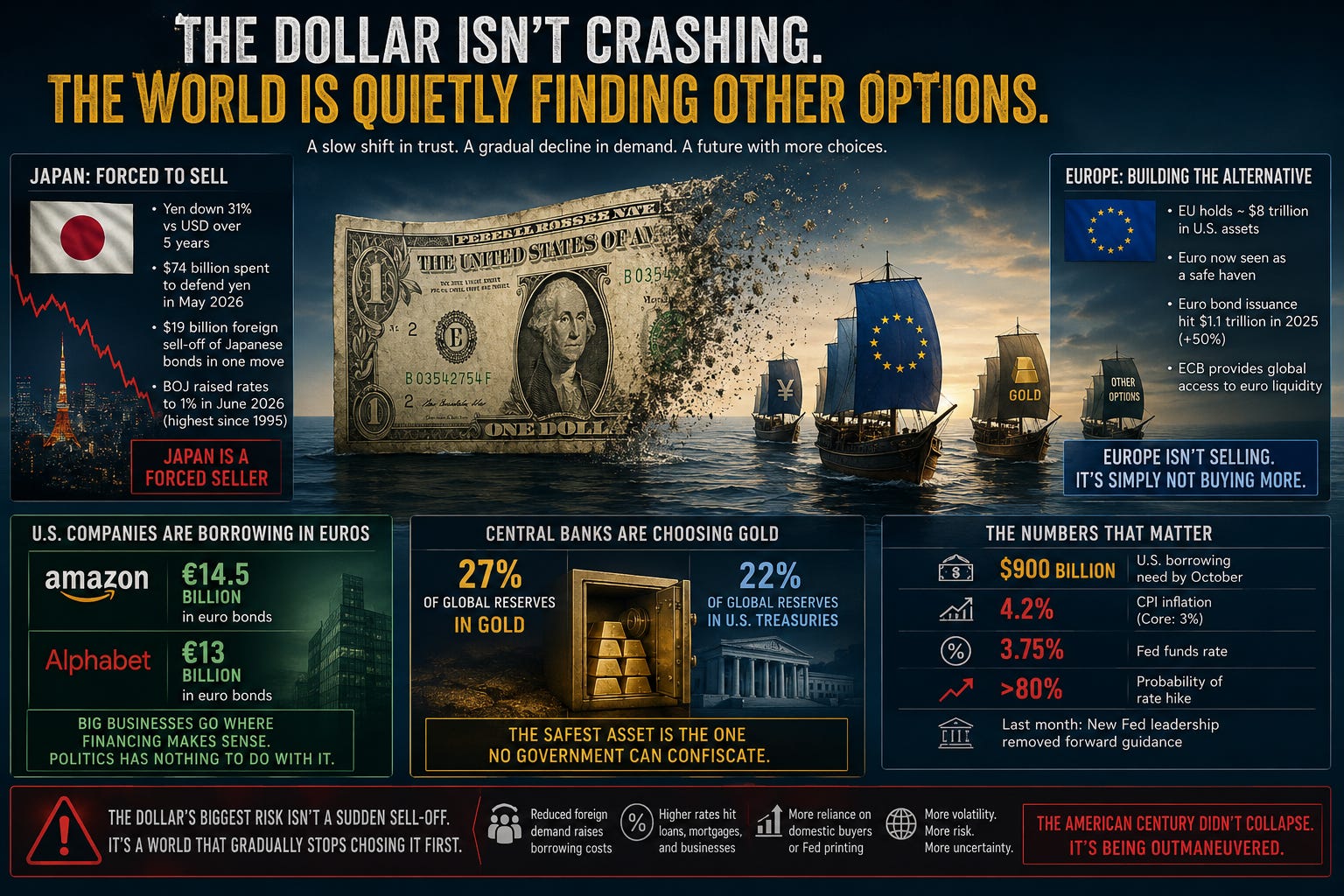
The yen has lost roughly 31% of its value against the U.S. dollar over the past five years. As the currency weakened, Japanese officials were forced to intervene repeatedly to defend it.
In May alone, Japan reportedly spent about $74 billion trying to support the yen.
The uncomfortable part for Washington?
Those interventions require selling dollars.
Japan isn’t unloading U.S. assets because it wants to. It’s doing it because it has to.
That makes Japan something far more significant than an angry seller.
It becomes a forced seller.
And forced sellers rarely care about helping someone else’s financing needs.
Europe Is Playing A Different Game
Europe isn’t staging a rebellion against the United States.
In fact, European investors still hold roughly $8 trillion in U.S. assets.
But that’s not the whole story.
The more important question isn’t who owns American assets today.
It’s who plans to buy them tomorrow.
Europe has quietly spent the last few years building alternatives.
The euro is increasingly behaving like a safe-haven currency during periods of uncertainty.
European institutions have expanded global access to euro liquidity.
Euro-denominated bond markets have exploded in size.
Issuance reached approximately $1.1 trillion in 2025, a jump of about 50%.
That’s not a protest.
That’s infrastructure.
And infrastructure changes behaviour.
When alternatives become easier to use, people eventually start using them.
Even American Companies Are Looking Across The Atlantic
One of the more revealing developments isn’t coming from governments at all.
It’s coming from corporate finance departments.
Major American companies have increasingly borrowed money in Europe instead of the United States.
Amazon issued roughly €14.5 billion in euro bonds.
Alphabet issued approximately €13 billion.
These aren’t political statements.
They’re business decisions.
Big corporations go where financing conditions are most attractive.
When they start looking elsewhere, it tells you something about where the market sees value.
Gold Keeps Winning Quietly
Perhaps the most interesting change isn’t happening in currencies at all.
It’s happening in central bank vaults.
For generations, U.S. Treasuries were the default reserve asset.
Today, central banks are steadily increasing gold holdings.
Gold now represents roughly 27% of global central bank reserves.
U.S. Treasuries sit near 22%.
Think about that for a moment.
Gold produces no income.
It pays no interest.
It sends no dividend cheque.
Yet central banks are choosing more of it.
Why?
Because gold carries one advantage that no government bond can offer.
Nobody can freeze it, sanction it, or turn it into a geopolitical weapon.
In a world where financial systems are increasingly tied to political conflicts, that matters.
A lot.
The Timing Couldn’t Be Worse For Washington
The United States needs enormous amounts of financing.
Reports suggest Washington needs to borrow roughly $900 billion by October.
That task becomes much harder if foreign demand weakens.
Not collapses.
Weakens.
That’s the distinction many people miss.
A dramatic sell-off makes headlines.
A gradual decline in future buying changes the entire system.
If fewer foreign buyers show up, somebody else must.
Domestic investors.
American banks.
Or ultimately the Federal Reserve.
None of those options are free.
All of them have consequences.
The Math Doesn’t Care About Politics
Meanwhile, inflation remains stubborn.
Consumer inflation sits around 4.2%.
Core inflation remains near 3%.
The Federal Reserve’s policy rate sits at 3.75%, and markets increasingly expect further tightening.
That creates a difficult reality.
Economic growth, inflation control, debt financing, and interest rates all pull against one another.
Which makes political promises of explosive growth increasingly detached from economic reality.
You can make speeches.
You can make campaign promises.
You cannot negotiate with arithmetic.
The bond market has a nasty habit of eventually demanding honesty.
This Isn’t A Collapse Story
That’s what makes this moment different.
Nobody is replacing the dollar tomorrow.
Nobody is announcing a new global financial order next week.
The dollar remains the world’s dominant currency.
But dominance and invincibility are not the same thing.
The real story is much quieter.
Japan is selling because it must.
Europe is building alternatives.
Central banks are accumulating gold.
Major corporations are borrowing elsewhere.
And future buyers are becoming a little harder to find.
Individually, none of these developments changes the world.
Together, they suggest something larger.
The dollar isn’t being abandoned.
It’s slowly losing its monopoly on trust.
And trust, more than anything else, is what made the dollar king in the first place.
The Recap…
Everyone is watching for a dollar crash.
They’re looking in the wrong direction.
Japan is selling dollars to defend its own currency. Europe is building financial alternatives. Central banks are buying gold. Even American companies are borrowing in euros.
The real threat isn’t a sell-off.
It’s a world that gradually stops choosing the dollar first.
The Gut-Punch…
Empires rarely fall because everyone leaves at once.
They weaken because fewer people show up each year.
The dollar still sits at the head of the table.
The question is how many chairs are now being set somewhere else.
Source credit:
Research compiled by House of El from Bank of Japan actions, European financial market developments, central bank reserve data, corporate bond issuance records, Federal Reserve policy expectations, and international currency market reports referenced in the supplied research notes.
If you enjoy thoughtful conversations, Canadian stories, and the occasional smart-ass observation about the world we’re living in, you’re in the right place.
Subscribe free and get new stories, insights, and observations delivered directly to your inbox.
No paywall.
No spam.
No nonsense.
Leave anytime with a single click.
I promise not to take it personally.
The level to which Trump has downgraded the USA is mind boggling.
Thank you Fred- yet again can clearly understand the whole picture. I had read about Japan offloading US bonds, figured it was likely the reason for trump calling them the Islamic state of Japan. Of course they have to protect their own currency