

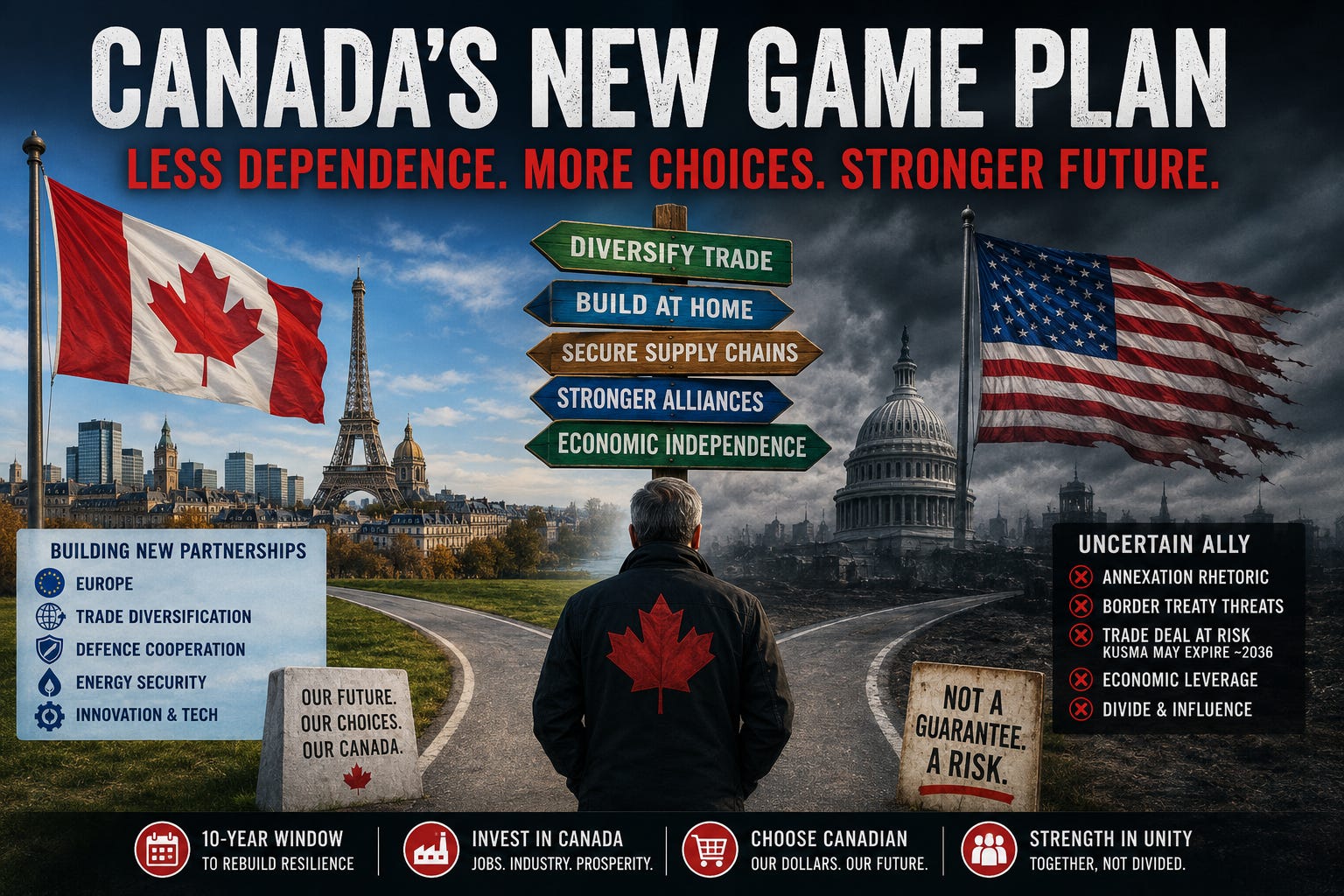
For most of my life, Canada’s strategy was simple.
Stay close to the United States.
Sell them our products. Buy their products. Share intelligence. Build military systems together. Assume that, whatever political storms came and went, the relationship itself would survive.
That assumption may have just expired.
A recent Wall Street Journal report paints a picture that is far more serious than another political shouting match. If the reporting is accurate, Canada’s leadership concluded that some of the threats coming from Washington weren’t just campaign theatre. They had to be treated as genuine national security concerns.
That’s a completely different conversation.
According to the report, intelligence briefings convinced Prime Minister Mark Carney that Canada had to prepare for a future where the United States might become an unreliable economic and political partner.
If that’s true, it explains a lot of what we’ve been watching over the past several months.
Suddenly, trips to Europe weren’t photo opportunities.
They were strategy sessions.
Partnerships with France and the European Union weren’t symbolic.
They were insurance policies.
The goal wasn’t to replace the United States overnight. That’s impossible.
The goal was to make sure Canada never again depends so heavily on a single customer, a single military supplier, a single technology ecosystem, or a single trading partner.
That’s diversification.
And diversification isn’t panic.
It’s risk management.
Think about any financial advisor worth listening to.
Nobody tells you to put your retirement savings into one stock.
Yet that’s essentially what Canada has done economically for decades.
When your biggest customer becomes unpredictable, smart businesses don’t argue with reality.
They find more customers.
The same principle applies to countries.
That also explains why Ottawa has been reviewing supply chains for critical goods, expanding trade relationships, strengthening defence partnerships outside North America, and talking more openly about economic resilience.
Those aren’t isolated decisions.
They’re pieces of the same puzzle.
The uncertainty surrounding the future of the Canada-U.S.-Mexico trade agreement only adds more urgency.
If that agreement is eventually abandoned or fundamentally changed, Canada needs alternatives already in place… not after the fact.
Building those alternatives takes years.
Sometimes decades.
That timeline matters because economic relationships aren’t built with press releases.
They’re built with infrastructure, investment, manufacturing, shipping routes, research partnerships and long-term trust.
Those things can’t be assembled in six months.
Meanwhile, Canada faces another challenge closer to home.
External pressure always tests internal unity.
When discussions about provincial separation grow louder during a period of international tension, they naturally attract greater attention from Ottawa.
Whether those movements remain political debates or become something more serious, national cohesion becomes part of the country’s overall security picture.
None of this means Canada is walking away from the United States.
Geography hasn’t changed.
Our economies remain deeply connected.
Millions of jobs on both sides of the border depend on that relationship continuing.
But there’s a significant difference between partnership and dependence.
For decades, Canada largely treated those two ideas as if they were the same thing.
They’re not.
A strong partnership gives both countries choices.
Dependence leaves one country exposed when the other changes direction.
That’s the lesson emerging from this moment.
Some critics questioned why Carney invested so much time strengthening relationships across Europe.
If the Wall Street Journal report accurately reflects what Canada’s leadership was seeing behind closed doors, those trips suddenly make a lot more sense.
Government leaders often have access to intelligence the rest of us never see.
Opposition parties don’t.
Neither do columnists.
Neither do YouTubers.
That doesn’t automatically make every government decision correct.
But it does remind us that public debate sometimes happens without the full picture.
Canada now appears to be preparing for a world that looks very different from the one we assumed would last forever.
More trading partners.
More domestic production.
More diversified supply chains.
More strategic independence.
That’s not anti-American.
It’s pro-Canadian.
And in an increasingly uncertain world, those are two very different things.
The Recap…
For decades, Canada treated the U.S. relationship as permanent.
Now Ottawa appears to be planning for a future where it isn’t.
That’s not abandoning America.
It’s making sure Canada can stand on its own if it has to.
The Gut-Punch…
The biggest change isn’t who Canada trades with.
It’s that Ottawa may no longer believe our closest ally will always behave like one.
Source Credit:
Wall Street Journal reporting on Canada-U.S. relations; publicly reported statements by Canadian officials; publicly available information on Canada-EU diplomatic initiatives, trade diversification efforts, and the Canada-United States-Mexico Agreement (CUSMA/USMCA).
Editorial note: Some of the more dramatic claims referenced in the Wall Street Journal report… such as private conversations, intelligence assessments, and alleged annexation rhetoric… are based on reported accounts rather than independently verifiable public records.
Where those claims are discussed here, they are presented as reported, not as established fact.
If you enjoy thoughtful conversations, Canadian stories, and the occasional smart-ass observation about the world we’re living in, you’re in the right place.
Subscribe free and get new stories, insights, and observations delivered directly to your inbox.
No paywall.
No spam.
No nonsense.
Leave anytime with a single click.
I promise not to take it personally.
I just had a bit of an epiphany here! I was in my senior years of college/university when Mulroney and Reagan cemented the original FTA between Canada and USA. At the time, Canada was very much trying to do something similar with Europe, and many other elements were leaning International.
Then Reagan showed up, waved the magic promise of "something better, North America-style" (though Mexico wasn't in on this at that point), and well, Canada pivoted heavily into FTA (and then NAFTA).
So, we could revisit all of the coulda-woulda-shoulda/was integration with the USA better or worse, etc., etc. The answer is (and was) that there are pros/cons all ways around, but it sure is EASIER to do things north-south, and that won the day!
So, later in life (over the past decade or two), I've always wondered WHY Reagan was so keen on this deal with Canada. And now the epiphany: He saw that we might slip away to do trade elsewhere, and suddenly thought, "Gee, that won't work if we're trying to dominate the continent. Better rope them into a deal (that Europe would kill for) PDQ before it's too late!"
Okay, the "this is good for USA" part was obvious to me since the start. What wasn't so obvious (behind that "we are the most important country in the world and you're not" veneer) was how desperate the USA has been to lock in that control, and by desperate, I mean they FEAR what could happen if they are NOT able to dictate everything. That's the significant thing that just hit this weekend, and with your article, Fred!
Very well said I am so glad we
we.have a PM who understands this and who is diversifying our trade.