

There’s something Canadians need to understand fast…
Not every “Canadian voice” online is actually Canadian anymore.
And some of the loudest Alberta-separation content flooding YouTube right now?
It appears to be synthetic. Industrialized. Automated. And in some cases… foreign-run.
Not opinionated.
Manufactured.
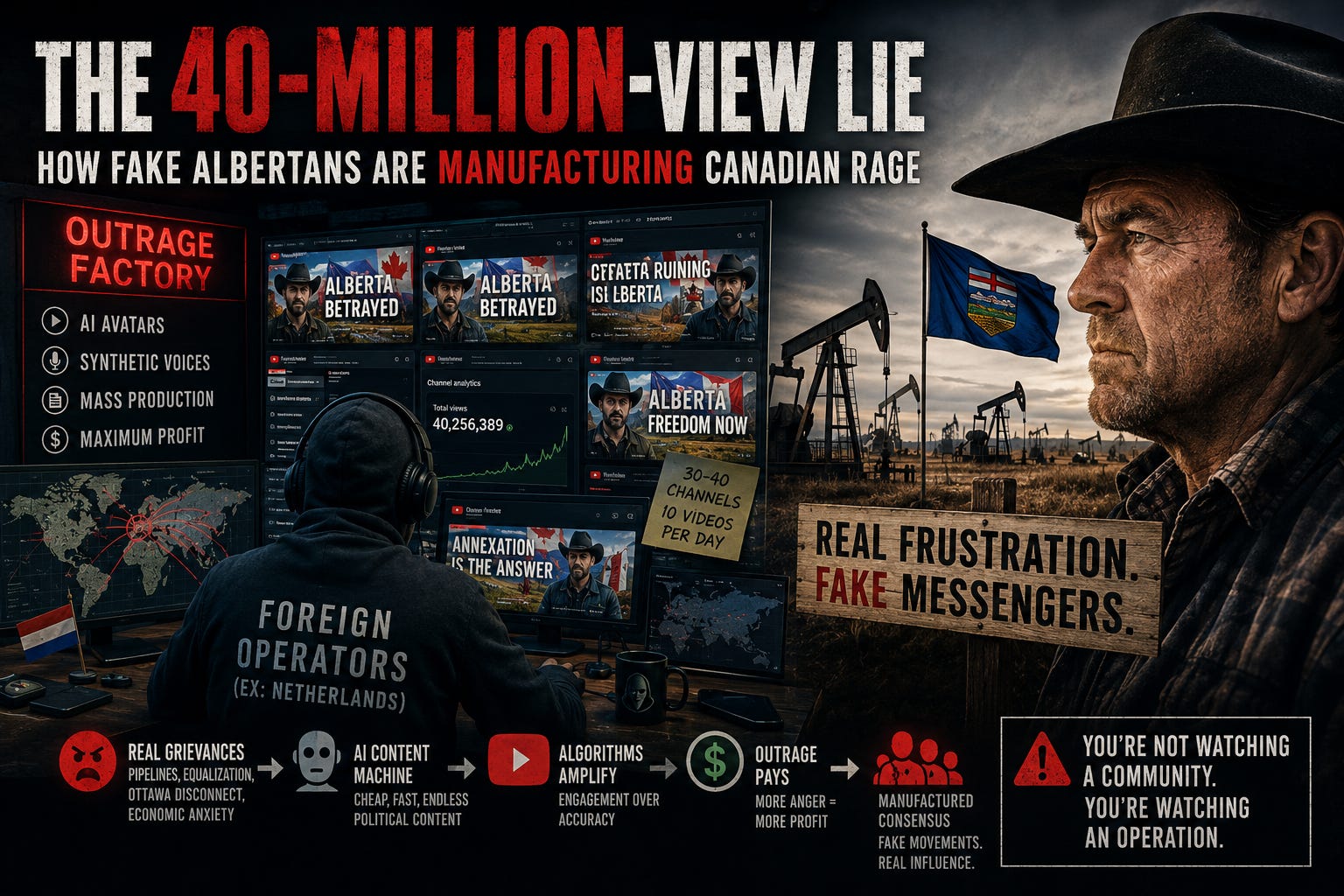
Researchers are now tracing entire networks of AI-generated political channels pretending to be Albertans while pumping out anti-Canada, pro-separation, and even pro-U.S. annexation content at industrial scale.
We’re not talking about a few angry guys in a basement recording rants between hockey games.
We’re talking about operations capable of running 30–40 channels simultaneously… posting up to 10 videos per day…
using AI avatars, synthetic voices, recycled scripts, fake grassroots framing, and algorithm manipulation to generate attention and ad revenue.
Some researchers say these channels have already generated roughly 40 million views.
Forty million.
That’s not fringe anymore.
That’s narrative shaping.
And here’s the part most people still haven’t fully absorbed:
This content doesn’t need to convince everyone.
It only needs to create the illusion that “everybody’s talking about it.”
That’s the real game now.
Manufactured consensus.
The internet figured out years ago that outrage is profitable. AI just made it scalable.
Now anybody with the right software stack can mass-produce emotional political content the same way factories produce cheap T-shirts.
Cheap.
Fast.
Disposable.
Emotionally addictive.
Political fast food.
Researchers are reportedly calling it “slopaganda.”
Honestly?
That might be the perfect word for it.
Because most of this content isn’t designed to inform people.
It’s designed to trigger them.
Anger gets clicks.
Clicks get ad revenue.
Ad revenue funds more outrage.
Round and round it goes.
And Alberta happens to be perfect fuel for the machine right now because the frustrations are real.
Pipeline fights.
Equalization resentment.
Federal disconnect.
Economic anxiety.
Alienation from Ottawa.
Those emotions already exist.
The manipulation works because it attaches itself to legitimate frustrations and quietly steers people toward preloaded conclusions.
That’s why the messaging feels repetitive.
“Canada is broken.”
“The West is being betrayed.”
“Annexation would solve everything.”
“Alberta would be richer alone.”
The conclusion is built before you even click the video.
And meanwhile many viewers genuinely believe they’re watching authentic local opinion.
But some of these operations reportedly trace back outside Canada entirely… including operators linked to places like the Netherlands.
Think about how insane that sentence would’ve sounded 10 years ago.
Foreign-run AI channels pretending to be Albertans in order to monetize Canadian political division.
That’s not democracy.
That’s emotional market manipulation.
And the algorithms help amplify it because algorithms don’t care what’s true.
They care what keeps people watching.
YouTube doesn’t optimize for national unity.
It optimizes for engagement.
That’s a very different thing.
The most dangerous part of all this isn’t even the misinformation itself.
It’s the emotional conditioning.
People slowly start believing extreme opinions are mainstream simply because they’re seeing them constantly.
Repetition becomes perceived reality.
That’s how synthetic consensus works.
And once people begin feeling surrounded by outrage, distrust spreads outward into everything:
Government.
Media.
Institutions.
Neighbours.
The country itself.
A divided population becomes easier to influence.
That’s the ugly truth sitting underneath this entire thing.
And here’s where the irony gets almost comical…
Some of these channels scream nonstop about “freedom” while casually promoting annexation into another country entirely.
That’s not sovereignty.
That’s surrender with a different flag attached to it.
Real Albertans absolutely have the right to be frustrated.
They have the right to criticize Ottawa.
Question policy.
Demand better treatment.
Argue for provincial autonomy.
That’s democracy.
But fake grassroots influence operations pretending to be communities?
That’s something very different.
Because once political influence becomes fully industrialized, truth itself starts losing market share to emotion.
Scale beats credibility.
Emotion beats nuance.
And the loudest voice online increasingly belongs to whoever can automate outrage the fastest.
That should concern every Canadian… regardless of politics.
Because if public opinion itself can now be mass-manufactured artificially…
Then eventually nobody knows what’s real anymore.
Not the audience.
Not the platforms.
Not even the politicians reacting to it.
And once that happens?
The country stops arguing with itself…
…and starts arguing with ghosts.
The Recap…
The internet just industrialized political manipulation.
Researchers say AI-generated “fake Albertan” channels have already pulled in roughly 40 million views pushing separation and annexation narratives.
Not grassroots.
Not organic.
Not local.
Outrage is now a business model.
And Canada is becoming content.
The Gut-Punch…
What looks like a movement online is sometimes just a revenue stream wearing a political costume.
And the scariest part?
The people being manipulated are often reacting to real pain.
That’s what makes modern propaganda so effective now.
It doesn’t invent emotion.
It hijacks it.
Source credit:
Research notes and summarized reporting provided by user transcript materials regarding AI-generated political influence networks targeting Alberta and Canadian discourse.
🔎 The GeezerWise Standard
This space is built on disciplined thinking.
Facts over spin.
Verification before amplification.
Good-faith discussion over tribal noise.
I use AI tools to help shape my spoken drafts into clear writing.
The judgment, conclusions, and final message are mine.
If you’re new here, this explains how I decide what’s worth sharing:
How I Decide What’s Worth Sharing → [link]
💌 Subscribe at GeezerWise.com to receive future letters:
www.geezerwise.com/subscribe
— Fred Ferguson
GeezerWise
#CanadaStrong
All the more reason to get to know your neighbours - literally - to feel the actual pulse. Local Facebook groups are helpful and the app “Eh” as well. In Ontario, the volunteer group Ontario Corps is building a base of volunteers for emergencies. And I think the federal government is getting the “citizen army” set up.
It does scare me. It is trumpism. Repeat the lies and its the truth. And some random people putting lies out there.