

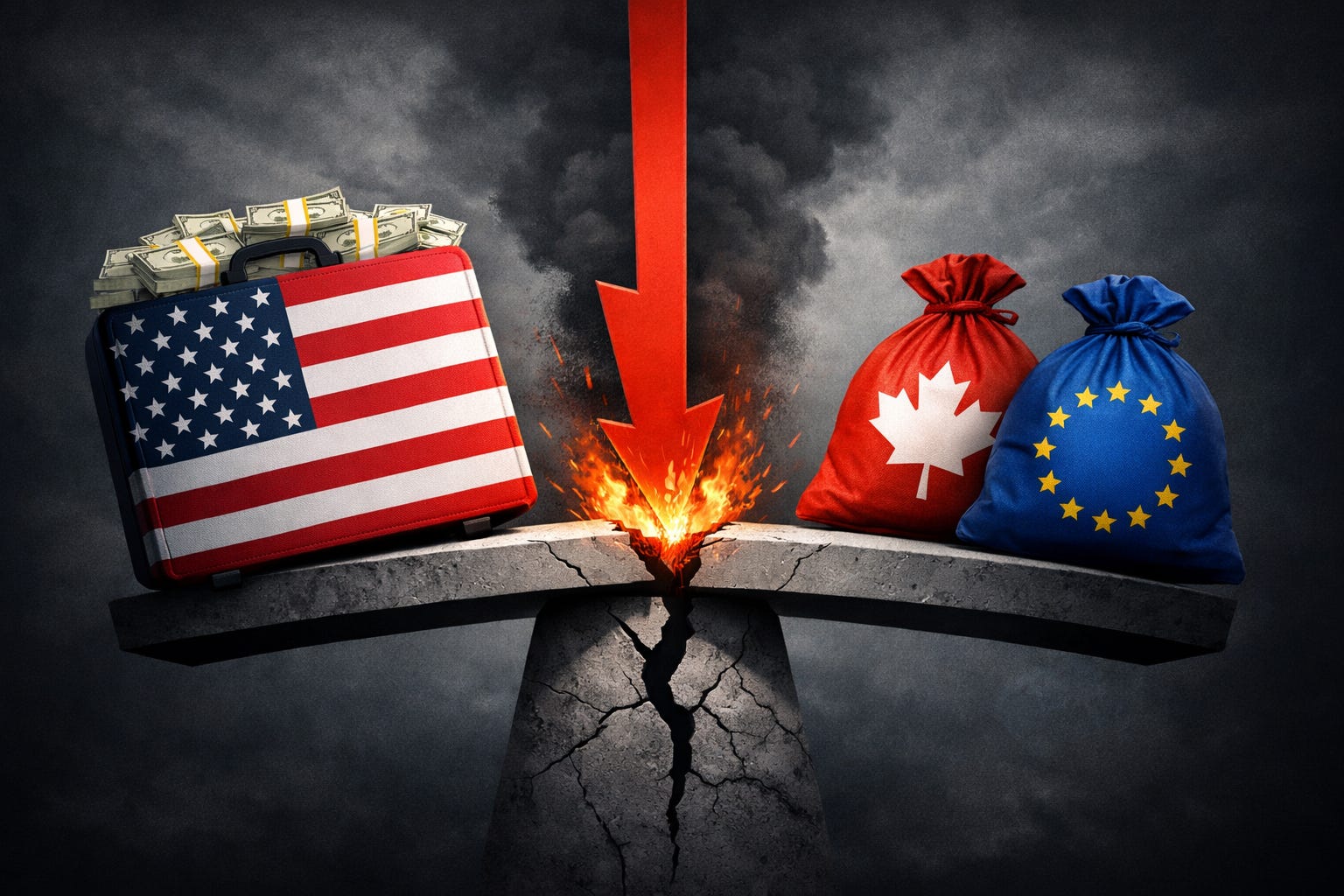
For years the sales pitch was simple.
Slap tariffs on foreign goods, fill the U.S. Treasury with cash, and make other countries pay for it.
That was the theory.
Reality turned out to be a lot more expensive.
In February 2026, the U.S. Supreme Court ruled 6–3 that sweeping tariffs imposed under the International Emergency Economic Powers Act (IEEPA) were unconstitutional.
The court said the power to impose tariffs belongs to Congress, not the president.
That ruling triggered a financial problem few people noticed at first.
Refunds.
Lots of them.
The $175 Billion Problem
During the tariff period beginning in early 2025, the U.S. government collected roughly $175 billion in duties from importers… including companies importing goods from Canada and Europe.
Once those tariffs were declared illegal, U.S. law kicked in automatically.
The government must return the money.
But there’s a twist.
Refunds for unlawful duties must include interest.
And the clock is already running.
U.S. Customs and Border Protection sets the interest rate at about 4.5% annually, compounded daily for amounts above $10,000.
Do the math and the liability grows quickly.
That $175 billion sitting in the Treasury is now generating roughly $700 million in interest every month… about $23 million every day until the refunds are paid.
In other words, the longer the government waits, the larger the bill becomes.
Who Actually Paid the Tariffs
Here’s where the story gets even stranger.
The tariffs were sold politically as a tax on foreign countries.
But the economic data tells a different story.
Research from the Federal Reserve Bank of New York found that about 90% of tariff costs were absorbed by U.S. businesses and consumers, not foreign exporters.
The Yale Budget Lab estimated American households paid an extra $1,300 to $1,700 per year because of higher prices on goods like electronics, clothing, and industrial equipment.
So the money came from Americans.
But the refunds go somewhere else.
Refunds are paid to importing companies… the businesses that paid the duties at the border.
Consumers who paid higher prices at the checkout counter don’t get anything back.
The Bureaucratic Traffic Jam
Now comes the administrative nightmare.
The Supreme Court ruled the tariffs illegal… but it didn’t provide instructions on how to issue refunds.
That job now falls to U.S. Customs and Border Protection and the Court of International Trade.
Nearly 2,000 legal cases are already tied to the issue.
There is no established procedure for returning this scale of tariffs.
That means delays.
And delays mean interest.
Some officials have suggested the process could take months or even years.
At the current pace, a one-year delay would add about $8.4 billion in interest.
Stretch that out longer and the liability could climb past $25 billion.
The Replacement Tariff
If this sounds like the story is ending… it isn’t.
On the same day the court struck down the earlier tariffs, a new 10% global tariff was introduced using a different law… Section 122 of the Trade Act of 1974.
Economists estimate the new policy still costs U.S. consumers about $800 per year on average.
In other words, the old tariff system was ruled illegal…
and a similar one replaced it almost immediately.
The Real Economic Loop
Stack the events together and the loop becomes obvious.
Americans paid higher prices because of tariffs.
Those tariffs were ruled illegal.
Refunds — plus interest — must now be paid.
And the same taxpayers will likely cover that cost through government spending and deficits.
That’s not a transfer of wealth from foreign countries.
That’s a circular tax.
Money leaves American households, enters the Treasury, then returns to importers with interest — while taxpayers fund the bill.
It’s the economic equivalent of spilling coffee on your own desk and sending yourself the cleanup invoice.
The Recap…
The U.S. collected $175 billion in tariffs.
The Supreme Court just ruled the policy illegal.
Now the refund bill is growing by $700 million every month — and American taxpayers will likely cover the interest.
This is what a policy boomerang looks like.
The Gut-Punch…
The tariffs were sold as foreigners paying America.
Instead, America paid itself — and now owes itself interest.
Source Credit:
Source: U.S. Supreme Court ruling (2026), Federal Reserve Bank of New York, Yale Budget Lab, Kato Institute, and U.S. Customs and Border Protection data.
🔎 The GeezerWise Standard
This space is built on disciplined thinking.
Facts over spin.
Verification before amplification.
Good-faith discussion over tribal noise.
I use AI tools to help shape my spoken drafts into clear writing.
The judgment, conclusions, and final message are mine.
If you’re new here, this explains how I decide what’s worth sharing:
How I Decide What’s Worth Sharing → [link]
💌 Subscribe at GeezerWise.com to receive future letters:
www.geezerwise.com/subscribe
— Fred Ferguson
GeezerWise
#CanadaStrong
The $175 billion tariff boomerang proves the point. Consumers already paid through higher prices. Now taxpayers cover the refunds and interest. I checked StatsCan for Canada. One-quarter of businesses passed those extra tariff costs to customers. Trade fights like this always end up in our wallets too. https://www150.statcan.gc.ca/n1/pub/11-631-x/11-631-x2025004-eng.htm
It’s more obvious all the time how Trump bankrupted multiple casinos, he’s financially ignorant and happy to stay that way. Where is Congress to stop the insanity??