

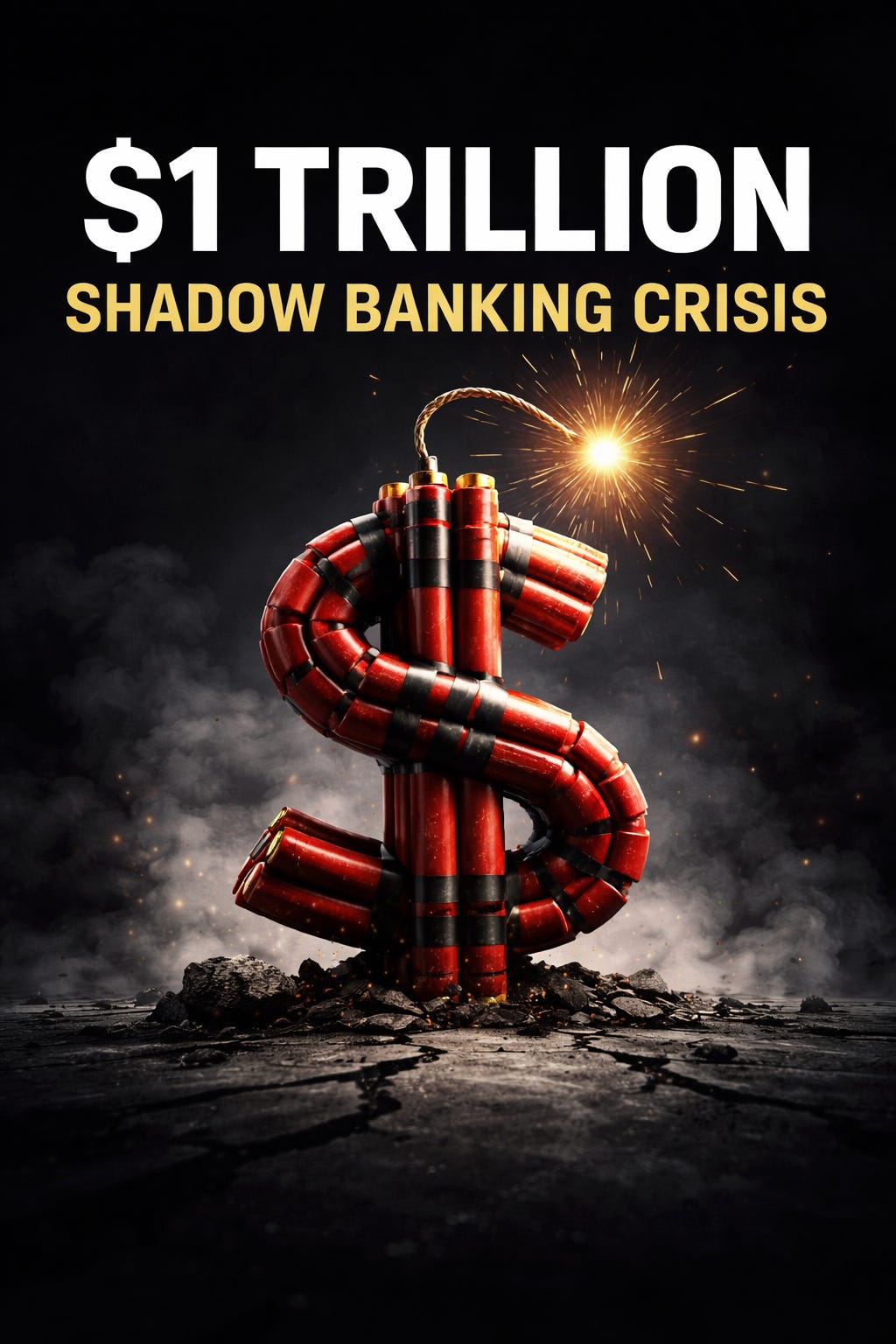
There’s a part of the financial system most people have never heard of.
That’s usually where the real trouble lives.
It’s called private credit… and right now, it’s starting to crack.
Defaults in this market just hit 9.2%, the highest level ever recorded. Not a blip. Not a bad quarter. A record.
And this isn’t one industry having a rough day.
This is 300+ companies across software, manufacturing, and services all struggling at the same time.
That’s not a sector problem.
That’s a system problem.
What This Actually Is (In Plain English)
After the 2008 crash, regulators tightened the rules on banks.
Banks got safer.
But the risk?
Didn’t disappear.
It just packed its bags and moved somewhere quieter.
Instead of borrowing from banks, companies… specially mid-sized, riskier ones… started borrowing from private funds.
Big names. Big money. Less oversight.
Over time, that turned into a $1 trillion market.
No spotlight. No real transparency. No regular reporting.
Just yield… and a lot of people chasing it.
Why It’s Breaking Now
Simple.
Interest rates.
Most of these loans weren’t fixed… they were floating.
So when rates went up…
Payments didn’t creep up.
They jumped.
Companies that borrowed when money was basically free are now staring at 8%, 10%, sometimes higher.
That crushes cash flow.
And when cash flow gets crushed…
Defaults follow.
Here’s Where It Gets Ugly
This isn’t Wall Street gamblers losing their own chips.
This money came from…
Pension funds
Insurance companies
University endowments
In other words…
Regular people’s future.
Retirement income.
Insurance coverage.
Scholarships.
That’s the capital that got fed into this machine.
And if this thing unwinds?
Those are the people who feel it.
Not the architects.
They already got paid.
The Real Danger… Nobody Knows How Bad It Is
Banks have to show their books.
Private credit funds?
Not so much.
They don’t have to clearly disclose…
What they’re holding
How risky it is
How close it is to blowing up
And here’s the kicker…
These assets are illiquid.
You can’t just sell them quickly.
So when investors want out?
Funds can’t raise cash.
So what do they do?
They freeze withdrawals.
Which has already started happening.
That’s not a small warning sign.
That’s the canary gasping.
How This Spreads (Fast)
Private credit doesn’t sit alone.
It’s tied directly to private equity.
Same players. Same money. Same incentives.
So when loans start failing...
→ Private equity takes hits
→ New investment dries up
→ Companies lose funding
→ Layoffs begin
→ Suppliers get squeezed
And suddenly…
What looked like a niche financial issue becomes a real-world economic slowdown.
The Timing Couldn’t Be Worse
A massive wave of debt… taken on during the “free money” era… is coming due over the next 18 months.
But now…
Borrowing costs are high
Lenders are pulling back
Valuations are down
So companies can’t refinance.
They can’t raise fresh money.
That leaves two options…
Default… or fire-sale liquidation.
Neither ends well.
The Quiet Warning
The IMF has already flagged private credit as a risk.
And here’s how to read that properly…
When institutions like that say “keep an eye on it”…
What they mean is…
“We’ve seen this movie before.”
Hidden leverage.
Illiquid assets.
Too much risk in places nobody’s watching.
That’s how financial crises start.
Every time.
Why Europe Isn’t Sweating (As Much)
After 2008, Europe stayed… boring.
More regulation.
More transparency.
Less appetite for shadow systems.
They still have exposure… but nothing like the U.S. concentration.
So if this blows up?
They’ll feel it.
But they won’t be the ones holding the grenade.
The Pattern (Again)
This isn’t new.
It’s the same cycle…
Loosen rules
Create “innovative” financial products
Chase higher returns
Ignore risk
Watch it break
The only thing that changes…
Is the name of the product.
What This Means for Regular People
You don’t need to know the mechanics.
But you should know where to look…
Pension performance
Insurance pricing
University funding cuts
That’s where the damage shows up first.
Quietly.
Gradually.
Then all at once.
Bottom Line
This isn’t a headline yet.
But it’s getting close.
The system didn’t remove risk.
It hid it.
And now it’s starting to surface… right where nobody was looking.
The Recap…
There’s a $1 trillion corner of the financial system most people have never heard of.
It just hit record defaults.
And the money inside it?
Pensions. Insurance. Endowments.
This isn’t noise.
It’s a warning.
The Gut-Punch…
They didn’t make the system safer… they just moved the danger where nobody could see it.
Source Credit:
Source: Inspired by House of El… data collected from financial data trends and private credit markets reporting.
🔎 The GeezerWise Standard
This space is built on disciplined thinking.
Facts over spin.
Verification before amplification.
Good-faith discussion over tribal noise.
I use AI tools to help shape my spoken drafts into clear writing.
The judgment, conclusions, and final message are mine.
If you’re new here, this explains how I decide what’s worth sharing:
How I Decide What’s Worth Sharing → [link]
💌 Subscribe at GeezerWise.com to receive future letters:
www.geezerwise.com/subscribe
— Fred Ferguson
GeezerWise
#CanadaStrong
This post is public. Share with someone who prefers evidence over adrenaline.
Does this article refer to Canada specifically or to the US, or both combined?
What country are you referring to