

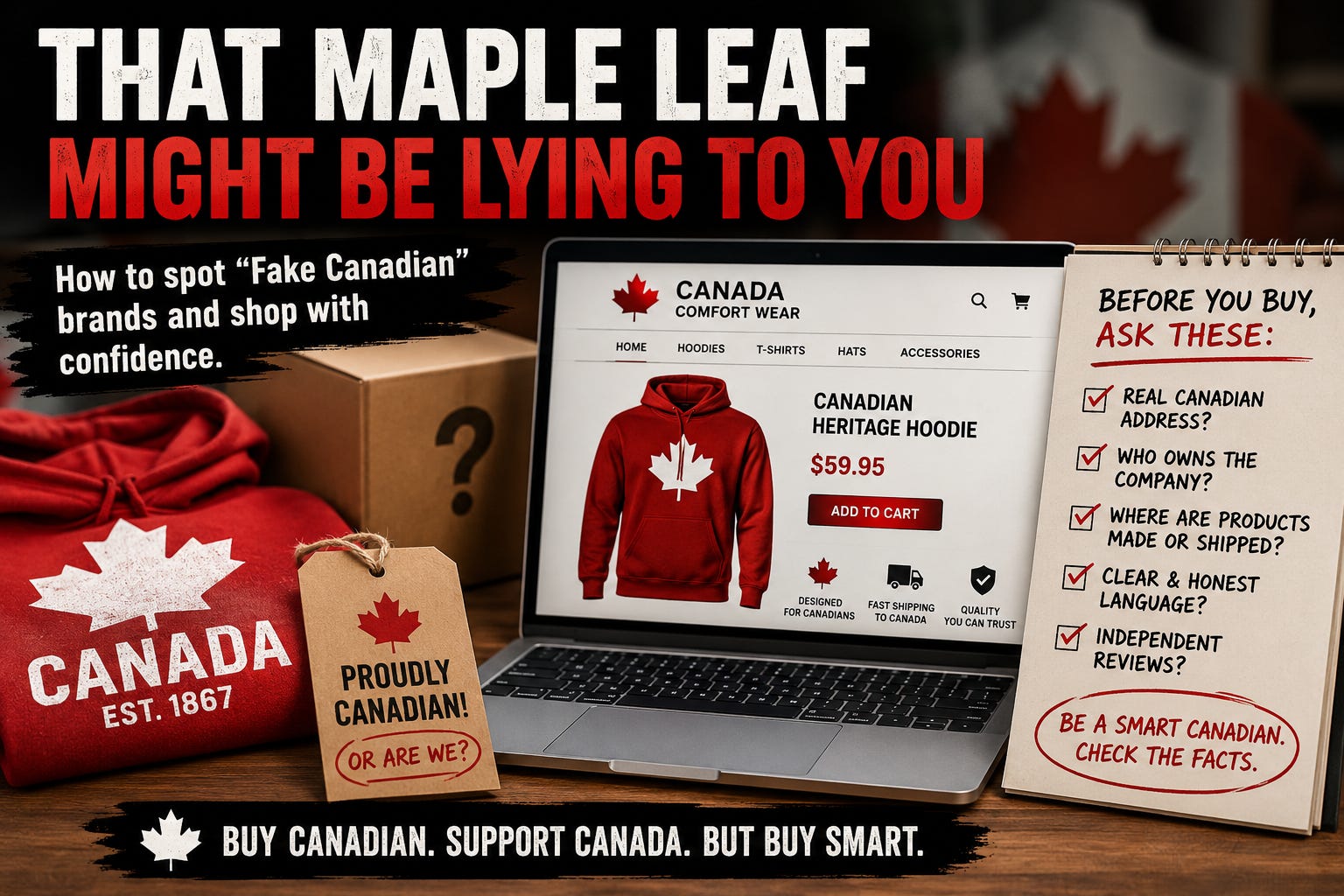
Something has changed in Canada over the past year.
People are paying attention to labels.
Not because we suddenly became patriotic overnight… but because many Canadians are trying to spend their money more carefully. More intentionally.
We’ve watched trade tensions flare up. We’ve watched tariffs fly around like confetti at a bad political circus. And a lot of us quietly made a decision…
If I can support Canadian businesses, I will.
Fair enough.
But here’s the problem.
Some companies may have figured out that waving a maple leaf around is good for business… whether they’re actually Canadian or not.
And that should bother us.
The Rise of “Looks Canadian Enough”
Lately, I’ve been seeing online ads for products wrapped in Canadian branding.
Big maple leaves.
Red-and-white themes.
Words like Canadian, True North, Maple, Patriot, Comfort, Northern, Made for Canadians.
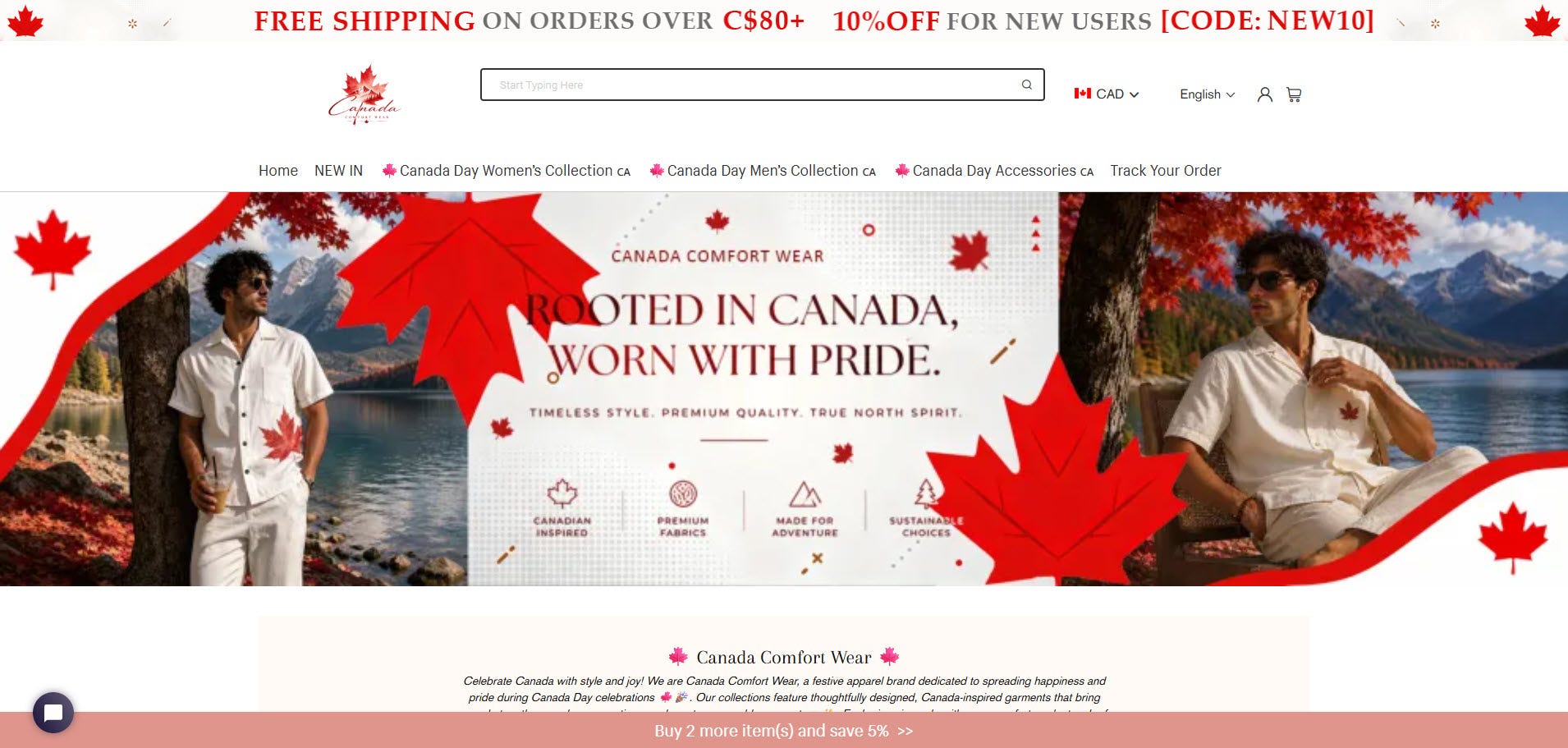
The whole thing practically screams…
“Hey buddy, we’re one of you.”
But are they?
That’s the question.
Because in many cases, it’s surprisingly hard to tell.
No clear company information.
No obvious ownership details.
No physical Canadian address.
No explanation of where products are actually made.
Just a website with patriotic wallpaper and a checkout button.
That doesn’t automatically make something dishonest.
But it should make us pause.
Buying Canadian Is About More Than the Flag
Look… nobody expects every T-shirt or coffee mug to be stitched together in Moose Jaw.
Canada imports things.
We all know that.
The issue isn’t whether every screw or zipper came from Saskatchewan.
The issue is transparency.
If a company says:
“We’re Canadian-owned.”
Great.
Say it clearly.
If products are designed here but manufactured overseas?
Fine.
Tell us.
If fulfillment comes from another country?
No problem.
Just don’t hide it behind maple syrup marketing and hope nobody asks questions.
Because that crosses the line from branding into manipulation.
How To Spot a “Maybe Not So Canadian” Company
Here are a few simple things I’ve started checking before clicking Buy Now…
1. Is there a real Canadian address?
Not just an email form.
A real location.
A business presence.
Something verifiable.
2. Who owns the company?
Can you find an actual company name?
Leadership?
A business registration?
Or is the About page written like it was assembled by AI after three energy drinks?
3. What does the language actually say?
Watch for slippery wording…
Inspired by Canada
Designed for Canadians
Canadian style
Serving Canadian customers
That is not the same thing as Canadian-owned.
Words matter.
4. Where do products ship from?
Sometimes the truth hides in shipping times.
If your “Canadian” hoodie takes four weeks and arrives from halfway around the planet… well…
You may have just bought patriotism with international postage.
5. Can you find independent reviews?
Not testimonials on the company site.
Real reviews.
Outside sources.
Actual humans saying:
“Yep, I ordered this and here’s what happened.”
This Isn’t About Paranoia
This isn’t a call to become internet detectives wearing aluminum hats.
It’s just common sense.
Because right now, many Canadians are trying to make intentional buying choices.
And if companies are leaning into Canadian identity to make sales, then Canadians deserve honesty in return.
That maple leaf should mean something.
Not just marketing.
A Simple Rule I’m Starting To Follow
If I have to spend twenty minutes trying to figure out whether a company is actually Canadian…
I probably already have my answer.
Canada has thousands of real businesses worth supporting.
Transparent businesses.
Hardworking businesses.
Businesses that aren’t pretending.
Those are the ones I want my dollars helping.
And frankly?
I think more of us are starting to feel the same way.
The Recap…
More Canadians are trying to buy local… but not every company waving a maple leaf is easy to verify.
A Canadian-looking brand name doesn’t automatically mean Canadian-owned.
Before clicking Buy Now, take two minutes to check who’s actually behind the curtain.
Because patriotism shouldn’t be a marketing costume.
The Gut-Punch…
A maple leaf on a website means nothing if the company hiding behind it won’t tell you who they are.
Source credit:
Inspired by recent observations of online brands marketing themselves as “Canadian” while offering little verifiable information about ownership, location, or sourcing. Always do your own due diligence before purchasing.
🔎 The GeezerWise Standard
This space is built on disciplined thinking.
Facts over spin.
Verification before amplification.
Good-faith discussion over tribal noise.
I use AI tools to help shape my spoken drafts into clear writing.
The judgment, conclusions, and final message are mine.
If you’re new here, this explains how I decide what’s worth sharing:
How I Decide What’s Worth Sharing → [link]
💌 Subscribe at GeezerWise.com to receive future letters:
www.geezerwise.com/subscribe
— Fred Ferguson
GeezerWise
#GeezerWise #GeezerWiseSays
Good one Fred. I've noticed a lot of tv advertising lately where the statement being used to try to trick you into thinking you're buying a Canadian product is "shipped from Canada". To me, all that means is that an American company opened a warehouse in Niagara Falls, ON and think they can fool us wily Canucks. No way man.
If I can find a company name on an advertisement, I now routinely Google search the company to try to find out where they're from. (ok, now I just admitted that I use Google, an American search engine, but as far as I know we don't have a Canadian alternative)
Thanks Fred! What I sometimes notice is a "Maple Leaf" that is shaped like a weed plant, &, since I don't want to wear something that advertises weed, I walk away! It's like manufacturers think we won't notice the difference? We didn't just fall off a turnip truck, we KNOW what a beautiful Maple Leaf looks like!!! haha