

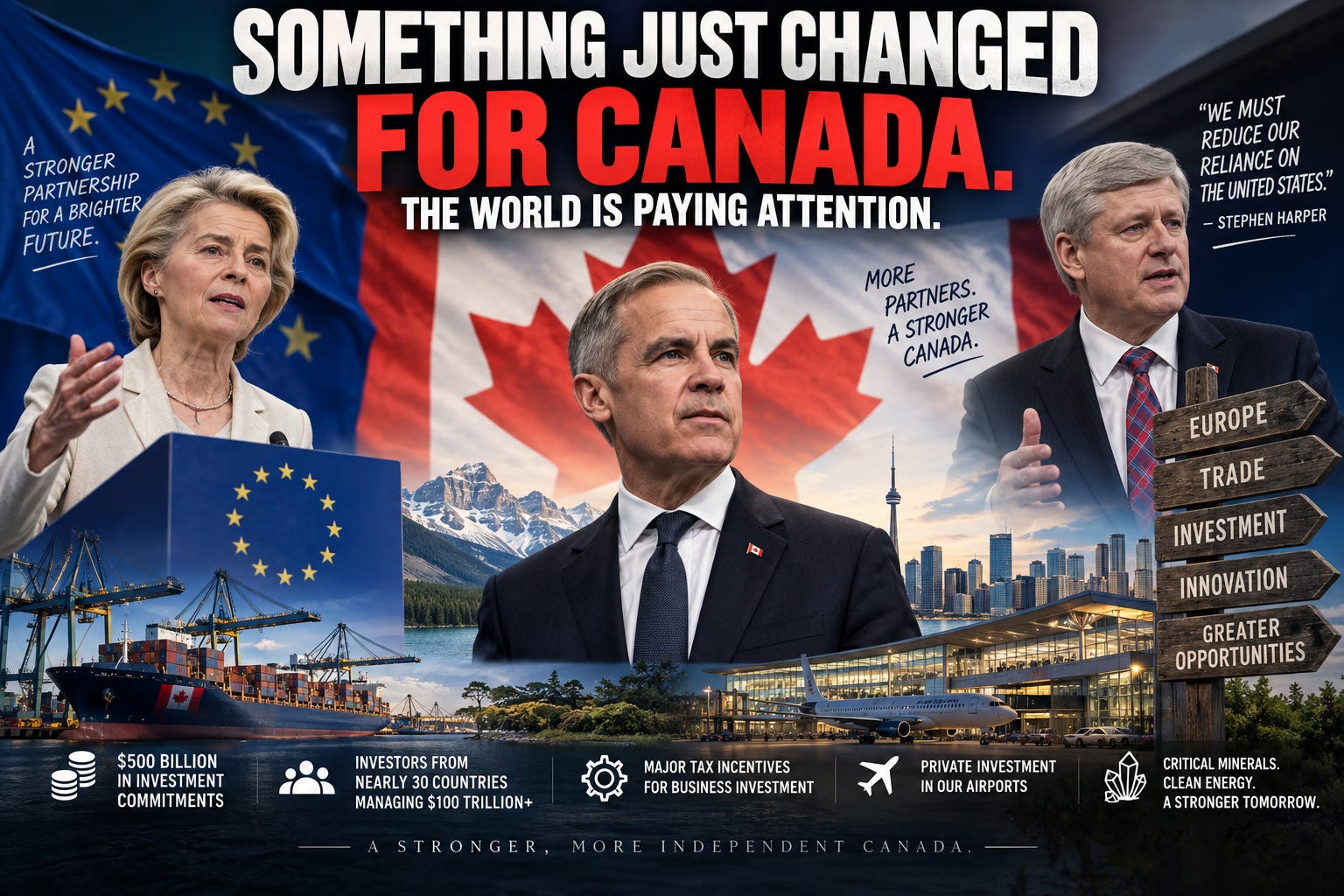
Stephen Harper delivered a message nobody expected him to deliver.
I think Canadians need to understand what just happened.
Not because Canada suddenly became the centre of the universe.
We didn’t.
Not because every announcement made this week is guaranteed to work.
It isn’t.
But because several things happened within a couple of days that point in the same direction.
Canada is trying to build an economy that doesn’t depend quite so heavily on one customer.
And apparently, other countries and some very large investors are interested.
First came Toronto
Canada held its first national Investment Summit.
This wasn’t a convention hall full of people collecting tote bags.
Investors from nearly 30 countries attended.
Between them, they manage more than $100 trillion in assets.
Think about that number for a second.
Canada’s government isn’t asking these people for applause.
It’s asking them for money.
Lots of it.
Ottawa says the summit generated nearly $500 billion in investment commitments, including almost $100 billion in new capital commitments from Canadian pension funds, insurers and institutional investors.
The longer-term target is even bigger…
$1 trillion in total investment over five years.
That’s the scale of what Canada is trying to do.
And government can’t write the cheque for all of it.
Neither can Canadian taxpayers.
So Canada has to become a place where international capital looks at the alternatives and says…
Put the money there.
Carney gave investors something very specific
One of the biggest announcements didn’t have much political sex appeal.
Naturally, I loved it.
It’s called the Productivity Mega Deduction.
Don’t worry. I’m not going to make you sit through an accounting seminar.
Here’s the GeezerWise version.
A company considering a major Canadian investment wants to know how quickly it can recover the money it spends building the thing.
Canada is now allowing businesses to deduct the cost of a much broader range of investments immediately.
That includes things like pipelines, mining property, fibre-optic cable, software, R&D, computer equipment, aircraft, vehicles, rail track, bridges and roads.
Ottawa says the change will reduce Canada’s marginal effective tax rate on new business investment from roughly 13% to 6.4%.
That’s not a slogan.
That’s an investment incentive.
Canada is essentially telling companies:
If you’re going to build something big, we want Canada on your shortlist.
Then came the airports
Carney also announced that Canada will seek private investment through long-term concessions to operate the country’s four largest airports.
There’s an important distinction here.
The government says the underlying land and assets would remain publicly owned.
The idea is to bring private capital into operating and developing the airports, then use the capital raised for other infrastructure.
Canadian pension funds already invest in infrastructure like this around the world.
The argument from Ottawa is pretty simple…
Why shouldn’t some of that expertise and money come home?
Whether the eventual model is a good deal for Canadians will depend on the details.
And those details matter.
But this is part of the larger strategy…
Use private and institutional capital to build things Canada cannot realistically finance quickly enough through government alone.
And then Stephen Harper walked onto the stage
This may have been the most politically interesting moment of the summit.
Not Mark Carney.
Stephen Harper.
The former Conservative prime minister said the Carney government had “no choice” but to walk away from the latest U.S. trade negotiations.
Then he went considerably further.
Harper said the current U.S. administration sees the existing level of Canada-U.S. economic integration as incompatible with Canada’s separate sovereignty.
His conclusion?
Canada must reduce its reliance on the United States.
Harper also warned that doing that will carry costs.
That’s important.
Diversification isn’t free.
Moving supply chains isn’t free.
Building new ports, pipelines, power connections, mines, factories and export markets isn’t free.
But Harper’s basic argument was unmistakable…
If excessive dependence on one country gives that country leverage over Canadian sovereignty, Canada needs more options.
You don’t have to agree with Harper or Carney on everything to understand the significance of a former Conservative prime minister saying that publicly.
Twenty-four hours later, Europe opened another door
Then things got really interesting.
European Commission President Ursula von der Leyen proposed something unprecedented…
Canada becoming the European Union’s first “associate member.”
Now, before somebody starts yelling that Brussels is going to decide how much tax your waitress pays in Moose Jaw, settle down.
There isn’t even an established EU legal category called “associate membership” yet.
This isn’t Canada joining the European Union.
Nobody handed Mark Carney an EU passport and told him we’re moving Ottawa to Brussels.
What von der Leyen proposed is a new form of much deeper partnership.
And the areas being discussed tell us what this is really about:
Defence.
Critical minerals.
Energy.
Batteries.
Artificial intelligence.
Quantum technology.
Cybersecurity.
Advanced manufacturing.
The Arctic.
Economic security.
Carney welcomed the proposal in his address to the European Parliament and talked about building a broader strategic alliance between Canada and Europe.
The details still have to be negotiated.
But the direction isn’t difficult to see.
Canada isn’t replacing America
And this is where I think we need to keep our heads.
The United States remains enormously important to Canada.
Geography didn’t change this week.
Neither did decades of integrated supply chains.
We’re not loading Ontario onto a tugboat and towing it across the Atlantic.
What Canada appears to be attempting is something much more practical…
More customers.
More investors.
More trading partners.
More defence partners.
More places to sell Canadian resources and Canadian expertise.
Because having one enormous customer works beautifully right up until that customer decides your dependence is leverage.
Then it isn’t a relationship problem anymore.
It’s a business problem.
Look at what happened in roughly 48 hours
Canada brought some of the world’s largest pools of capital to Toronto.
Ottawa says nearly $500 billion in investment commitments emerged from the summit.
The government introduced a major new incentive for companies investing in Canadian productive assets.
Canada opened the door to private capital in major airport infrastructure.
Stephen Harper publicly supported reducing Canada’s economic dependence on the United States.
Then the president of the European Commission proposed creating an entirely new relationship with Canada.
Those aren’t all the same thing.
They aren’t guarantees.
And some of them could change substantially before anything is implemented.
But taken together, they tell us something.
Canada isn’t simply talking about diversification anymore.
It’s trying to build the machinery required to do it.
For decades, Canada had the easiest business model imaginable.
Dig it up.
Pump it out.
Build it.
Send it south.
Cash the cheque.
The United States was wealthy, close, enormous and mostly predictable.
That model made sense.
Until predictability disappeared.
Now Canada has to learn something every smart business owner eventually learns…
Your biggest customer can be your best customer.
But you’d better make damn sure they’re not your only customer.
And suddenly, there are a lot of people knocking on Canada’s door.
Maybe it’s time we opened a few of them.
The Recap…
Something unusual happened this week.
More than $100 trillion in global capital came to Toronto.
Stephen Harper said Canada must reduce its dependence on the United States.
Then Europe proposed an unprecedented new relationship with Canada.
Those aren’t three separate stories.
The Gut-Punch…
For decades, Canada worried about whether the world wanted what we had.
Maybe we’ve been asking the wrong question.
The world seems interested.
Now we have to prove we can actually build the bloody stuff.
Source credit: Prime Minister of Canada… Canada Investment Summit, Sept. 15, 2026; Reuters… Canada/EU relationship and Ursula von der Leyen associate-membership proposal, Sept. 16–17, 2026; The Canadian Press/CityNews… Stephen Harper remarks at the Canada Investment Summit, Sept. 15, 2026.
If you enjoy thoughtful conversations, Canadian stories, and the occasional smart-ass observation about the world we’re living in, you’re in the right place.
Subscribe free and get new stories, insights, and observations delivered directly to your inbox.
No paywall.
No spam.
No nonsense.
Leave anytime with a single click.
I promise not to take it personally.
Oh how I appreciate your condensed analysis Fred- thank you as always!
WELL written Fred! I think all Canadians are ready for a change, & happy with the countries stepping in to help us rise, instead of applying duct tape to keep us attached to a country that doesn't respect us! Forward Ho! Canada Strong!